
What a 110 Volt Water Heater Can (and Can’t) Do for Your Skoolie
A 110 volt water heater is a compact, low-voltage electric heater designed for single-point hot water needs — think kitchen sinks, bathroom vanities, or RV and Skoolie builds where 240V power simply isn’t available.
Here’s a quick breakdown of what you need to know:
| Feature | 110V Water Heater |
|---|---|
| Best use | Point-of-use (one sink or fixture at a time) |
| Common types | Tankless (instant) or mini-tank (2.5–10 gallon) |
| Typical wattage | 1,500W–3,000W |
| Flow rate | 0.5–1.0 GPM (low flow) |
| Whole-house capable? | No — single fixture only |
| Good for Skoolies/RVs? | Yes — works well with inverters and shore power |
These units are not replacements for a full home water heater. But for off-grid and mobile living, they’re often exactly the right tool.
The 110V category includes two very different products: true tankless heaters that heat water on demand, and mini-tank heaters that store a small amount of pre-heated water. Knowing the difference matters a lot before you buy.
I’m Jacob Reese, VP of Standard Plumbing Supply and a third-generation plumbing industry professional — I’ve helped countless contractors and DIYers find the right 110 volt water heater for tight spaces and mobile applications. Let’s walk through everything you need to make a confident choice for your Skoolie build.
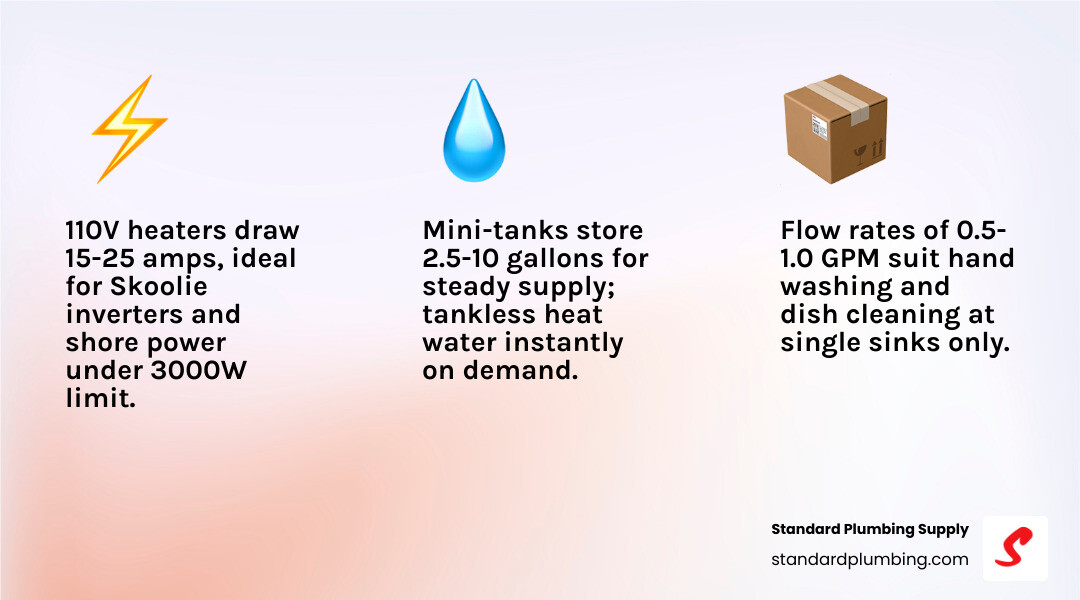
Discover more about 110 volt water heater:
Understanding the 110 Volt Water Heater: Tankless vs. Mini-Tank
When we talk about a 110 volt water heater, we are usually looking at two distinct technologies. While a traditional residential water heater typically runs on a 240V circuit and holds 40 to 50 gallons of water, these “tiny tank” solutions are designed to fit under a sink or in the tight closet of a converted bus.
The Benefits of Point-of-Use Heating
Point-of-use (POU) heating means the heater is located exactly where the water is needed. In a Skoolie, this is a game-changer. By installing a small unit directly under the kitchen sink, you eliminate “line loss”—the energy wasted while hot water travels through feet of cold pipes.
We find that these units are incredibly efficient for specific tasks. If you only need to wash your hands or a few dishes, a 110V unit provides enough heat without the massive energy draw of a whole-house system. This targeted approach reduces water waste because you aren’t running the tap for two minutes waiting for the “hot” water to arrive from a central tank.
Why Voltage Matters in Mobile Environments
In a mobile environment like a Skoolie or RV, your electrical “budget” is everything. Most 240V water heaters require a massive amount of power that standard portable inverters or small battery banks simply cannot handle.
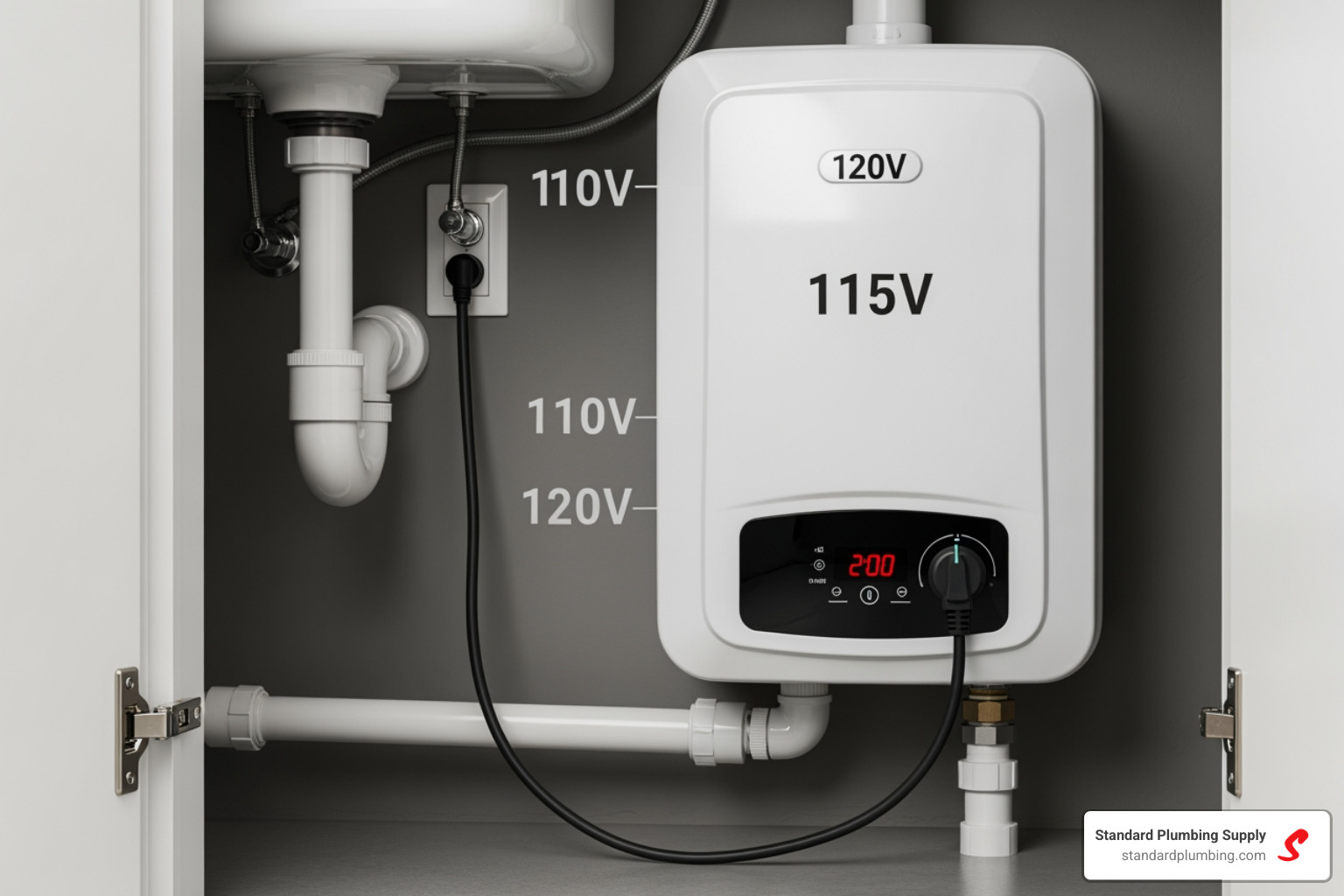
A 110 volt water heater (often labeled as 120V in modern US standards) is much more compatible with standard shore power connections found at campgrounds. Furthermore, if you are running on solar power, a 1,500W mini-tank is far easier for a 2,000W or 3,000W inverter to manage than a high-draw 240V model. It allows you to have the luxury of hot water without needing a commercial-grade electrical grid on wheels.
Performance Reality Check: Flow Rates and Temperature Rise
We need to have a “real talk” about physics. Electricity at 110 volts can only move so much heat into water at once. This is why understanding flow rates (measured in Gallons Per Minute or GPM) and temperature rise is critical.
Managing Expectations for a 110 Volt Water Heater
A typical 3,000W tankless 110 volt water heater is designed for a flow rate of about 0.5 to 1.0 GPM. For perspective, a standard kitchen faucet flows at 1.5 to 2.2 GPM. This means if you want truly hot water from a 110V tankless unit, you have to slow the water down. If you open the tap all the way, the water won’t have enough time to pick up heat from the element, and you’ll end up with a lukewarm stream.
| Heater Type | Typical GPM | Best Application |
|---|---|---|
| 3000W Tankless | 0.5 GPM | Hand washing, light dishes |
| 2.5 Gallon Mini-Tank | 1.5 GPM (Limited) | Short bursts of full-flow hot water |
| 10 Gallon Mini-Tank | 1.5+ GPM | Quick showers |
Performance in Cold Climates
The biggest challenge for a 110 volt water heater is the “Inlet Temperature.” If you are camping in Arizona, the water coming into your bus might be 70°F. Heating that to 105°F is easy. However, if you are in Idaho or Wyoming during the winter, that inlet water might be 40°F. A 3,000W heater can only raise the temperature so many degrees. In cold climates, a tankless 110V unit may struggle to provide anything more than “not freezing” water. This is where mini-tanks shine, as they heat the water slowly over time regardless of the outside temperature.
Top 5 110 Volt Water Heater Options for Mobile Living
Based on what we see moving through our stores and the feedback from the Skoolie community, here are the top-rated options currently available.
High-Capacity Mini-Tanks for Showers
If you want a real shower in your bus, you likely need a storage tank.
- Bosch Tronic 3000 T (2.5 to 7 Gallon): This is a legendary unit in the DIY world. It plugs into a standard outlet and provides a consistent 1,440W of heating. It’s small enough to fit in a cabinet but powerful enough for a quick, hot shower.
- GE Appliances 10-Gallon 120V: For those with a bit more space, this “plug and play” model offers a 4.5-star rating. It’s perfect for those who don’t want to mess with complex wiring but need more than a few gallons of storage.
- thermomate ES250: A 2.5-gallon point-of-use tank that is UL listed and very popular for its floor or wall-mount versatility.
Compact Tankless Units for Sinks
If space is your absolute priority and you only need hot water for a sink, these are the contenders:
- EcoSmart ECO 11 (Note: requires higher voltage, but ECO 3 is the 110V equivalent): Known for self-modulating technology that adjusts power based on demand.
- Titan N-120: A compact on-demand heater that is often used in warm climates for single-point applications.
Installation and Electrical Requirements for Your Skoolie
Installing a 110 volt water heater isn’t as simple as plugging in a toaster. Because these units pull high amperage, you must pay attention to your electrical setup.
Safety Features to Prioritize
When shopping, we always recommend looking for these key safety specs:
- UL) or ETL Certification: Ensures the unit has been tested to rigorous safety standards.
- Overheat Protection: An automatic shut-off if the water gets dangerously hot.
- Dry-Fire Prevention: This is crucial for tankless units. It prevents the heating element from burning out if there is no water in the system.
- Pressure Relief Valve (T&P Valve): Essential for tank models to prevent pressure build-up.
Professional vs. DIY Setup
Many Skoolie owners prefer the DIY route. If you’re using PEX plumbing, most 110V units use standard 1/2″ NPT connections, making them very compatible with modern plumbing kits.
However, the electrical side is where you should be careful. A 3,000W heater pulls about 25-27 Amps. This means you cannot just plug it into a standard 15-amp household circuit. You will likely need a dedicated 30-amp circuit with heavy-gauge wire (typically 10-gauge) to prevent the wires from overheating. Always check the manufacturer’s spec sheet for the required breaker size.
Maintenance and Efficiency: Keeping the Hot Water Flowing
To ensure your 110 volt water heater lasts for the duration of your travels, a little maintenance goes a long way.
- Scaling and Mineral Deposits: If you are using well water or water from various campgrounds, minerals will build up on the heating element. We recommend a flushing kit to descale the unit once a year.
- Anode Rods: If you have a mini-tank model, it likely has an anode rod designed to “sacrifice” itself to prevent the tank from rusting. Check this every year and replace it if it’s looking thin.
- Standby Loss: Mini-tanks lose heat over time (standby loss). To maximize efficiency, look for models with high-density foam insulation.
Frequently Asked Questions about 110V Heating
Is a 110 volt water heater enough for a shower?
It depends on the type. A 110V tankless heater is generally not enough for a comfortable shower unless you are in a very warm climate and use a 0.5 GPM ultra-low-flow showerhead. However, a 110V mini-tank (6-10 gallons) is perfectly sufficient for a quick, efficient shower.
Can I use a 110 volt water heater for a whole house?
In a standard 2,000-square-foot home? No. The flow rate is too low to support multiple fixtures. However, for a “tiny home” or a Skoolie where you only ever run one faucet at a time, it can serve as the primary hot water source.
What are the safety features of a 110 volt water heater?
Most modern units include auto-shutdown for overheating, self-modulation to maintain steady temperatures, and physical pressure relief valves. High-quality models also feature “water-electric separation” to ensure the heating element never comes into direct contact with the electrical terminals.
Conclusion
Choosing a 110 volt water heater is about finding the balance between your comfort needs and your bus’s power limitations. Whether you opt for the instant heat of a tankless unit or the reliability of a mini-tank, these small but mighty appliances can make a mobile lifestyle feel a lot more like home.
At Standard Plumbing Supply, we’ve been helping folks across the West—from the deserts of Arizona to the mountains of Utah and Idaho—find the right plumbing solutions for nearly a century. If you’re currently in the middle of a Skoolie build in cities like Salt Lake, Boise, or Phoenix, stop by one of our locations. Our experts can help you spec out the right wire gauge, plumbing fittings, and heater models for your specific project.
Ready to get started? Use our SPS store locator to find the nearest expert advice and high-quality parts. We’re here to help you keep the hot water flowing, no matter where the road takes you.
For more specialized heating needs, check out our catalog of Rheem residential natural gas water heaters.
