
Understanding the Material Science of 316 Pipe Fittings
When we talk about 316 pipe fittings, we are diving into a specific branch of metallurgy known as austenitic stainless steel. At its core, the “316” designation refers to the chemical recipe used to create the metal. While many people are familiar with 304 stainless steel (the kind often used in kitchen appliances), 316 is the heavy-duty sibling designed for environments that would make standard steel crumble.
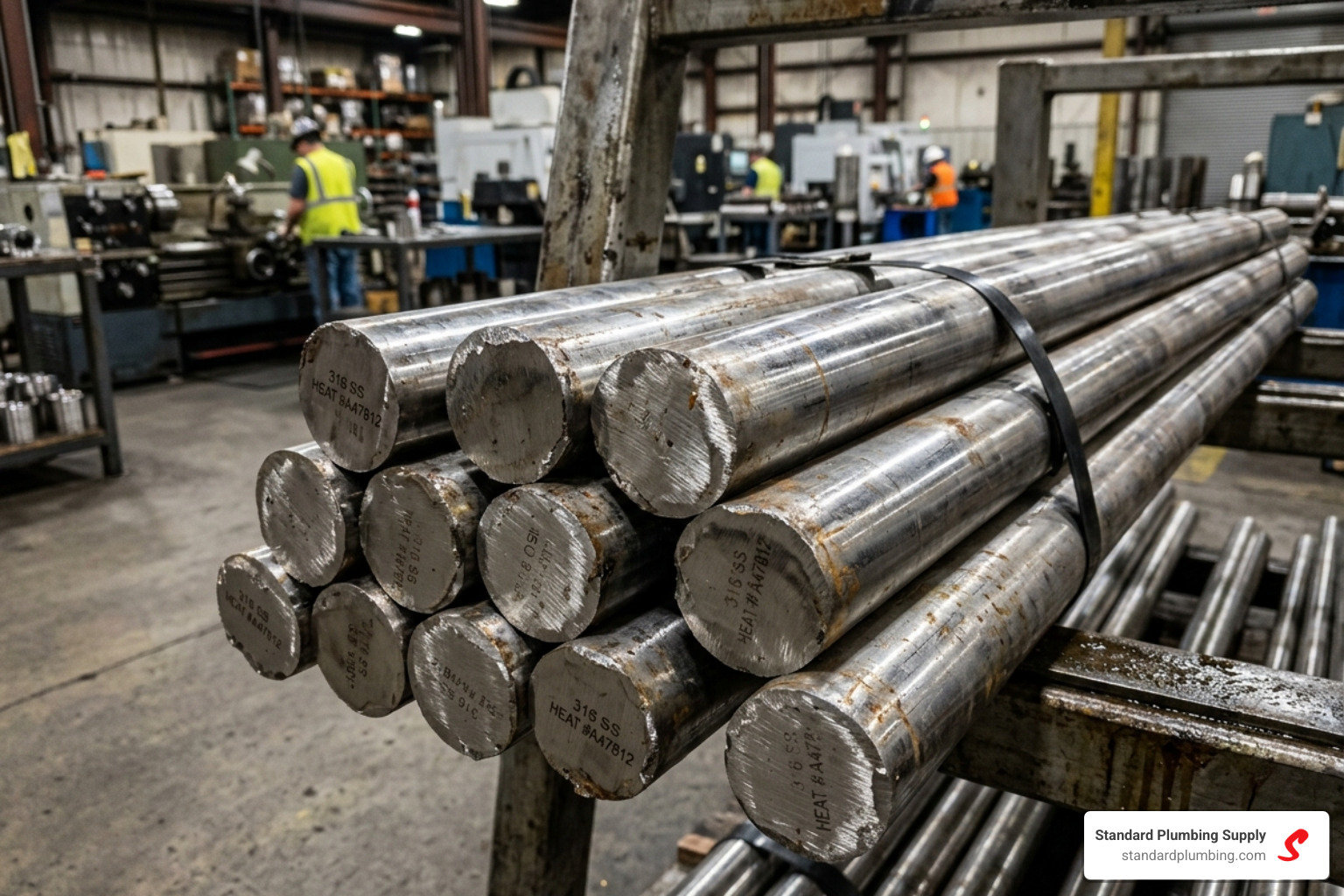
The “magic ingredient” in 316 is molybdenum. By adding roughly 2% to 3% molybdenum to the chromium-nickel mix, manufacturers create a material that is significantly more resistant to “pitting”—those tiny, localized holes that can form in metal when it’s exposed to salt or industrial chemicals.
Most industrial 316 pipe fittings are manufactured to meet the ASTM A403 specification. Specifically, you will often see the grade WP316. The “WP” stands for “Wrought Pipe,” indicating that the fitting was made from a wrought material like pipe, plate, or bar, rather than being cast in a mold.
Chemical and Mechanical Specifications of 316 Pipe Fittings
To understand why these fittings handle pressure and corrosion so well, we have to look at the numbers. The mechanical strength of 316 is impressive, providing a balance of toughness and flexibility (ductility).
- Tensile Strength: 75,000 psi (515 MPa) – This is the maximum stress the material can withstand while being stretched or pulled before breaking.
- Yield Strength: 30,000 psi (205 MPa) – This is the point where the metal starts to deform permanently.
- Elongation: 35% – This indicates the material’s ability to stretch without snapping, which is vital for absorbing system vibrations or thermal expansion.
- Density: 8.0 g/cm³ – A solid, heavy-duty feel that signifies quality.
- Melting Point: 1400°C (2550°F) – This high melting point allows 316 fittings to perform in high-heat industrial processes.
The chemical composition is equally precise. According to standard metallurgical specifications, the mix includes 16-18% Chromium, 11-14% Nickel, and the crucial 2-3% Molybdenum. This specific ratio ensures that the protective “passive layer” on the surface of the steel reforms quickly if it’s scratched or chemically attacked.
Equivalent International Grades for 316 Stainless Steel
If you are working on a project with international blueprints, you might see 316 referred to by different names depending on the country of origin. Here are the most common equivalents we see in the field:
- UNS S31600: The Unified Numbering System used primarily in North America.
- Werkstoff 1.4401: The German standard designation.
- EN 10088-3: The European standard.
- JIS SUS316: The Japanese industrial standard.
- BS 316S31: The British standard.
- AFNOR Z7CND17-11-02: The French standard.
Regardless of the name on the spec sheet, the performance requirements remain consistent: high corrosion resistance and reliable mechanical strength.
Common Types and Configurations of 316 Stainless Steel Fittings
In our warehouses across the West, from Salt Lake City to San Diego, we stock a massive variety of shapes. Because every piping system has to turn corners, split flows, or change sizes, 316 pipe fittings come in several standard configurations.
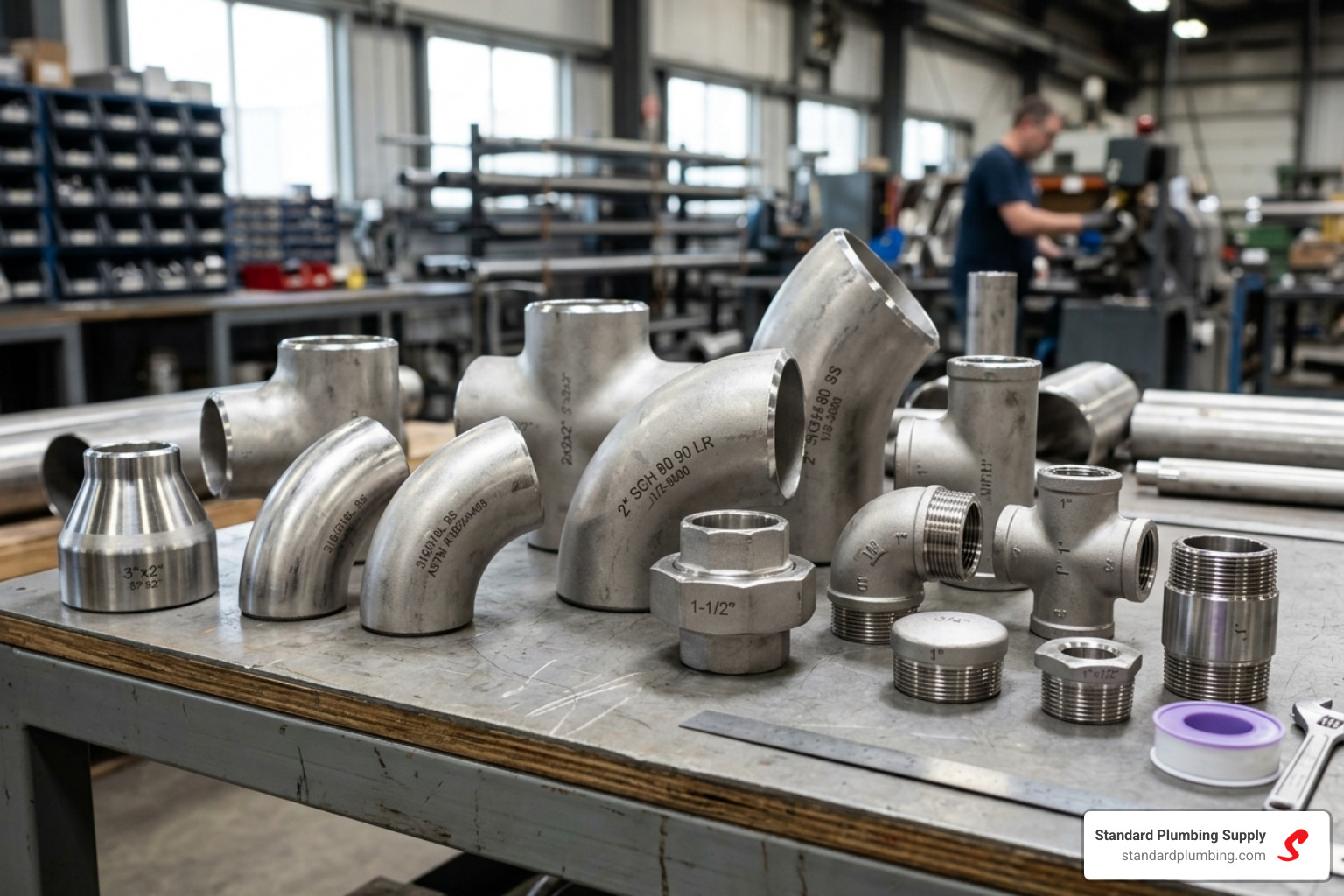
- Elbows (90° and 45°): Used to change the direction of the pipe. These are available in “Long Radius” (LR) for smoother flow or “Short Radius” (SR) for tight spaces.
- Tees (Equal and Reducing): These allow you to branch off a main line. An equal tee has three openings of the same size, while a reducing tee has a smaller branch.
- Reducers (Concentric and Eccentric): Used to join a larger pipe to a smaller one. Concentric reducers look like a cone, while eccentric reducers have one flat side, often used in horizontal lines to prevent air pockets.
- Caps: These are used to close the end of a pipe line permanently or for future expansion.
- Unions: A three-piece fitting that allows you to disconnect a section of pipe without cutting it—essential for maintenance.
- Couplings and Bushings: Used to join two pipes of the same size (couplings) or to adapt a larger threaded opening to a smaller pipe (bushings).
For a detailed look at our inventory of nipples and specific connectors, you can browse our catalog of Plumbing Fittings: Stainless Steel Fittings & Nipples.
Buttweld vs. Threaded 316 Pipe Fittings
One of the most important decisions you’ll make is how the fitting connects to the pipe.
- Buttweld Fittings: These are designed to be welded directly to the pipe ends. They follow the ANSI B16.9 standard. They are preferred for high-pressure, high-temperature, or permanent systems because a welded joint is less likely to leak over time.
- WP-S: Seamless fittings made from seamless pipe.
- WP-W: Welded fittings made from welded pipe where the weld is radiographed.
- WP-WX: Welded fittings where all welds are radiographed.
- Threaded Fittings: These use NPT (National Pipe Taper) threads to screw onto the pipe. They follow ASME B16.11. They are easier to install and disassemble, making them popular for lower-pressure systems or applications where welding isn’t feasible.
Specialized Fittings for Directional and Size Changes
Beyond the basics, there are specialized components like Lateral Tees (which branch off at a 45-degree angle), Crosses (four-way connections), and Stub Ends (used in conjunction with lap joint flanges). When you’re dealing with aggressive seawater or chemicals, using the correct 316 pipe fittings for these transitions ensures the system’s structural integrity isn’t compromised by turbulence or stress concentrations.
Sizing, Schedules, and Pressure Ratings
Size matters, but so does wall thickness. In 316 pipe fittings, we use “Schedules” to define how thick the walls are. The thicker the wall, the more pressure the fitting can handle.
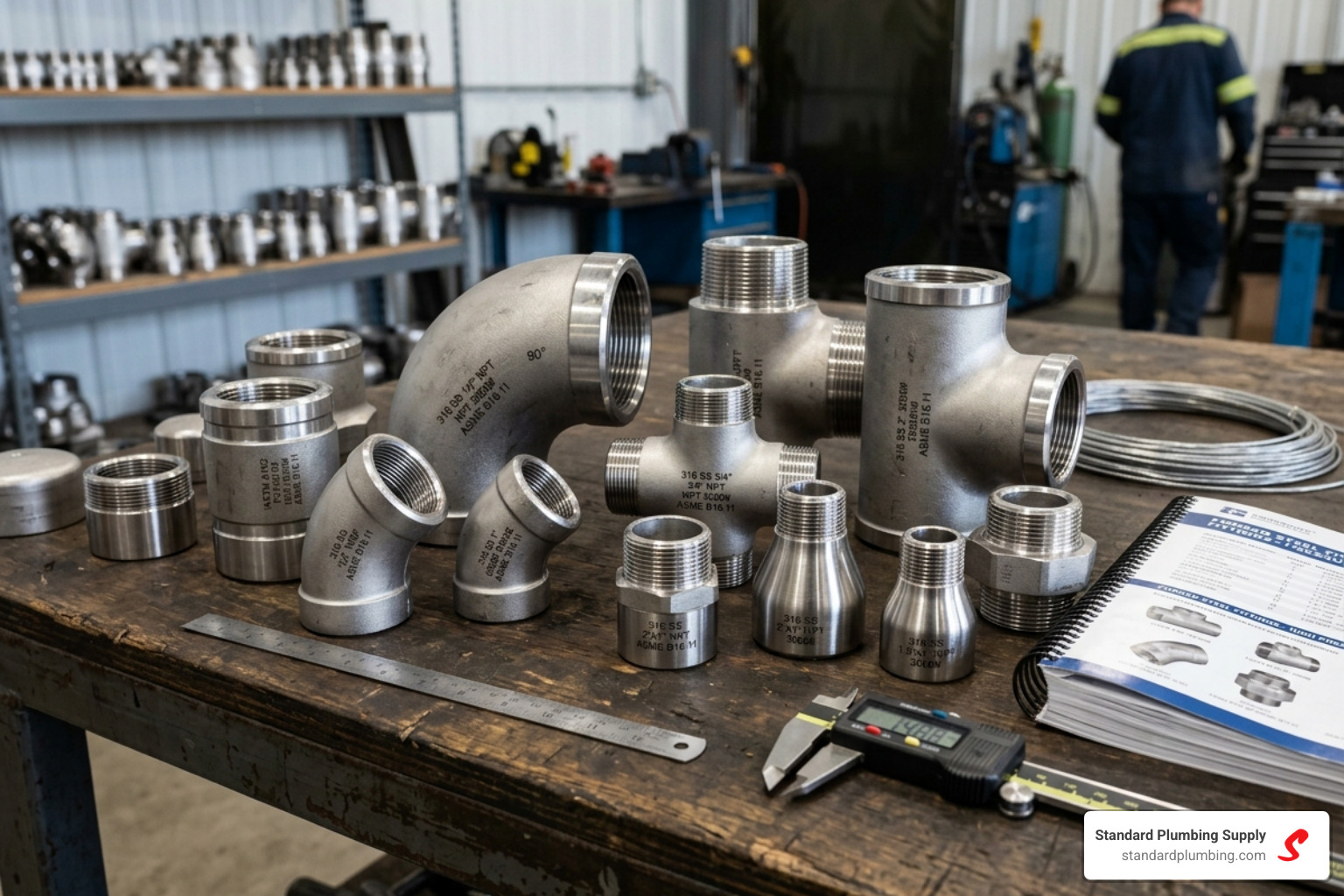
Common size ranges for seamless buttweld fittings typically run from 1/2″ NB to 10″ NB, while welded versions can go all the way up to 48″ NB.
- Schedule 10s: Lightweight, often used in water treatment or food processing where pressures are moderate.
- Schedule 40s: The “standard” weight for most industrial applications.
- Schedule 80s: Extra heavy, used for higher pressure or where extra corrosion allowance is needed.
- Schedule 160s and XXS: For extreme high-pressure environments.
Understanding Pressure Classes and Wall Thickness
When you move into forged fittings (usually the threaded or socket-weld variety), we stop talking about schedules and start talking about “Classes.”
- Class 150: These are cast fittings used for general plumbing and low-pressure industrial use.
- Class 3000: These are heavy-duty forged fittings. A Class 3000 fitting is rated to handle up to 3,000 psi of pressure.
- Class 6000: Used for the most demanding hydraulic or high-pressure steam systems.
These ratings are governed by standards like ANSI/ASME B16.3 and B1.20.1, ensuring that a fitting you buy in Arizona will fit perfectly with a pipe manufactured in Utah.
Industrial Applications and Global Standards
Why do we see 316 pipe fittings in so many different places? It comes down to versatility.
- Marine and Seawater: Because 316 contains molybdenum, it resists the “chloride stress corrosion cracking” that destroys lesser steels in salty air and water.
- Food and Beverage: 316 is considered “food grade” because it’s easy to clean, doesn’t leach chemicals into the product, and resists the acidic cleaners used in sanitization.
- Pharmaceuticals: The high purity and smooth finish of 316 fittings prevent bacterial growth and contamination.
- Oil and Gas: Specifically in “sour service” (environments with hydrogen sulfide), 316 fittings meeting NACE MR 01-75 standards are essential for safety.
Why 316 is the Preferred Choice for Aggressive Environments
In many cases, 316 isn’t just a “nice to have”—it’s a requirement. For example, NSF 61 certification often requires high-grade stainless for drinking water components to ensure long-term health and safety. Furthermore, ASTM A182 ensures that forged components can handle high-temperature service without losing their shape or strength.
Frequently Asked Questions about 316 Fittings
What is the difference between 316 and 316L fittings?
The “L” stands for “Low Carbon.” 316L has a maximum carbon content of 0.03%, whereas standard 316 allows up to 0.08%. The main benefit of 316L is during welding; the lower carbon prevents “carbide precipitation,” which can lead to corrosion at the weld site. If you are doing a lot of welding, 316L is usually the better choice.
When should I use Class 3000 fittings instead of Class 150?
Think of it as the difference between a residential garden hose and a hydraulic line on a bulldozer. Class 150 is for low-pressure applications (like air or water lines under 150 psi). Class 3000 is forged for high-pressure industrial systems where a failure could be catastrophic.
How do I identify genuine ASTM A403 WP316 fittings?
Genuine fittings will have a “heat code” or “traceability mark” stamped into the metal. This allows the manufacturer to provide a Material Test Report (MTR) that proves the chemical and mechanical properties. At Standard Plumbing Supply, we ensure all our industrial fittings meet these strict traceability standards.
Conclusion
Choosing the right 316 pipe fittings is about more than just matching pipe sizes; it’s about ensuring the longevity and safety of your entire system. From the molybdenum-rich chemistry that fights off salt-water corrosion to the heavy-duty Class 3000 forged unions that handle extreme pressure, 316 stainless steel truly is a masterclass in material engineering.
At Standard Plumbing Supply, we’ve spent decades helping folks across the Western United States—from our hubs in Boise and Salt Lake City to our locations in Phoenix and San Diego—find exactly what they need for their most challenging projects. Whether you are a mechanical contractor working on a wastewater plant or a facility manager in a food processing plant, we have the inventory and the expertise to help.
Ready to get started? You can Shop 316 Pipe Fittings at Standard Plumbing or visit one of our many locations across Arizona, California, Colorado, Idaho, Nebraska, Nevada, Oregon, Utah, and Wyoming. We’re here to make sure you get the right fitting, the first time.
