
Why the Right Sink Makes or Breaks a Small Bathroom
Bathroom sinks for small bathrooms are one of the most searched plumbing topics — and for good reason. In a tight space, the wrong sink can block traffic, eat up storage, and make the whole room feel cramped.
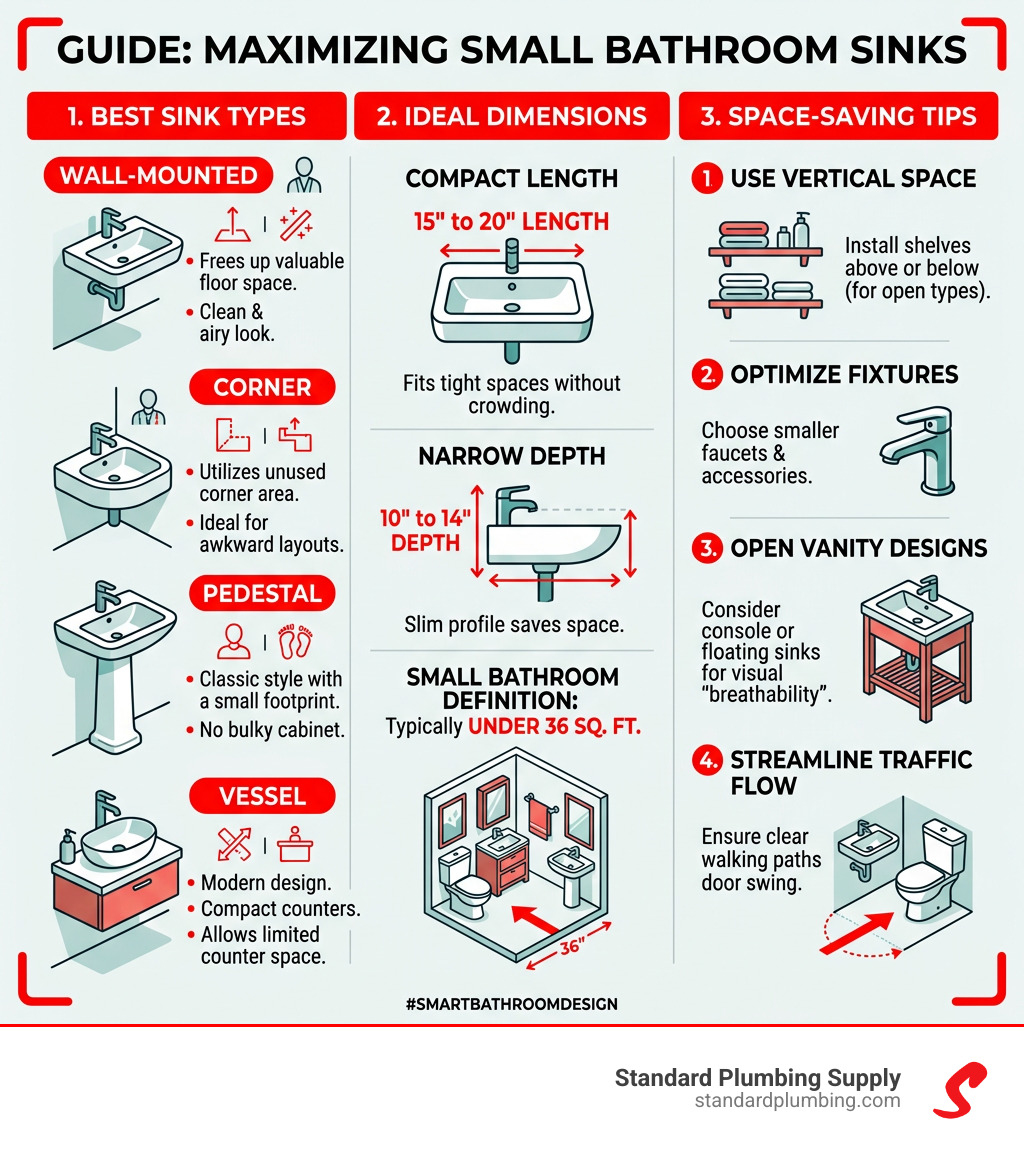
Here are the best sink types to consider for a small bathroom:
| Sink Type | Best For | Space Saved |
|---|---|---|
| Wall-mounted | Powder rooms, guest baths | High — frees up floor space |
| Corner | Awkward layouts, tiny baths | High — uses dead corner space |
| Pedestal | Classic style, small footprint | Medium — no under-sink storage |
| Vessel | Modern look, compact counters | Medium — needs counter space |
| Console | Added surface area | Low-Medium — open legs save visual space |
Small bathrooms are typically under 36 square feet. In that kind of space, every inch matters. The most popular sink sizes run 15 to 20 inches in length — compact enough to fit without crowding the room.
The good news: a smaller sink doesn’t mean a lesser bathroom. With the right choice, a compact sink can actually elevate the entire space.
I’m Jacob Reese, Vice President of Standard Plumbing Supply and a third-generation leader in the plumbing supply industry — I’ve helped contractors and DIYers find the right bathroom sinks for small bathrooms across hundreds of projects. Let’s walk through exactly what to look for so you can make a confident, practical choice.
Best Types of Bathroom Sinks for Small Bathrooms
When you are working with a limited footprint, the “standard” vanity often won’t cut it. We need to look at specialized configurations that prioritize floor area and visual “breathability.” At our locations across the West—from the busy streets of Los Angeles to the quiet corners of Logan, Utah—we see homeowners successfully using these five main types:
Wall-Mount Sinks
If your goal is to make a room feel larger, go with a wall-mount. By attaching directly to the wall studs and leaving the floor clear, you trick the eye into seeing more square footage. You can even find models like the Kohler Brockway which offer a vintage, industrial utility look while staying tight to the wall.
Corner Sinks
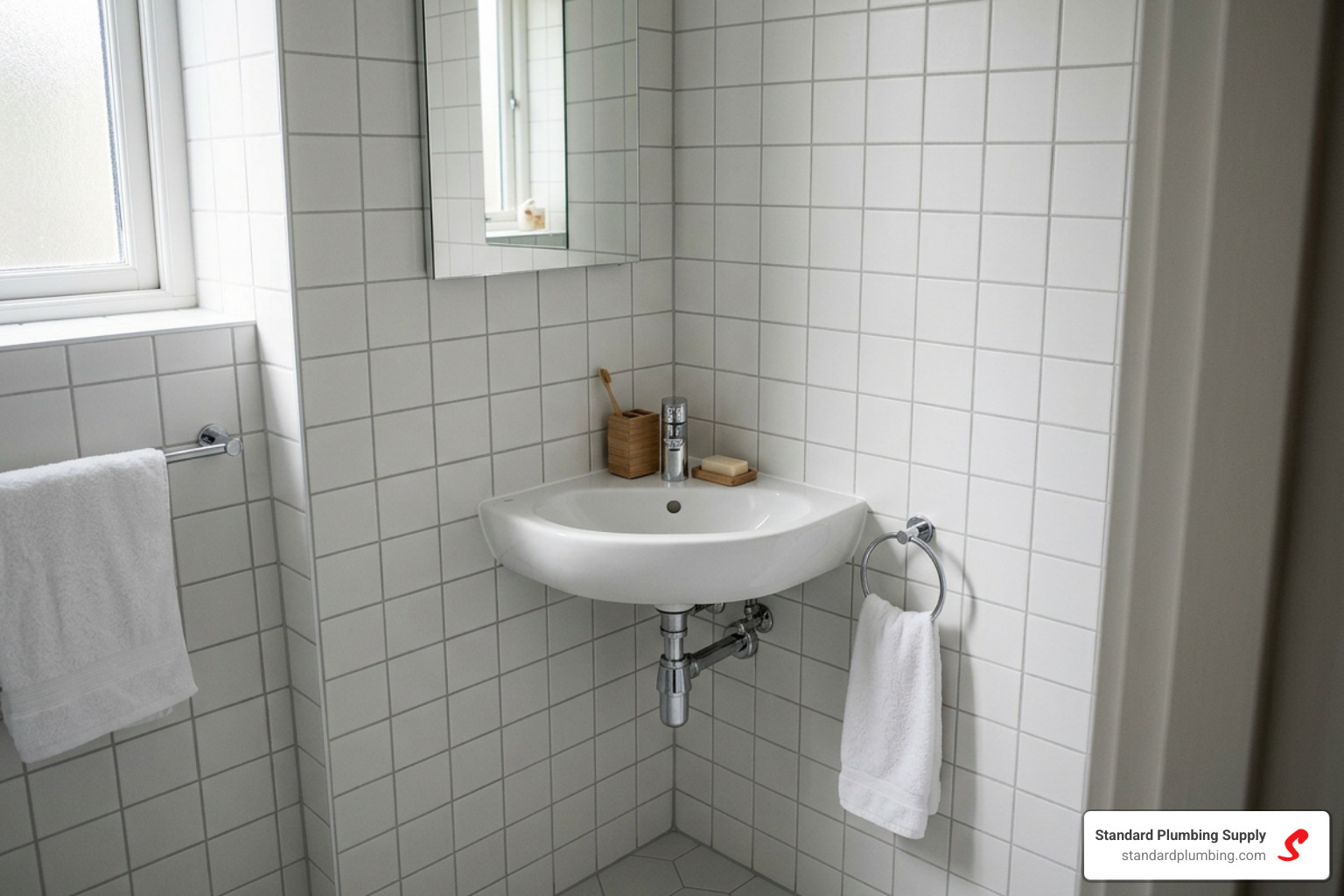
The corner sink is the ultimate “space hacker.” It utilizes the one area of the bathroom that usually goes to waste. These are increasingly popular in tiny powder rooms where a standard sink would prevent the door from opening. They can be floating, pedestal-style, or even drop-in.
Pedestal Sinks
The Kohler Cimarron pedestal is a classic for a reason. It hides the plumbing inside a slender column. While you lose cabinet storage, you gain a timeless aesthetic that doesn’t feel bulky. For an even slimmer profile, the Kohler Veer is a fantastic modern alternative.
Console Sinks
Think of a console sink as a hybrid. It has the open feel of a wall-mount but stands on two or four legs. Many console sinks feature a crossbar that doubles as a built-in towel rack—a huge win for small spaces where wall real estate is limited.
Vessel Sinks
Vessel sinks sit on top of the counter like a bowl. Because the basin is above the surface, you can often use a much narrower vanity cabinet than you would with an undermount sink. A Kohler Conical Bell vessel adds a high-end, spa-like feel without needing a massive countertop.
| Installation Type | Floor Impact | Storage Potential | Visual Weight |
|---|---|---|---|
| Wall-Mount | None | Low (add a shelf) | Very Light |
| Corner | Minimal | Low | Light |
| Pedestal | Minimal | None | Moderate |
| Console | Moderate | Low (towel bars) | Light/Open |
| Vessel | High (needs vanity) | High (cabinet) | Bold |
Maximizing Storage with Bathroom Sinks for Small Bathrooms
Just because you have a small sink doesn’t mean you have to give up on storage. The key is choosing a narrow-depth vanity. A standard vanity is 21 inches deep, but for small bathrooms, we recommend looking for 18-inch or even 16-inch depths.
The Amati 18-inch Vanity Combo is a perfect example of a “tiny but mighty” solution. It provides a dedicated spot for extra toilet paper or cleaning supplies without dominating the room. If you have a bit more width but still need a shallow profile, the Balmoral 26-inch Single Vanity offers a beautiful antique walnut finish that feels substantial but fits comfortably in a guest bath.
Floating cabinets are another great trick. By lifting the vanity off the floor, you maintain that open “wall-mount” feel while keeping the drawer space you need for toiletries.
Modern Aesthetics in Bathroom Sinks for Small Bathrooms
Modern manufacturing has allowed for “thin-edge” designs. Older porcelain sinks had thick, rounded rims that took up a lot of space. Today’s ceramic and vitreous china sinks are stronger, allowing for squared-off, razor-thin edges that maximize the basin size while keeping the outer dimensions small.
For a sleek, high-end look, consider the Kohler Iron Plains dual-mount sink. It offers a sophisticated “Dune” finish and a shape that works perfectly on a narrow countertop.
Matte finishes are also trending. A matte black or grey sink can make a bold statement in a powder room, turning a functional necessity into a design centerpiece.
Measuring and Planning for Compact Layouts
Before you fall in love with a specific model, you need to get your measuring tape out. In the plumbing world, we have a few “golden rules” for small bathroom layouts:
- The 36-Square-Foot Rule: If your bathroom is under 36 square feet, you should almost exclusively look at sinks with a length of 20 inches or less.
- Clearance: You need at least 18 inches of clear floor space in front of the sink for a person to stand comfortably.
- Side Gaps: Ideally, leave 3 inches of space between the edge of the sink and the wall or other fixtures (like the toilet). In extremely tight “micro-bathrooms,” you can get away with 1 inch, but it will feel tight.
- Depth vs. Length: Don’t just measure how wide the sink is. Measure how far it sticks out from the wall (depth). A narrow rectangular sink might be 20 inches wide but only 12 inches deep, which is a lifesaver in a narrow hallway-style bathroom.
Typical basin depths for small sinks range from 5 to 8 inches. If you go too shallow, you’ll deal with splashing; too deep, and it might interfere with the plumbing trap inside a small vanity.
Material Selection and Essential Features
The material of your sink affects more than just the look—it determines how much cleaning you’ll be doing.
- Vitreous China & Ceramic: These are the gold standard. They are kiln-fired at high temperatures, making them non-porous and incredibly easy to wipe down. The DXV Petite Round Undermount Sink is a great example of a durable, high-gloss vitreous china option.
- Fireclay: Similar to ceramic but fired at even higher temperatures for extreme durability. Check out the Fireclay Single Undermount for a robust, scratch-resistant surface.
- Stainless Steel: While common in kitchens, a small stainless sink like the Elkay Quartz Classic can bring a modern, industrial vibe to a bathroom and is virtually indestructible.
Essential Features to Look For:
- Overflow Protection: This is the small hole near the rim that prevents the sink from flooding your bathroom if the faucet is left on. Most of our small bathroom sinks include this.
- ADA Compliance: If you are planning for “aging in place” or need an accessible bathroom, look for ADA-compliant wall-mount sinks that allow for wheelchair clearance underneath.
- Faucet Hole Configuration: Small sinks usually come with one pre-drilled hole for a single-handle faucet. This saves space compared to a three-hole “widespread” faucet setup.
Frequently Asked Questions about Small Sinks
What is the best sink for a very tiny powder room?
For a true “tiny” powder room, a wall-mount corner sink is almost always the winner. It keeps the floor clear, making the room easier to clean and visually larger, and it utilizes space that would otherwise be dead air.
What are the ideal dimensions for a small bathroom sink?
We generally recommend sinks that are 16 to 20 inches in length. For depth (how far it sticks out from the wall), aim for 12 to 15 inches. This provides enough room to wash your hands comfortably without blocking the “walkway” of the bathroom.
Can I install double sinks in a small master bathroom?
Yes, but you have to be clever. Instead of two bulky vanities, use a single narrow countertop with two small vessel sinks. Another trick is to use wall-mounted faucets. By moving the faucet from the sink deck to the wall, you can push the sink closer to the wall, saving valuable inches of counter space.
Conclusion
Choosing the right bathroom sinks for small bathrooms doesn’t have to be a headache. Whether you’re remodeling a historic home in Salt Lake City or updating a modern condo in Phoenix, the key is to balance your storage needs with the available floor space.
At Standard Plumbing Supply, we’ve been helping our neighbors across the West find these exact solutions for decades. From ADA-compliant wall-mounts to stylish furniture-grade vanities, we have the inventory to make your small bathroom feel like a master suite.
Ready to transform your space? Use our store locator to find an SPS near you—whether you’re in Boise, St. George, or Sacramento—and let our experts help you measure twice and buy once.
Shop our full selection of small bathroom sinks and pedestals
