
Why 110mm Waste Pipe is Essential for Modern Drainage Systems
110mm waste pipe is the standard for underground drainage in residential and commercial buildings. Here’s what you need to know:
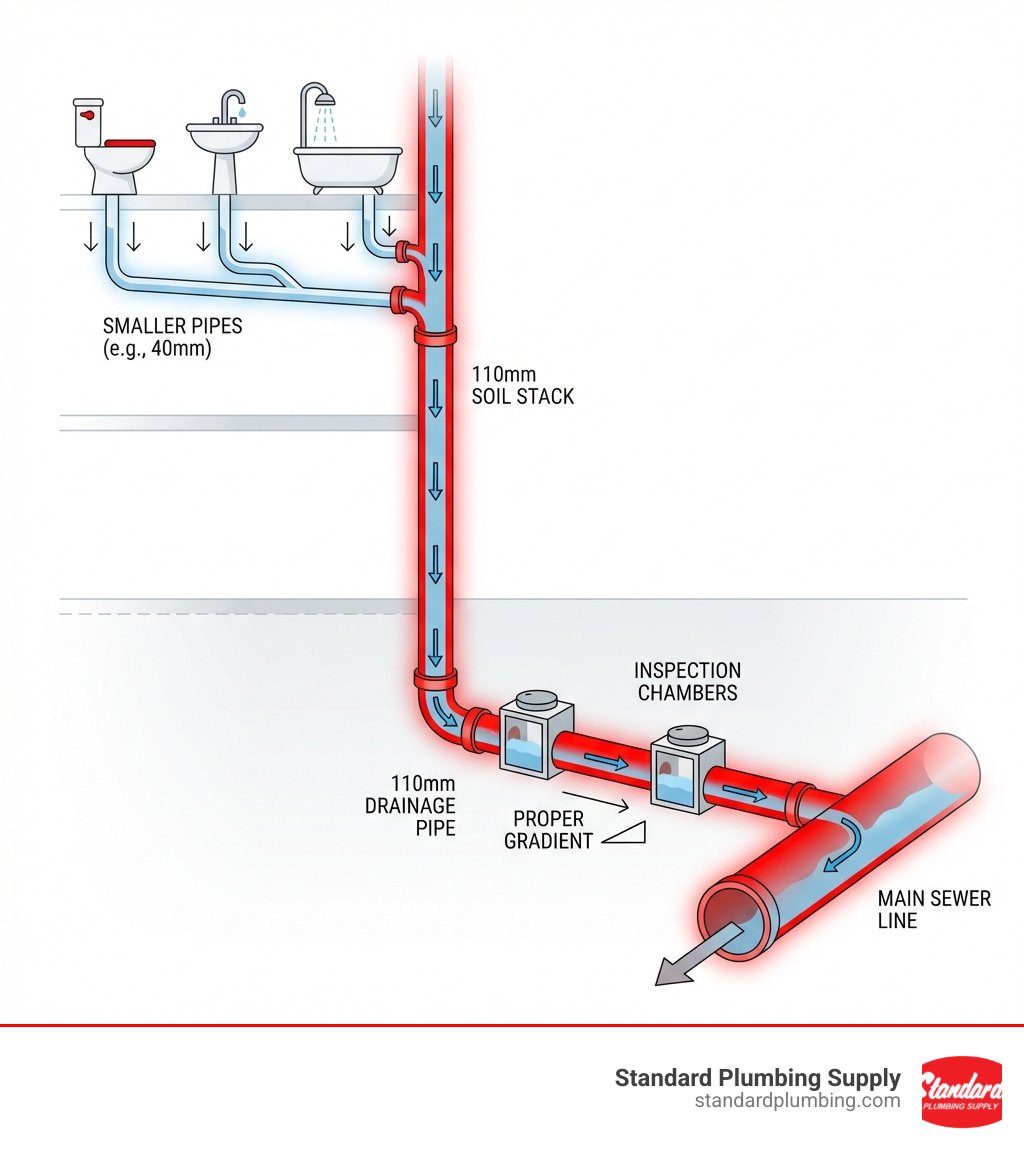
- Primary Function: Carries sewage and wastewater from toilets, sinks, and baths to the main drainage network.
- Common Material: PVC-u (unplasticized polyvinyl chloride) for its strength, durability, and corrosion resistance.
- Key Standards: Manufactured to high industry standards. Always check local building codes for specific requirements.
- Connection Types: Push-fit joints with rubber seals or solvent weld connections.
- Typical Applications: Main soil stack, underground drainage, and connecting multiple waste outlets.
A 110mm waste pipe is the backbone of a home’s drainage system, handling the combined flow from bathrooms, kitchens, and laundry rooms. Unlike smaller 32mm or 40mm pipes for individual fixtures, the 110mm pipe manages the total volume.
The system is gravity-fed, so proper installation with the correct fall (gradient) is critical to prevent blockages and leaks. A well-installed system can provide decades of reliable, maintenance-free service. This guide will walk you through every step, from planning to installation.
I’m Jacob Reese, Vice President of Standard Plumbing Supply. With decades of hands-on experience in the plumbing industry, I’ve helped countless contractors and DIYers select and install 110mm waste pipe systems, and I know how to avoid the common pitfalls that lead to costly repairs.
Planning Your Installation: Tools, Materials, and Regulations
Before cutting any pipe, thorough planning is essential for a smooth installation and a long-lasting drainage system.

First, map out the entire pipe run, from the fixtures to the main sewer connection. This involves measuring and calculating the crucial “fall” or gradient. You’ll also need to consider whether the 110mm waste pipe will be above or below ground, as each has different requirements.
| Feature | Above-Ground 110mm Pipes | Underground 110mm Pipes |
|---|---|---|
| Primary Use | Main soil stack for toilets, collecting smaller waste pipes. | Main drainage system connecting to public sewer. |
| Visibility | Typically runs vertically or horizontally within walls, ceilings, or utility spaces. | Buried beneath the ground, out of sight. |
| Support | Requires secure clips and brackets to hold its weight and prevent movement. | Requires proper bedding (e.g., sand or pea shingle) and backfilling for stability. |
| Material Needs | Often PVC-u, sometimes cast iron for specific aesthetics or fire ratings. | Almost exclusively PVC-u for its durability, corrosion resistance, and ease of installation. |
| Installation | Focus on routing around structural elements, sound insulation, and fire stopping. | Focus on trenching, depth requirements, and protection from ground movement or vehicle loads. |
| Access | May include access points or rodding eyes for maintenance within the building structure. | Often includes inspection chambers or rodding points at changes in direction or junctions. |
| Regulations | Governed by internal plumbing codes regarding venting, fire stopping, and support. | Governed by external drainage codes regarding depth, gradient, and connection to public systems. |
Understanding local building codes is paramount. These regulations ensure public health and safety. For our customers in Nebraska, Nevada, Oregon, and Utah, you can find relevant information here:
- Relevant building codes for sanitary drainage (Nebraska)
- Relevant building codes for sanitary drainage (Nevada)
- 2023 Oregon Plumbing Specialty Code
- Department of Environmental Quality (Utah)
Always consult the most current version of your local codes.
Choosing the Right 110mm Waste Pipe and Fittings
For modern 110mm waste pipe systems, PVC-u (unplasticized polyvinyl chloride) is the top choice. It’s lightweight, durable, corrosion-resistant, and cost-effective. Its smooth inner walls prevent blockages, and it’s tough enough for underground use.
PVC-u systems offer two reliable connection methods:
- Push-Fit Joints: Popular for their speed and ease. A rubber sealing ring creates a watertight seal when the pipe is pushed in. Always use pipe lubricant on the seal and pipe end to ensure a smooth connection and prevent leaks.
- Solvent Weld Joints: This method creates a permanent, fused bond. A special solvent cement chemically welds the pipe and fitting together, creating an incredibly strong, watertight connection.
Essential Tools and Materials:
- 110mm PVC-u pipes and fittings (bends, junctions, couplings, adaptors)
- Pipe saw, de-burring tool/file, and chamfering tool
- Spirit level, measuring tape, and marker pen
- Pipe lubricant (for push-fit) or PVC-u solvent cement/primer (for solvent weld)
- Pipe clips/brackets and safety gear (gloves, goggles)
- Trenching tools and bedding material (sand/pea shingle) for underground work.
Understanding Drainage Gradient (Fall)
Wastewater relies on gravity, making “fall” or “gradient” (the downward slope of the pipe) one of the most critical aspects of installation.
Why is fall important? A proper gradient ensures both liquids and solids are carried away efficiently, preventing blockages and odors. Too flat, and solids settle; too steep, and liquids outrun the solids.
Calculating the Correct Gradient:
For 110mm waste pipe systems, a fall of 1:40 to 1:110 is recommended. This means for every 40 to 110 units of horizontal run, the pipe drops 1 unit vertically. A range of 1:80 to 1:110 is often considered ideal.
How to Achieve the Correct Fall:
- Measure the horizontal length of your pipe run.
- Calculate the total drop needed based on your chosen ratio (e.g., a 10-meter run at 1:80 needs a 12.5 cm drop).
- Use a Spirit Level to set the slope. For long runs, a laser level provides greater precision.
- Check Regularly as you lay each section to ensure a consistent gradient.
Step-by-Step Guide to Installing Your 110mm Waste Pipe
With planning complete and tools gathered, it’s time to install the 110mm waste pipe. Always prioritize safety.
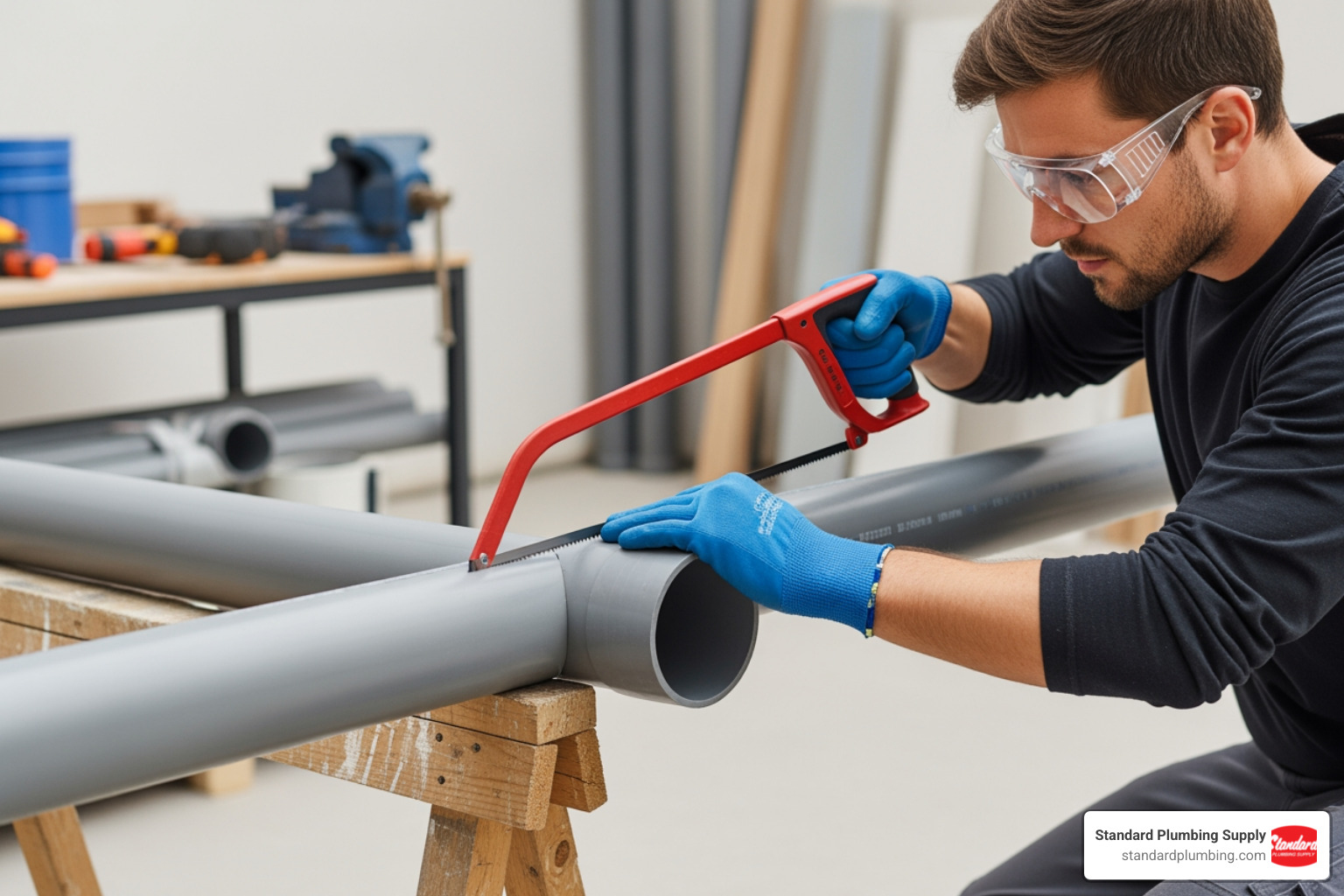
Safety Precautions:
- Wear gloves and safety goggles.
- If working in a trench, ensure it’s stable and never work alone in deep trenches.
- Use solvent cement only in well-ventilated areas.
Preparing the Trench (for underground installations):
If your 110mm waste pipe is going underground, dig a trench wide enough to work in and deep enough to accommodate the pipe, bedding, and required cover, all while maintaining the correct fall. Minimum depth is dictated by local codes to protect the pipe from frost and surface loads.
Step 1: Cutting and Preparing the Pipe
Accuracy is key to a leak-free system.
- Measure and Mark: Double-check your measurements before marking the 110mm waste pipe.
- Cut the Pipe: Use a fine-toothed handsaw to make a straight, square cut.
- De-burr and Chamfer: Remove rough edges (burrs) from inside and outside the cut with a file or de-burring tool. For push-fit joints, create a slight bevel (chamfer) on the outside edge of the pipe end. This helps it slide past the rubber seal without damaging it.
- Apply Lubricant (for Push-Fit): Generously apply pipe lubricant to the chamfered end and the rubber seal inside the fitting. This is crucial for a watertight joint.
Step 2: Making the Connections
This is where you create the leak-proof bonds.
For Push-Fit Joints:
- Align the pipe and fitting.
- Push the lubricated pipe end firmly into the socket until it hits the stop.
- Give the joint a gentle tug to ensure it’s secure.
For Solvent Weld Joints:
- Clean the pipe end and inside of the fitting.
- Apply PVC-u primer to both surfaces, followed by an even coat of solvent cement.
- Immediately push the pipe fully into the fitting, giving it a quarter-turn to spread the cement.
- Hold firmly for 15-30 seconds.
- Wipe off excess cement and allow the joint to cure per the manufacturer’s instructions before testing.
Step 3: Supporting and Securing the Pipework
Proper support prevents sagging and stress on joints.
For Above-Ground Pipework:
- Use pipe clips and brackets to secure the pipe to walls or joists. For horizontal 110mm pipe, space supports roughly every 1.1 meters (43 inches). Support vertical pipes at each floor level.
- Don’t overtighten clips, as PVC-u pipes expand and contract with temperature.
For Underground Pipework:
- Bedding: Lay a continuous bed of at least 100mm (4 inches) of granular material (sand or pea shingle) in the trench to provide even support.
- Lay the Pipe: Place the assembled 110mm waste pipe system onto the bedding, checking that the fall is correct.
- Side Fill & Backfill: Add more granular material around the sides of the pipe. Once supported, backfill the trench with the excavated soil, compacting it in layers.
A Guide to 110mm Fittings and Adaptors
The 110mm waste pipe is the highway, and fittings are the intersections that make the system work. Understanding them is key to a good design.
Here are the most common fittings you’ll encounter:
- Bends and Elbows: Change the direction of the pipe run (e.g., 15°, 45°, 90°). Gentler bends are preferred to reduce blockage risk.
- Junctions: Allow pipes to join, such as T-junctions or Y-junctions, for connecting smaller pipes or another 110mm line.
- Couplings: Connect two straight lengths of 110mm waste pipe or repair a damaged section.
- Traps (Gully Traps): Used in underground drainage to create a water seal that blocks foul odors and sewer gases.
- Inspection Chambers and Rodding Points: Provide access for inspection, maintenance, and clearing blockages.
Connecting to the Main 110mm Waste Pipe System
A common task is connecting smaller waste pipes (from sinks, baths) to the larger 110mm waste pipe. This requires adaptors.
- Using Adaptors: These fittings create a secure, leak-proof connection between pipes of different diameters.
- Connecting 32mm, 40mm, or 50mm Pipes: You’ll need specific adaptors to connect these common fixture waste pipes to the 110mm system.
- Single Waste Adaptors: Connect one smaller pipe. For example, a Underground Drainage 110mm Waste Pipe Adaptor 32mm Single or a 50mm version. Some, like the Underground Drainage 110mm Single Waste Pipe Adaptor, may require a Waste Boss Adaptor.
- Double Waste Adaptors: Connect two smaller pipes at the same point, such as a 110mm Double Waste Adaptor for two 40mm pipes.
- Boss Adaptors: Used with bossed pipes or junctions, which have pre-formed inlets for the adaptor.
Ensuring a Secure, Leak-Proof Connection:
Always use the correct size adaptor. For push-fit connections, ensure the pipe end is clean, de-burred, and lubricated before pushing it firmly into place to create a watertight seal.
Common Problems and How to Fix Them
Even well-installed 110mm waste pipe systems can have issues. Knowing how to diagnose and fix common problems can save stress and expense.
1. Blockages:
- Diagnosis: Slow drainage, gurgling sounds, or water backing up.
- Causes: Grease, hair, foreign objects, or tree root infiltration. Incorrect fall is a common contributor.
- Resolution: Start with a plunger or a plumber’s snake fed through an access point. For stubborn blockages, professional hydro-jetting is effective. Use chemical drain cleaners with caution, as they can damage pipes.
2. Leaks at Joints:
- Diagnosis: Drips, damp patches, or a musty smell around pipework.
- Causes: Improperly made connections, damaged seals, or external damage.
- Resolution: For push-fit joints, try reseating the pipe; if the seal is damaged, replace it. Leaking solvent weld joints usually require the faulty section to be cut out and replaced.
3. Incorrect Fall (Gradient):
- Diagnosis: Chronic slow drainage or frequent blockages.
- Causes: Poor installation or ground settlement.
- Resolution: This is a serious issue that often requires re-laying sections of the pipe to the correct gradient.
4. Bad Smells (Sewer Gas):
- Diagnosis: Foul odors from drains.
- Causes: Dry traps (evaporated water seal), damaged traps, cracked pipes, or inadequate venting.
- Resolution: Pour water into dry traps. Inspect pipework for cracks. Ensure the system’s vent stack is not blocked, as it allows sewer gases to escape safely and prevents water from being siphoned from traps.
5. Damaged Sections of Pipe:
- Diagnosis: Visible cracks or breaks in the pipe.
- Resolution: The damaged section must be cut out. Use two couplings to join a new piece of pipe into the gap, ensuring the correct fall is maintained.
We understand these issues can be frustrating, but by carefully diagnosing the problem and applying the right solution, we can get your 110mm waste pipe system flowing freely once again.
Frequently Asked Questions about 110mm Waste Pipes
Here are answers to the most common questions about 110mm waste pipe installation.
What is the difference between a soil pipe and a waste pipe?
In short, it’s about what they carry.
- Waste Pipe (smaller, e.g., 32mm, 40mm): Carries “greywater” from sinks, baths, and showers.
- Soil Pipe (typically 110mm): Carries “blackwater” (containing human waste) from toilets. The 110mm soil pipe also collects all the greywater from the smaller waste pipes before it enters the main underground drain. So, a soil pipe carries all wastewater.
How deep should a 110mm underground drain pipe be?
Depth is critical for protection and is dictated by local building codes.
- General Rule: Pipes must be deep enough to be safe from frost and surface loads (like vehicles).
- Minimum Cover: A minimum cover of 450mm to 750mm (18 to 30 inches) is often required under soft ground like gardens.
- Under Load: Under driveways or other load-bearing areas, pipes must be buried deeper and may require extra protection like a concrete encasement.
- Local Codes are King: Always consult your local building authority for precise depth requirements in your area, as frost lines and regulations vary significantly across Arizona, California, Colorado, Idaho, Nebraska, Nevada, Oregon, Utah, and Wyoming.
Can you connect a 40mm waste pipe to a 110mm soil pipe?
Yes, this is a standard and essential practice. The 110mm soil pipe is designed to be the central collector for all waste, including from smaller 40mm pipes (e.g., from a kitchen sink).
You must use a specific adaptor, such as a 110mm to 40mm reducer or a boss adaptor fitted into a bossed pipe junction. Using the correct fitting with pipe lubricant ensures a secure, watertight seal, allowing greywater to enter the main 110mm waste pipe system hygienically.
Conclusion
We’ve journeyed through 110mm waste pipe installation, from understanding its critical role in modern drainage to the nitty-gritty of cutting, connecting, and supporting your pipework. We’ve explored the benefits of PVC-u, demystified the importance of correct fall, and equipped you with the knowledge to tackle common problems.
The takeaway? Proper installation of your 110mm waste pipe system is paramount. It’s the foundation for a reliable, maintenance-free drainage system that will serve your home or business for decades. Cutting corners here can lead to costly repairs, frustrating blockages, and unpleasant odors. By paying attention to detail, using the right materials, and adhering to local building regulations, you’re investing in the long-term health of your property’s plumbing.
Whether you’re a seasoned professional or a dedicated DIYer, we at Standard Plumbing Supply are here to support you every step of the way. For all your plumbing needs, from pipes and fittings to tools and expert advice, browse our extensive catalog. Find the right ABS cleanout tees and other fittings for your project and let us help you achieve seamless drains.
