
Why Choosing the Right Plumbing Fittings Matters
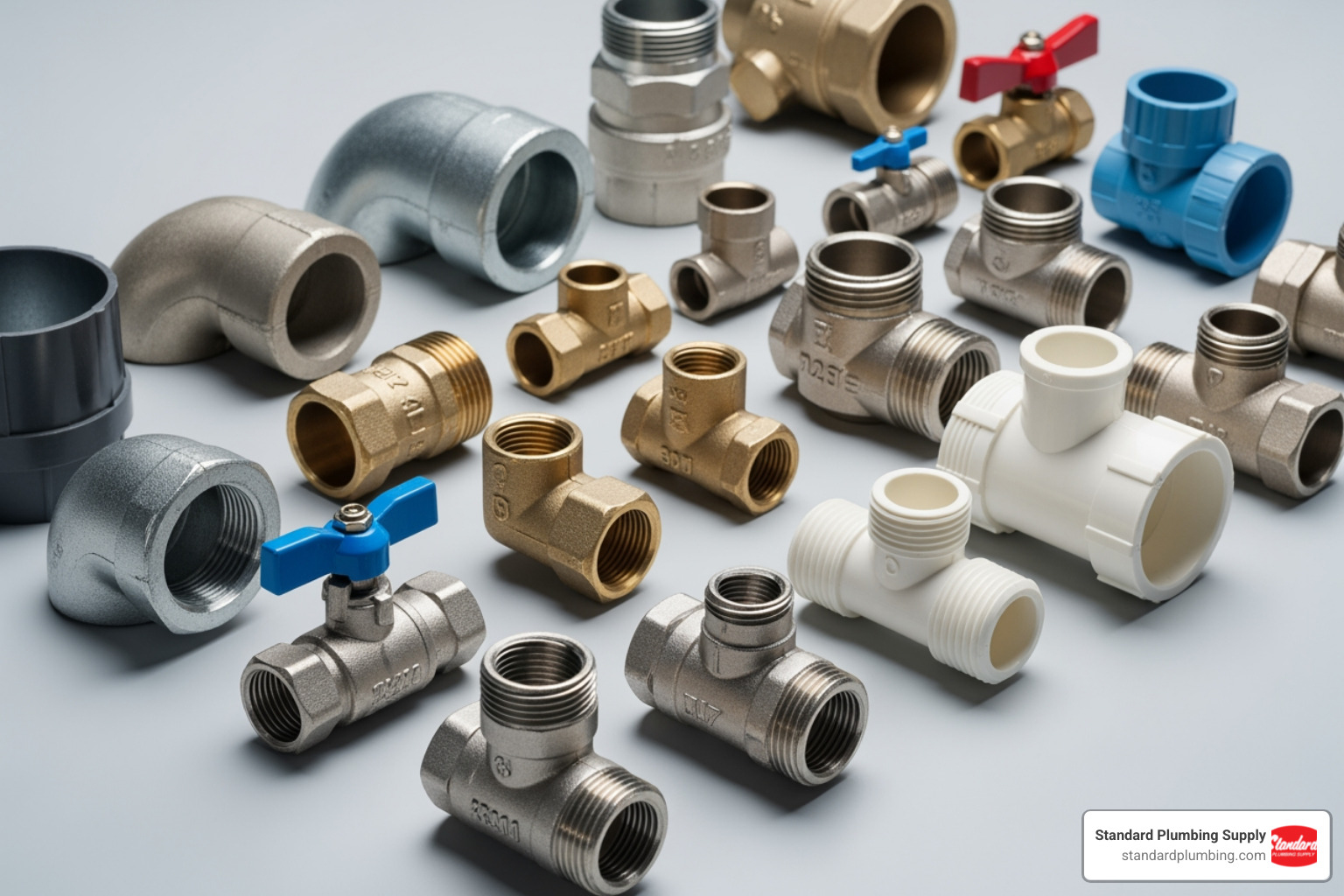
Plumbing fittings are the essential connectors that join pipes together, change directions, branch lines, adapt sizes, and terminate runs in any plumbing system. Understanding which fitting to use—and how to connect it—is critical for preventing leaks, ensuring proper flow, and building a safe, code-compliant system.
Quick Reference: Common Plumbing Fittings and Their Uses
| Fitting Type | Primary Function | Common Applications |
|---|---|---|
| Elbows | Change direction (90° or 45°) | Navigating around obstacles |
| Tees | Branch a line | Adding fixtures or multiple outlets |
| Couplings | Join two pipes in a straight line | Extending pipe runs or repairs |
| Reducers/Bushings | Adapt pipe size | Connecting different diameter pipes |
| Unions | Create removable connections | Maintenance access points |
| Caps/Plugs | Seal pipe ends | Terminating lines or future expansion |
| P-Traps | Trap water to block sewer gases | Under sinks and drains |
| Wyes | Connect drains at angles | Vertical to horizontal transitions |
If you’ve ever made multiple trips to the hardware store trying to find the right fitting, you’re alone. With thousands of fittings available in different materials, sizes, and connection types, even experienced DIYers can feel overwhelmed. The wrong choice can lead to leaks, code violations, or a system that simply doesn’t work.
The challenge isn’t just picking a fitting—it’s picking the right fitting for your specific pipe material, application (water supply vs. drain), pressure requirements, and connection method. A copper fitting won’t work on PVC pipe. A standard tee designed for pressurized water lines can cause drainage problems in a waste system. And connecting dissimilar metals without the proper transition fitting can lead to corrosion and costly repairs.
This guide breaks down everything you need to know: the most common fitting types and what they do, which materials work for different applications, how various connection methods compare, and when specialized fittings like dielectric unions or sanitary tees are necessary. Whether you’re tackling a small repair, planning a bathroom remodel, or installing a new water line, you’ll know exactly which fittings to use—and how to install them correctly.
I’m Jacob Reese, Vice President of Standard Plumbing Supply, and I’ve spent nearly my entire life in this industry—starting at age eight sweeping warehouses and working my way through every role in our family business. Over the years, I’ve helped thousands of contractors and DIYers steer the complexities of plumbing fittings, from simple repairs to large-scale installations, and I’m here to make your next project easier.
Understanding Fitting Fundamentals: Materials and Selection Factors
Choosing the correct plumbing fittings starts with understanding the materials they’re made from and the factors that influence their performance. It’s like picking the right tool for the job – a hammer won’t help you with a screw!
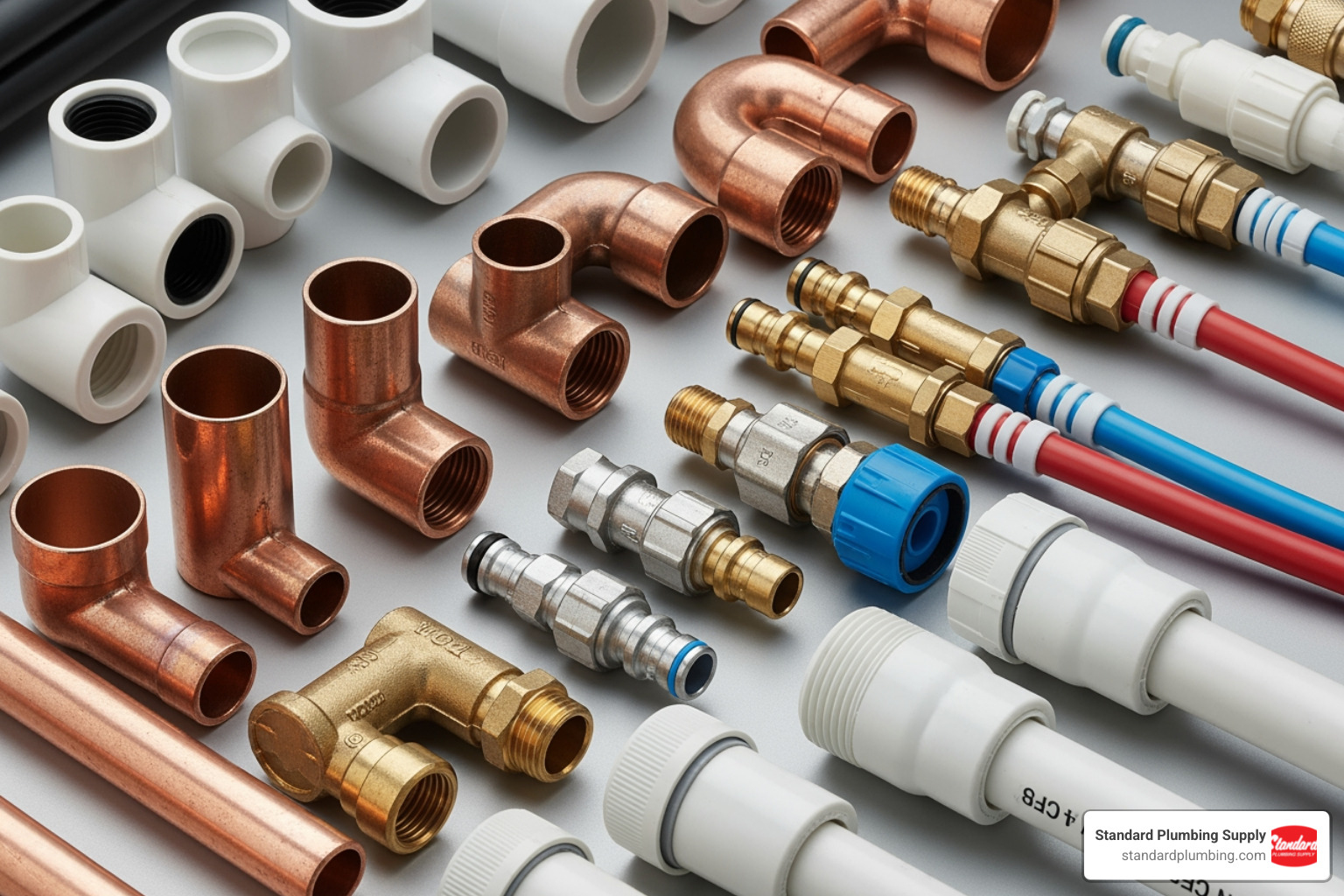
Common Fitting Materials
The material of your plumbing fittings is paramount, as it dictates compatibility, durability, and suitability for specific applications.
- Copper: Renowned for its corrosion resistance and durability, copper fittings are a classic choice for plumbing and heating applications. They’re often joined by soldering or brazing. We typically see two types: Type M for most home applications and the heavier-duty Type L for underground use.
- PVC (Polyvinyl Chloride): As the most widely used type of pipe fitting, PVC is popular for its cost-effectiveness and durability. It’s excellent for cold water lines and, especially, for sewage applications due to its high resistance to chemicals found in waste.
- CPVC (Chlorinated Polyvinyl Chloride): A step up from standard PVC, CPVC is more flexible and can withstand higher temperatures, making it suitable for both hot and cold water transfer, as well as industrial liquid handling.
- PEX (Cross-linked Polyethylene): The demand for PEX plumbing fittings is rapidly growing, and for good reason! PEX is incredibly flexible, durable, and easy to install, making it a favorite for hot and cold water supply lines. It comes in different types, such as PEX A, PEX B, and PEX C, each with slightly different properties.
- Brass/Bronze: These metal alloys are commonly used for valves and various plumbing fittings due to their excellent corrosion resistance, strength, and ability to be threaded or soldered.
- Galvanized Steel: Once a popular option for indoor plumbing, galvanized steel pipe is more affordable than copper and quite durable. However, its biggest drawback is the potential for internal corrosion, which can lead to buildup and reduced water flow over time. It’s often used in large-scale construction or for outdoor water distribution where corrosion is less of a concern.
- Stainless Steel: Offering superior strength and corrosion resistance, stainless steel plumbing fittings are used in demanding applications, including high-pressure systems and environments where hygiene is critical.
- ABS (Acrylonitrile Butadiene Styrene) plastic: Similar to PVC, ABS is primarily used for drain-waste-vent (DWV) systems. It’s typically black and often preferred for its impact resistance in colder temperatures.
Key Selection Factors
When choosing plumbing fittings, we consider several crucial factors to ensure a reliable and long-lasting system:
- Fluid Compatibility: What will be flowing through the pipes? Potable (drinking) water, non-potable water, gas, or waste? This is critical, especially for potable water systems, where lead-free fittings are legally mandated.
- System Pressure: Different fittings are designed to withstand varying pressures. For instance, hydraulic fittings are engineered for much greater pressure than general plumbing systems. Always match the fitting’s pressure rating to your system’s requirements.
- Water Temperature: Hot water systems require materials like CPVC or PEX that can handle liftd temperatures without degradation. Cold water lines are more forgiving but still require appropriate materials.
- Environmental Exposure: Will the fittings be exposed to UV light, extreme temperatures, or corrosive elements? Underground-rated fittings are specially constructed for buried applications.
- Local Plumbing Codes: Adhering to local plumbing codes and standards is non-negotiable. Organizations like the International Association of Plumbing and Mechanical Officials (IAPMO) and the International Code Council (ICC) set guidelines that our plumbing fittings must meet. Always check with your local authorities or a licensed plumber to ensure compliance in your area, whether you’re in Arizona, California, Utah, or any of the other states we serve.
Tips for Choosing the Right Fitting Material for Your Project
- Identify your pipe material: Always match your fitting material to your pipe material for optimal compatibility and to prevent issues like galvanic corrosion.
- Determine the fluid: Potable water requires lead-free fittings. Gas lines need specific, approved materials.
- Consider temperature and pressure: Ensure the fitting’s specifications meet or exceed your system’s operating conditions.
- Check local codes: Verify that your chosen materials and installation methods comply with all relevant plumbing codes in your region.
- Assess the environment: Account for factors like UV exposure, freezing temperatures, or corrosive soil if applicable.
The Anatomy of a Plumbing System: Common Types of Plumbing Fittings
Every plumbing system is a network of pipes, and plumbing fittings are the joints that make the network function. They allow us to change direction, join different sections, branch off to fixtures, and terminate lines.
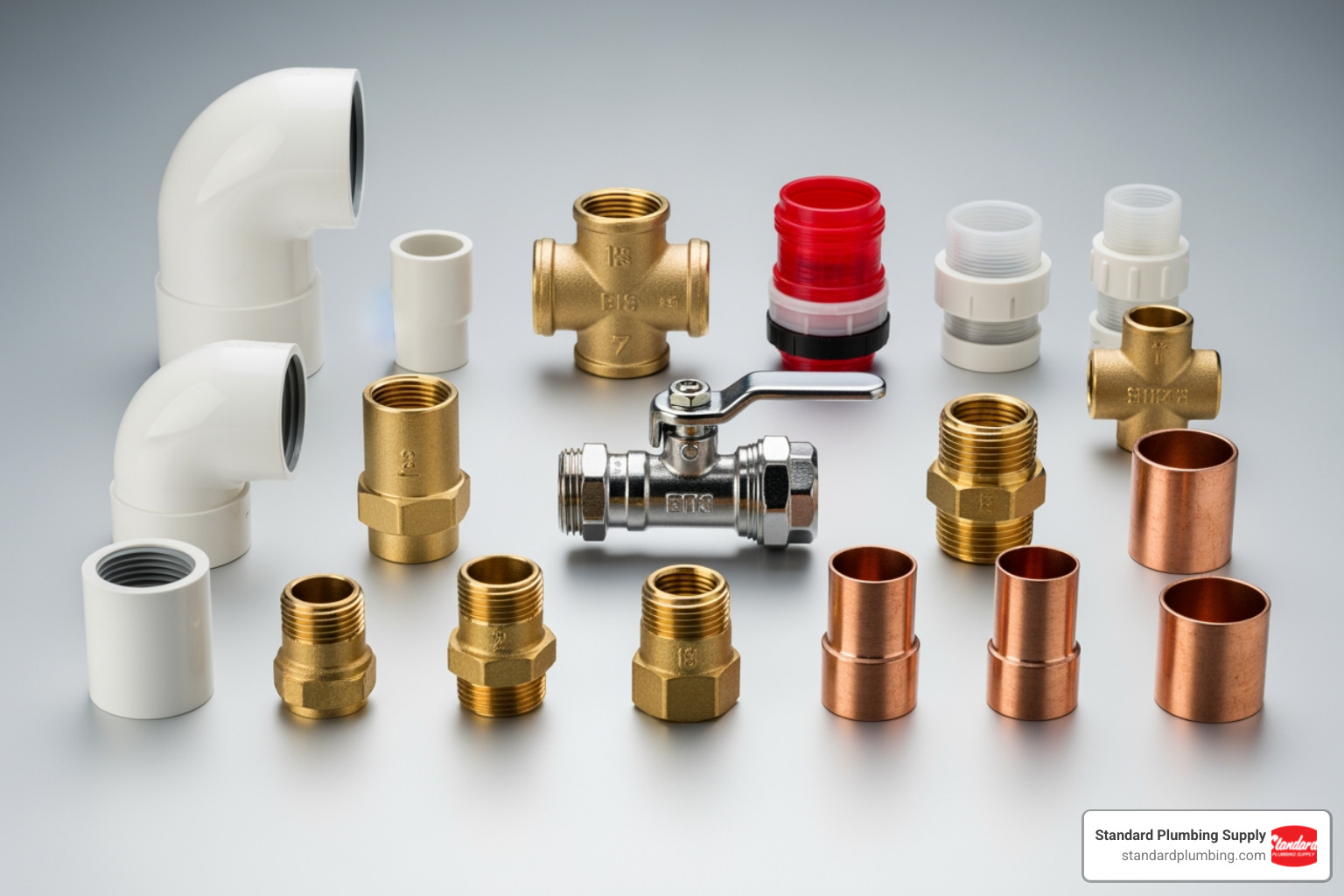
Essential Water Line Plumbing Fittings
These are the workhorses of your pressurized water supply system:
- Elbows (90°, 45°): When you need to change the direction of a pipe run, elbows are your go-to. They come in various angles, with 90-degree and 45-degree bends being the most common. Long-radius (sweep) elbows are also available, especially useful in drain lines.
- Couplings: These simple fittings join two lengths of pipe in a straight line. They’re indispensable for extending pipe runs or reconnecting pipes after a repair. Slip couplings are particularly handy for repairs in tight spots.
- Unions: A union is like a special coupling that allows for easy, temporary disassembly of pipes without cutting or rotating them. They’re secured by a large threaded nut, making them perfect for maintenance access points or connecting appliances. Dielectric unions, which we’ll discuss more, are crucial for joining dissimilar metals.
- Adapters: Adapters are the chameleons of plumbing fittings, designed to connect pipes of different types (e.g., slip joint to threaded) or materials. A reducing adapter, for example, connects pipes of different diameters.
- Tees: Shaped like the letter “T,” these fittings are used to add a branch line to an existing pipe. A reducing tee can accommodate a branch line that’s a different size than the main line.
- Reducers & Bushings: These fittings reduce the pipe size from a larger bore (inner diameter) to a smaller one, or vice-versa. Reducers can be concentric or eccentric, while bushings are similar but typically have one male and one female end. They’re used to meet hydraulic flow requirements or adapt to existing piping.
- Caps & Plugs: When you need to seal off the end of a pipeline, either temporarily for a test or permanently to terminate a line, caps (which fit over the pipe) and plugs (which fit inside) do the job.
Key Drain-Waste-Vent (DWV) Plumbing Fittings
DWV systems rely on gravity, not pressure, so their plumbing fittings are designed with smooth interior surfaces and specific angles to ensure efficient waste removal and prevent clogs.
- Sanitary Tees (Santee): These fittings connect a horizontal waste line to a vertical one. They feature a curved center section, or “sweep,” that promotes smooth flow in the direction of the drain, reducing the chance of waste backing up.
- Wyes: Shaped like a “Y,” wye fittings angle the branch line to reduce friction and turbulence. They are often used to connect vertical drains to horizontal sewer lines or to connect horizontal waste pipes to vertical ones, offering less chance of backflow than a sanitary tee in certain applications. A double wye can connect two horizontal lines to a single vertical one, common for double-basin sinks.
- Combination Wye (Combo): A “combo” fitting combines a wye and a 1/8 bend (45-degree elbow) into a single unit, providing a smooth, gradually curving path in drains. This design is excellent for minimizing obstructions and ensuring efficient flow.
- Sweep Elbows: Unlike the sharper bends of standard elbows used in pressurized systems, sweep elbows have a gentler, long-radius curve. This design is crucial in DWV systems to reduce flow resistance and prevent solid deposits from accumulating, ensuring smooth waste flow.
- P-Traps: You’ve seen these under every sink! P-traps are specifically designed to trap a small amount of water, creating a water seal that prevents noxious sewer gases from entering your home.
- Cleanouts: These fittings provide accessible points in a drainage system, allowing plumbers to insert a snake or other tools to clear blockages. Strategically placed cleanouts are essential for maintaining a healthy DWV system.
- Closet Flange: This specialized flange is securely fastened to the floor and connects your toilet to the main drainpipe. It provides a stable base for the toilet and ensures a watertight seal.
Making the Connection: A Guide to Joining Methods
The way plumbing fittings connect to pipes is as varied as the fittings themselves. Each method has its pros, cons, and specific applications, influencing the tools required and the skill level needed.
Threaded and Welded Connections
These methods often create robust, long-lasting connections, some permanent, others designed for disassembly.
- NPT Threads: National Pipe Thread Tapered (NPT) is the standard thread used in the United States for connecting pipes and fittings. When you hear “IPS-sized,” it typically refers to pipes with NPT threads. For a secure, leak-free connection, use thread sealant (like pipe dope or PTFE tape) on male threads.
- Solvent Welding (PVC, CPVC, ABS): This method literally fuses plastic pipes and fittings together. A chemical solvent softens the surfaces, allowing them to bond permanently. We apply primer first, then the solvent cement, and quickly join the pieces. It’s a common, reliable method for plastic DWV and cold-water lines.
- Soldering & Brazing (Copper): For copper pipes, soldering involves heating the joint and drawing molten solder into it by capillary action, creating a strong, watertight seal. Brazing uses a higher temperature filler metal and is even stronger. Both require careful preparation (cleaning, fluxing) and a heat source.
- Welding (Steel): Welding fuses pipe or tubing material by melting it, creating an incredibly strong, permanent bond. This method is typically reserved for industrial applications, large-diameter steel pipes, or specialized systems like fire sprinklers, as it requires specialized equipment and highly qualified personnel. It’s time-consuming and often requires non-destructive testing.
Mechanical and Push-Fit Connections
These methods offer varying degrees of permanence and ease of installation, often without the need for heat or chemicals.
- Compression Fittings: These versatile fittings connect plastic or copper pipes without glue or solder. A compression ring (ferrule) fits around the pipe, and a nut tightens onto the fitting, wedging the ring to create a leakproof seal. They’re great for accessible locations where future disassembly might be needed, such as under sinks or behind toilets.
- Push-to-Connect Fittings: The champions of convenience! Push-to-connect plumbing fittings are incredibly easy to use – simply push the pipe into the fitting for a secure connection. They’re removable and don’t require special tools, making them a favorite for DIYers and quick repairs.
- Flare Fittings: Used primarily with copper, brass, or aluminum tubing, flare fittings create a seal by flaring the end of the tube into a conical shape, which is then pressed against a matching tapered surface on the fitting by a nut. They are common in gas lines and refrigeration.
- Flange Fittings: These fittings join two surfaces (like pipes or valves) tightly with bolts, wedges, or clamps. A gasket is typically placed between the flanges to ensure a leak-proof seal. Flanges are common in larger diameter pipes and industrial applications, allowing for strong, yet dismountable connections.
- Mechanical Fittings: This broad category includes various methods that rely on mechanical force to create a seal. Examples include rubber sleeve fittings, which connect plain-ended pipes (like cast iron) and can accommodate small misalignments, reduce vibration, and be disassembled. Clamped joints, like those using Fernco couplings, fall into this category.
- Pressed or Crimped Fittings: These fittings are permanently attached to tubing using a powered crimper tool. They’re incredibly fast to install (often within five seconds!) and create a strong, reliable joint, especially popular with PEX and some metal tubing systems. Stainless steel and carbon steel press fittings can withstand significant pressure.
| Connection Method | Pros | Cons | Common Pipe Materials |
|---|---|---|---|
| Threaded | Strong, disassemblable, standard | Requires sealant, can corrode (galvanized), proper torque needed | Galvanized steel, black iron, brass, some plastic |
| Solvent Weld | Permanent, strong, relatively inexpensive, quick | Permanent (no disassembly), fumes, requires primer/cement | PVC, CPVC, ABS |
| Soldering | Permanent, strong, smooth interior, neat appearance | Requires heat (torch), skill, flux/solder, fumes | Copper, brass |
| Compression | No heat/glue, disassemblable, easy for DIY | Can loosen over time, best for accessible, stationary connections | Copper, PEX, plastic |
| Push-to-Connect | Very easy, quick, no tools, disassemblable | Higher initial cost, limited pressure/temperature ratings, specific pipe prep | PEX, copper, CPVC |
The Advantages of Modern Press-Connect Fittings
Modern press-connect fittings are revolutionizing plumbing installations. They offer a fast, flameless, and reliable way to join pipes, significantly reducing installation time and eliminating the need for soldering or threading. This means no open flames, no fumes, and a much cleaner worksite. With specialized tools, these connections can be made in seconds, ensuring consistent, leak-free results that are ideal for both new construction and repairs.
Specialized Fittings and System Considerations
Beyond the basics, certain plumbing fittings and system designs require specialized knowledge. Understanding these nuances is key to a truly efficient and safe plumbing system.
Valves, Unions, and Adapters
These components allow us to control flow, join dissimilar materials, and transition between different pipe types.
- Valves: These are specialized plumbing fittings that permit regulating the flow of fluid within a system.
- Ball Valves: Offer quick, quarter-turn on/off control. Excellent for isolation.
- Gate Valves: Provide full flow when open and tight shut-off when closed, but are not ideal for throttling flow.
- Check Valves: Allow fluid to flow in one direction only, preventing backflow.
- Dielectric Unions: These are critical when connecting pipes made of dissimilar metals, such as copper and galvanized steel (a common scenario when replacing an old water heater). A dielectric union includes an insulating washer that separates the metals, preventing galvanic corrosion, which can quickly degrade pipes and lead to leaks.
- Transition Fittings: These are designed to connect pipes of different materials or sizes that might not otherwise be compatible. Examples include plastic-to-copper slip adapters or specialized couplings for joining cast iron to plastic.
DWV vs. Pressurized Water Systems
It’s vital to recognize the fundamental differences between drain-waste-vent (DWV) systems and pressurized water supply systems, as their plumbing fittings and design principles differ significantly.
- DWV Systems:
- Gravity Flow: DWV systems rely entirely on gravity to move waste and water away. This means pipes must be sloped downward (typically 1/4-inch for every horizontal foot) to ensure proper drainage.
- Smooth Interior Walls & Gradual Bends: To prevent clogs and ensure smooth flow, DWV fittings like sweep elbows, combo tees, and wyes feature smooth interior surfaces and gradual changes in direction. Sharp 90-degree turns common in pressurized systems would cause turbulence and blockages in a DWV line.
- Venting: DWV systems also include vent pipes that allow air into the drainage system, preventing a vacuum that could slow drainage or siphon water from P-traps. These vents also allow noxious sewer gases to escape safely.
- Low Pressure: DWV fittings are not designed to withstand significant pressure and are typically rated for atmospheric pressure.
- Pressurized Water Systems:
- High Pressure: These systems transport water under pressure from the main supply to fixtures. Fittings must be rated to handle the system’s operating pressure without leaking.
- Direct Flow: While changes in direction are still achieved with elbows, the need for smooth, gradual bends to prevent clogs is less critical than in DWV systems because the water is being pushed by pressure.
- Potable Water Standards: For any part of the system carrying drinking water, all plumbing fittings must comply with lead-free standards. The 2014 Federal Safe Drinking Water Act mandates that products in contact with drinking water be “essentially lead free” (less than 0.25% weighted average). California’s AB1953 compliance also addresses this critical safety aspect.
Frequently Asked Questions about Plumbing Fittings
We often hear similar questions from our customers, so let’s tackle some of the most common ones.
What is the difference between a sanitary tee and a wye fitting?
This is a classic question! Both sanitary tees and wye fittings are used in DWV systems to branch a line, but their design and primary applications differ:
- Sanitary Tee (Santee): A sanitary tee is primarily used to connect a horizontal drain line (like a fixture trap arm) to a vertical drain line. Its key feature is a curved center section (the “sweep”) that directs the flow downwards, promoting efficient drainage and preventing waste from accumulating at the joint. However, due to its design, a sanitary tee should generally not be used to connect a vertical drain to a horizontal one, as it can hinder flow and increase the risk of clogs.
- Wye Fitting: A wye fitting is shaped like a “Y,” with the branch angled at 45 degrees. This angle creates a much gentler transition than a sanitary tee, reducing friction and turbulence. Wyes are ideal for connecting a vertical drain to a horizontal sewer line, or for joining two horizontal lines. Because of its smoother angle, a wye offers better protection against backflow compared to a sanitary tee when connecting a vertical to a horizontal line. For connecting horizontal lines, a wye often works better to maintain flow.
How do I connect pipes made of different materials, like copper and galvanized steel?
Connecting dissimilar metals directly is a recipe for disaster due to a process called galvanic corrosion. When certain metals are in contact in the presence of an electrolyte (like water), one metal corrodes much faster than it normally would. To prevent this, we use a dielectric union.
A dielectric union contains an insulating washer or gasket that physically separates the two dissimilar metals (e.g., copper and galvanized steel), preventing the electrochemical reaction that causes corrosion. These are particularly important for connections to water heaters or anywhere copper piping meets galvanized steel in your system. For other material transitions, like connecting old cast iron drain pipes to newer plastic (PVC or ABS) pipes, a specialized transition coupling, often made of rubber with stainless steel clamps (like a Fernco coupling), is used.
What are the key standards that govern plumbing fittings?
Plumbing fittings are subject to a robust set of standards and regulations to ensure safety, performance, and public health. These vary slightly by region but generally include:
- Lead-Free Laws: A major standard, especially for potable water systems. The Federal Safe Drinking Water Act of 2014 requires that any product coming into contact with drinking water must be “essentially lead-free” (meaning less than 0.25% weighted average lead content). In California, AB1953 compliance also specifically addresses these lead-free requirements. We adhere to these strict guidelines to ensure the water in your home or business is safe to drink.
- ASTM International (American Society for Testing and Materials): ASTM develops and publishes voluntary consensus technical standards for a wide range of materials, products, systems, and services. Many plumbing fittings materials (like PVC, CPVC, PEX, copper) are manufactured to specific ASTM standards.
- ASME (American Society of Mechanical Engineers): ASME provides codes and standards for mechanical engineering, including those related to piping and pressure vessel design. Pipes must conform to dimensional requirements specified by standards like ASME B36.10M and B36.19M.
- IAPMO (International Association of Plumbing and Mechanical Officials) and ICC (International Code Council): These organizations develop comprehensive plumbing codes (like the Uniform Plumbing Code, UPC, by IAPMO, and the International Plumbing Code, IPC, by ICC) that dictate the design, installation, and materials allowed in plumbing systems. These codes are often adopted by local jurisdictions throughout Arizona, California, Utah, and other states we serve, making compliance essential for any installation.
Conclusion
Navigating plumbing fittings can seem daunting, but with a solid understanding of materials, types, connection methods, and governing standards, you’re well-equipped to tackle any project. We’ve seen how the right fitting can mean the difference between a reliable, leak-free system and a frustrating, costly repair.
From the robust strength of copper to the flexibility of PEX, the chemical resistance of PVC, and the specialized designs of DWV fittings, each component plays a vital role. Remember to always consider material compatibility, temperature and pressure ratings, and adhere to local plumbing codes, especially the crucial lead-free mandates for potable water systems.
At Standard Plumbing Supply, we’re not just about selling parts; we’re about empowering you with the knowledge and the right products to get the job done right the first time. Our team is always ready to help you find exactly what you need for your specific project, ensuring safety and efficiency in every connection.
Find all the ABS, PVC, copper, and PEX plumbing fittings you need for your next project
