
Why Lowboy Water Heaters Are the Solution for Tight Spaces

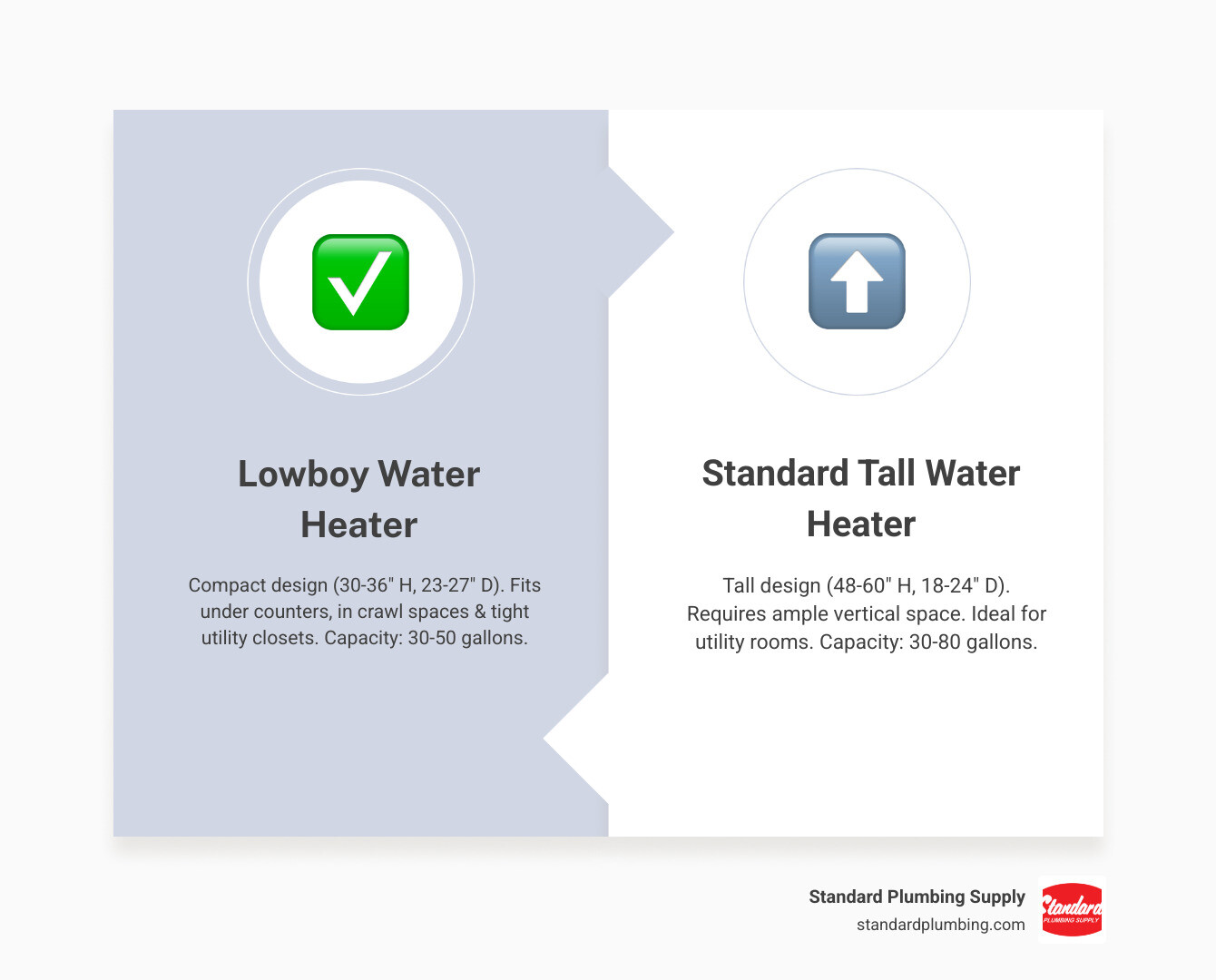
A lowboy water heater is a compact, space-saving water heating unit designed with a short, wide profile—typically 30-36 inches tall—that fits into tight spaces where standard tall water heaters won’t work.
Quick Definition:
- What it is: An electric or gas water heater with a shorter height and wider diameter than standard models
- Typical dimensions: 30-36 inches tall, 23-27 inches in diameter
- Capacity range: 30-50 gallons
- Best for: Under-counter installations, crawl spaces, utility closets, and low-clearance areas
- Key benefit: Provides reliable hot water without requiring the vertical space of traditional tanks
In areas with limited vertical clearance—like basements with low ceilings, tight utility closets, or space under a vanity—traditional tall water heaters simply won’t fit. Lowboy models solve this by delivering the same capacity and performance as standard units but in a different footprint.
Most lowboy water heaters range from 38 to 51 gallons and have top or side water connections for easier installation in confined spaces. Modern models offer impressive energy efficiency ratings (UEF of 0.90-0.93) and include features like dual heating elements, protective tank linings, and automatic sediment-cleaning systems.
I’m Jacob Reese, Vice President of Standard Plumbing Supply. I’ve spent years helping contractors and homeowners select the right lowboy water heater for challenging installation scenarios. From our experience serving thousands of customers across the Western United States, I’ve seen how the right lowboy model can solve tough space constraints while delivering years of reliable service.
What Is a Lowboy Water Heater and Why Choose One?
A standard water heater, or “upright” model, has a tall, narrow profile. While functional for homes with ample utility space, it simply doesn’t fit in areas with limited vertical clearance. This is where the lowboy water heater comes in. It’s engineered with a shorter, wider tank, allowing it to fit into spaces that would otherwise be unusable for hot water storage.
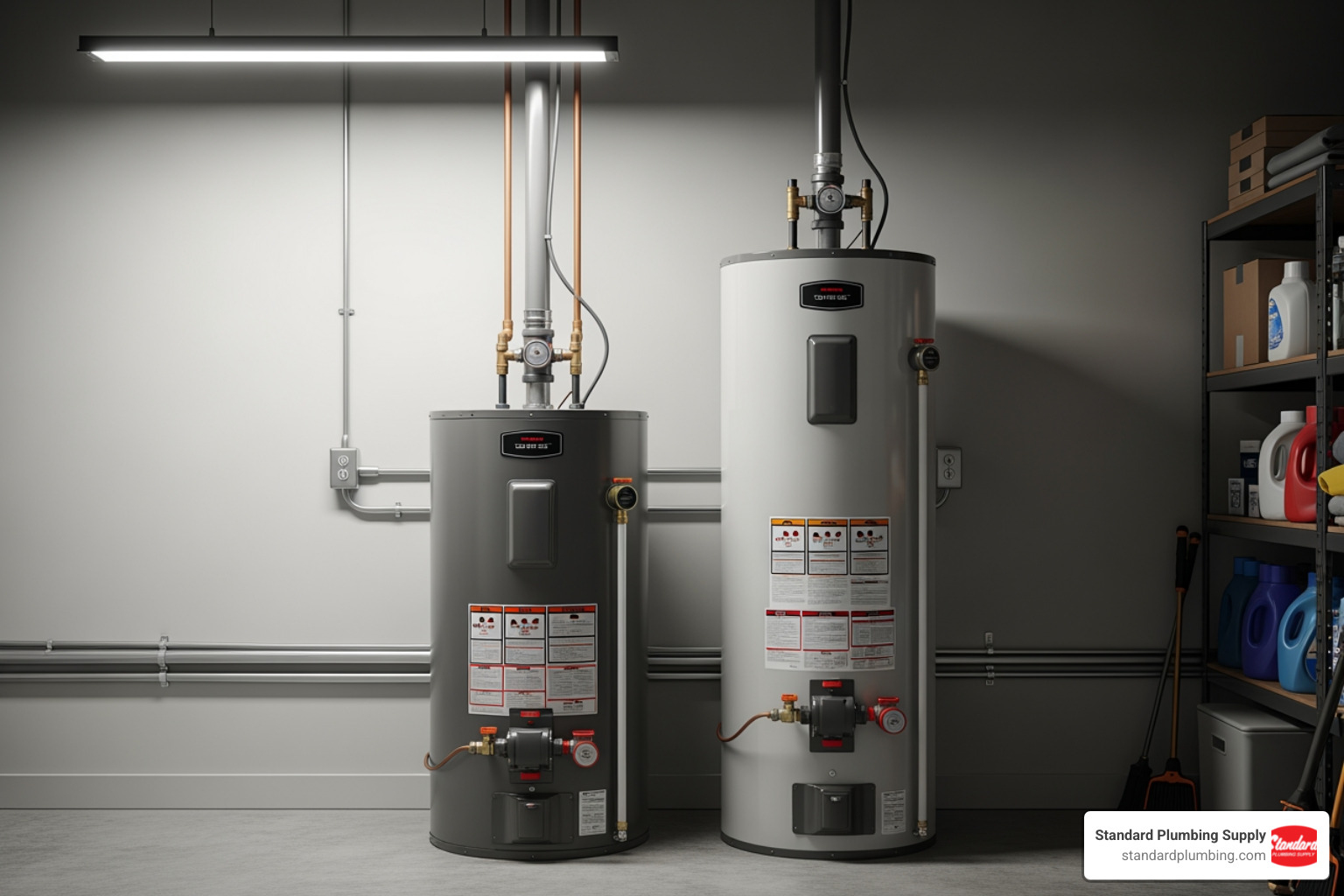
The primary advantage of a lowboy model is its space-saving design. While a standard 50-gallon water heater might stand 60 inches tall, a 50-gallon lowboy could be as short as 34-36 inches. This reduction in height makes all the difference. For instance, the A.O. Smith Signature 100 48-Gallon Lowboy Electric Water Heater (E6-50L45DVB) measures 34 inches high and 26.5 inches in diameter, while the ProLine® 51-Gallon Lowboy Top Connect Electric Water Heater (PNL-50 120) is 36 inches high and 26.5 inches in diameter. These dimensions stand in stark contrast to taller models, providing critical flexibility.
Choosing a lowboy water heater means you don’t have to compromise on hot water capacity just because you have limited space. You can often get the same amount of hot water as a standard unit, but in a footprint that works for your home. This installation flexibility is a game-changer for homeowners in states like Arizona, California, and Utah, where diverse housing styles often present unique spatial challenges.
Here’s a quick comparison to illustrate the difference:
| Feature | Lowboy Water Heater | Standard (Upright) Water Heater |
|---|---|---|
| Dimensions | Shorter height (approx. 30-36 inches), wider diameter (approx. 23-27 inches) | Taller height (approx. 48-60 inches), narrower diameter (approx. 18-24 inches) |
| Ideal Locations | Under counters, crawl spaces, utility closets, cabinets | Basements, dedicated utility rooms, garages with vertical clearance |
| Capacity Range | Typically 30-50 gallons | Typically 30-80+ gallons |
| Key Benefit | Maximizes hot water in minimal vertical space | Maximizes capacity for footprint, standard choice |
Ideal Applications and Locations
The versatility of the lowboy water heater makes it ideal for tight spaces, providing reliable hot water where conventional units can’t go.
Some of the most common installation locations for lowboy models include:
- Crawl Spaces: Many homes, especially older ones or those on raised foundations, have crawl spaces. A lowboy can be installed here, keeping it out of sight and preserving living space.
- Under Counters: Perfect for kitchens or large bathrooms where a standard water heater would disrupt aesthetics or take up valuable cabinet space.
- Utility Closets: A lowboy fits snugly into narrow closets with low ceilings, making efficient use of every inch.
- Apartments and Condos: Lowboys are excellent for fitting into small closets or utility areas in multi-family dwellings, ensuring residents have hot water without sacrificing living space.
- Garages and Workshops: If you need hot water in a detached garage or workshop with limited vertical space, a lowboy is an ideal solution.
- Small Homes or Mobile Homes: For smaller residences, a lowboy minimizes the footprint required for your hot water system.
Bradford White, for instance, explicitly states that their lowboy electric water heaters are “designed to fit in tight spaces, such as under counters, in crawl spaces, or inside cabinets.” This highlights their specific purpose.
For more information on various residential water heating options, you can always check out our resources on residential water heaters.
Key Features to Consider in a Modern Lowboy Water Heater
A modern lowboy water heater is more than its compact size; its technology and construction ensure efficient, reliable hot water for years. Most lowboy models available today are electric, offering convenience and performance that can be installed virtually anywhere electricity is available.
Sizing Your Lowboy Water Heater for Your Household
Choosing the right size lowboy water heater is crucial to meet your household’s hot water needs without being inefficient. We typically determine this based on your household size and “First Hour Delivery” (FHR).
The FHR is the number of gallons of hot water the heater can supply in one hour, starting with a full tank. This includes the tank’s capacity plus what the heating elements can produce in that hour.
Here’s a general guide based on common lowboy capacities:
- 30-38 Gallons: Ideal for households with 1-3 people. For example, the A.O. Smith Signature 100 38-Gallon Lowboy Electric Water Heater (E6-40L45DVB-TTP) is designed for 2-3 people and has a first-hour delivery of 51 gallons. Similarly, the ProLine® 38-Gallon Lowboy Side-Connect Electric Water Heater has an FHR of 38 gallons.
- 40-50 Gallons: Suitable for households with 3-4 people. The A.O. Smith Signature 100 48-Gallon Lowboy Electric Water Heater (E6-50L45DVB) delivers a robust 60 gallons in the first hour, making it perfect for this size family. The ProLine® 51-Gallon Lowboy Top Connect Electric Water Heater also provides 51 gallons of hot water in the first hour.
When sizing, we also consider the recovery rate (how quickly the heater reheats cold water) and your peak demand (when multiple hot water appliances are used simultaneously). A professional plumbing expert can help you calculate these factors for your needs in states like Nevada or Colorado, ensuring you select a lowboy water heater that’s just right.
Energy Efficiency and Long-Term Savings
Efficiency is a necessity for water heaters, which are significant energy consumers. It impacts your wallet and the environment. When considering a lowboy water heater, its energy efficiency directly impacts your long-term operating costs.
The industry standard for measuring efficiency is the Uniform Energy Factor (UEF). A higher UEF rating indicates greater efficiency and lower energy bills. Modern lowboy models have excellent UEF ratings, typically ranging from 0.90 to 0.93.
Let’s look at some examples:
- The A.O. Smith Signature 100 38-Gallon Lowboy Electric Water Heater (E6-40L45DVB-TTP) boasts a UEF of 0.92.
- The A.O. Smith Signature 100 48-Gallon Lowboy Electric Water Heater (E6-50L45DVB) has a UEF of 0.93.
- The ProLine® 51-Gallon Lowboy Top Connect Electric Water Heater (PNL-50 120) also achieves a UEF of 0.92.
- The ProLine® 38-Gallon Lowboy Side-Connect Electric Water Heater has a UEF of 0.90 or 0.91 depending on the model.
A higher UEF means less wasted energy and lower utility bills. For instance, one A.O. Smith 38-gallon model had an estimated annual energy cost of $573/year, but with high UEF models, these costs can be minimized.
Manufacturers achieve these efficiency levels through several key features:
- Non-CFC Polyurethane Foam Insulation: This dense insulation dramatically reduces heat loss from the tank, keeping water hotter for longer.
- Factory-Installed Heat Trap Nipples: These devices prevent unnecessary heat loss through the water pipes.
By investing in a lowboy water heater with a high UEF, you’re getting smart hot water that helps reduce your carbon footprint and save on energy bills. This is particularly valuable in regions like Arizona or Nevada, where energy costs can fluctuate.
Durability and Performance Technology
A lowboy water heater should be a reliable workhorse. This reliability comes from the durability and performance technology built into these compact units. Manufacturers have packed these smaller tanks with features designed to maximize lifespan and efficiency.
Key technologies to look for include:
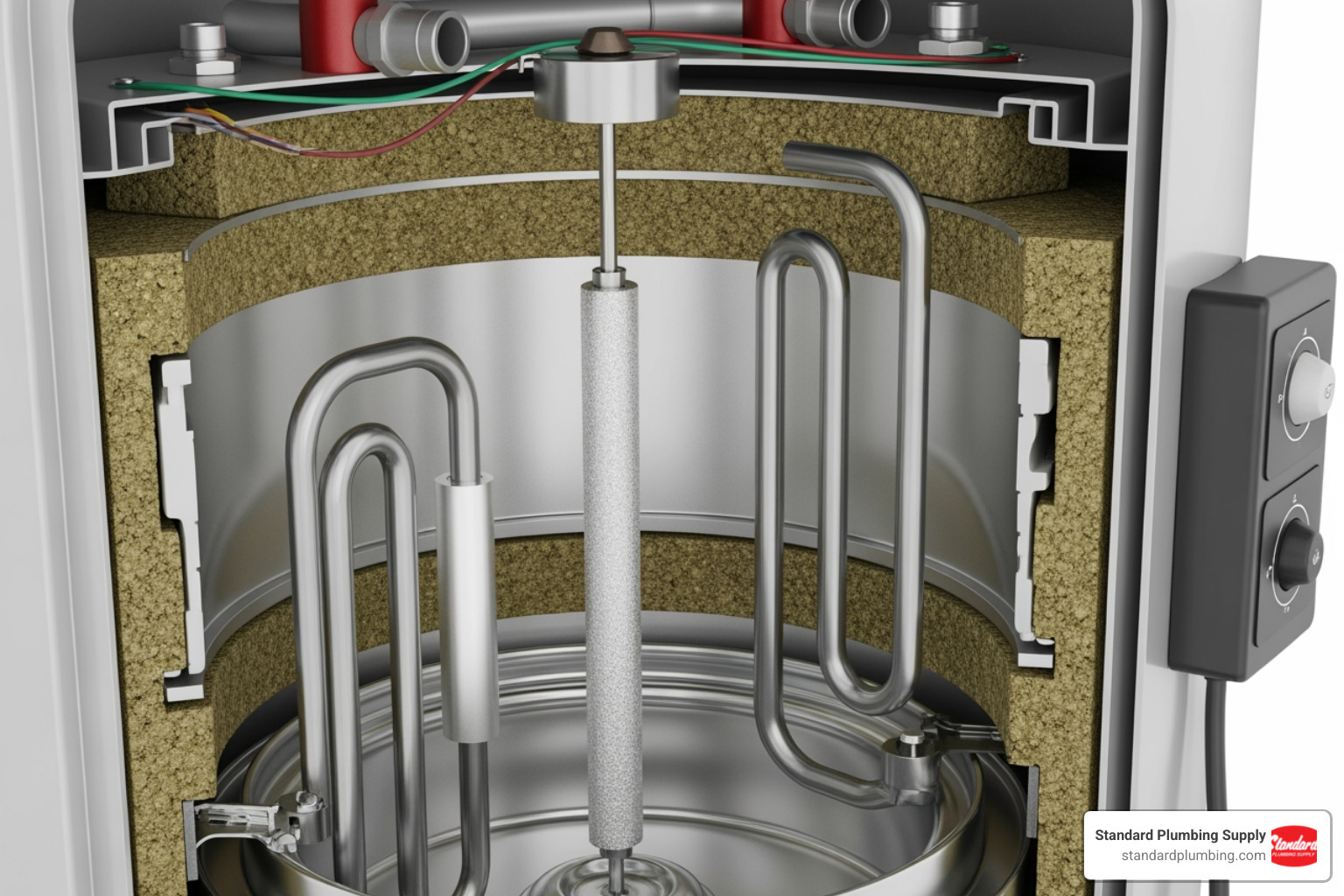
- Powerful Heating Elements: Many electric lowboys feature dual 4,500-watt heating elements for rapid heating. For example, the A.O. Smith Signature 100 48-Gallon Lowboy uses two 4,500-watt copper elements. Some models, like the ProLine® 51-Gallon Lowboy, boast “commercial-grade” elements for improved durability. Lower Incoloy™ stainless steel elements are also used for longevity, as the lower element is more susceptible to sediment buildup.
- Advanced Tank Linings: The tank’s interior is the first defense against corrosion, the leading cause of water heater failure. Manufacturers use specialized linings:
- Vitraglas® Tank Lining: Bradford White’s Vitraglas® lining is fused to the steel surface at over 1600°F, creating a tough layer. Some include Microban® antimicrobial protection to prevent bacterial growth on the lining.
- Blue Diamond® Glass Lining / Ceramic Fused Tank Shield: A.O. Smith and ProLine models feature patented Blue Diamond® glass lining or ceramic fused tank shields for superior corrosion protection.
- Sacrificial Anode Rods: Every tank water heater needs an anode rod. This “sacrificial” rod attracts corrosive elements in the water, protecting the tank. High-quality models from A.O. Smith and ProLine often incorporate stainless steel CoreGard™ anode rods, designed for longer corrosion protection.
- Sediment Reduction Systems: Sediment buildup reduces efficiency and shortens the water heater’s lifespan. To combat this, modern lowboys incorporate:
- Hydrojet® Total Performance System: Found in Bradford White models, this system helps reduce sediment accumulation.
- DynaClean™ Automatic Sediment-Cleaning System: ProLine models feature this system to protect against sediment buildup.
- Self-Cleaning Dip Tubes: A.O. Smith models often include a self-cleaning dip tube that creates turbulence to minimize sediment.
These features mean a modern lowboy water heater delivers robust performance and lasting reliability, even in areas with demanding water conditions like Utah or Arizona.
Installation and Maintenance Essentials
Proper installation and maintenance are key to your lowboy water heater’s long life and efficient operation. While its compact size is ideal for tight spots, the installation still requires careful attention to safety standards.
Given the electrical and plumbing work, professional installation is a smart investment in safety and longevity for most homeowners.
Installation Best Practices for a lowboy water heater
Installing a lowboy water heater involves critical plumbing and electrical work that requires a qualified professional. This ensures safety, efficiency, and compliance with local building codes, which vary across states like California, Oregon, or Wyoming.
Here are important considerations:
- Plumbing Connections (Top vs. Side): Many lowboys have top water connections, which can ease installation. However, some models, like certain ProLine lowboys, feature side-mounted connections with an option for field conversion to top-mounted for maximum flexibility. A professional will assess the best configuration for your space.
- Electrical Requirements: Electric lowboys typically require a dedicated 240V circuit. Ensuring your home’s electrical system can support this and that the wiring is correctly installed is paramount for safety.
- Temperature & Pressure (T&P) Relief Valve: This crucial safety device releases water if the tank’s temperature or pressure exceeds safe limits. It must be properly installed and discharged to a suitable drain. All lowboys come with a factory-installed T&P valve that must be correctly plumbed.
- Drain Pan: A drain pan is often required underneath the water heater, especially if a leak could cause damage (e.g., inside a cabinet). This pan collects leaks and directs them to a drain, preventing water damage.
- Local Building Codes and Regulations: A licensed plumber will be familiar with all local regulations in areas like Salt Lake City, Boise, or Phoenix, ensuring your installation is compliant and passes inspection.
We highly recommend working with a skilled professional. If you’re looking for expert assistance, we can help you find a plumbing professional in your area who understands lowboy water heater installations.
Lifespan, Warranty, and Routine Maintenance
Like any major appliance, a lowboy water heater requires care. Understanding its lifespan, warranty, and maintenance needs helps maximize your investment and ensure a consistent supply of hot water.
- Typical Lifespan: A well-maintained lowboy water heater typically lasts 6 to 12 years. Water quality, usage, and maintenance schedules can significantly impact this range.
- Warranty Coverage: Most lowboys come with a 6-year limited warranty on the tank and parts, which is offered by brands like A.O. Smith and ProLine. Some higher-end units might extend this to a 10-year limited tank and parts warranty, indicating greater durability. Labor warranties are usually separate and run for 1 year. Always review the specific warranty guide for your model. You can often explore warranty extension options for extra peace of mind.
- Routine Maintenance: Simple, regular maintenance can dramatically extend your water heater’s life and efficiency:
- Annual Tank Flushing: Flushing the tank annually removes mineral deposits, which improves efficiency and prevents premature wear.
- Checking the Anode Rod: The sacrificial anode rod protects your tank from corrosion. It should be inspected every 3-5 years (more frequently in hard water areas) and replaced when depleted.
- Testing the T&P Valve: The Temperature and Pressure (T&P) relief valve is a critical safety device. Test it annually by lifting the lever to ensure it operates correctly. If it fails to open or close properly, it needs replacement.
By following these maintenance tips, you can ensure your lowboy water heater provides efficient and reliable hot water for its full expected lifespan.
Frequently Asked Questions
Here are answers to common questions about the lowboy water heater to help you make an informed decision.
What are the pros and cons of an electric lowboy water heater?
Electric lowboy water heaters are popular for their versatility and efficiency. Here’s a look at their pros and cons:
Pros:
- Installation Flexibility: Their compact size allows them to fit into tight spaces like under counters, in crawl spaces, or inside cabinets, which is impossible for standard models.
- Space-Saving Design: They free up valuable floor space in utility rooms or garages.
- High Energy Efficiency: Modern electric lowboys have excellent UEF ratings (0.90-0.93), thanks to advanced insulation and heat-trapping technologies, which lowers operating costs.
- Environmentally Friendly (Zero Emissions at Point of Use): Electric water heaters produce zero direct emissions, making them a cleaner choice for indoor air quality.
- Easier Installation in Some Cases: Without the need for gas lines or venting, electric models can be simpler to install where electricity is available.
Cons:
- Reliance on Electricity: An electric lowboy water heater will not work during a power outage.
- Slower Recovery Rate (compared to gas): Gas water heaters typically reheat water more quickly. However, for appropriately sized electric lowboys, this is usually not an issue for typical household use.
- Higher Operating Costs (compared to gas in some regions): Depending on local utility prices, operating an electric water heater can sometimes be more expensive than a gas model, though high UEF ratings help mitigate this.
How do I troubleshoot no hot water?
If you have no hot water from your electric lowboy water heater, check these common issues before calling a professional:
- Check the Circuit Breaker: The most common culprit is a tripped breaker. Go to your electrical panel, find the breaker for your water heater, and flip it completely OFF, then back ON.
- Reset the High-Temperature Cutoff Switch: Electric water heaters have a safety cutoff switch (often a red button labeled ECO). If the water gets too hot, this switch trips. Turn off power at the breaker, remove the access panel on the heater, and press the red button. If it keeps tripping, call a professional.
- Inspect Heating Elements: If the above steps don’t work, one or both heating elements may have failed. This requires a multimeter to test and should be done by a qualified technician.
If these basic steps don’t restore hot water, it’s time to call a licensed plumber or electrician.
Can I install a lowboy water heater myself?
While some homeowners are experienced DIYers, we strongly advise against installing a lowboy water heater yourself.
Here’s why professional installation is crucial:
- Electrical and Plumbing Safety: Water heaters involve high voltage electricity (240V) and pressurized water lines. Incorrect work can lead to fires, electrocution, or major water damage.
- Code Compliance: Local building codes for water heater installation must be followed. A professional plumber ensures your installation is legal and safe. Non-compliant work can cause issues with home insurance or resale.
- Warranty Considerations: Many manufacturers’ warranties are voided if the unit is not installed by a licensed professional. Don’t risk losing a 6- or 10-year warranty to save money upfront.
- Proper Sizing and Venting (for gas models): While most lowboys are electric, any gas model requires critical attention to gas line connections and ventilation to prevent hazards like carbon monoxide poisoning.
For these reasons, we always recommend hiring a licensed and insured plumbing professional for any water heater installation.
Conclusion
The lowboy water heater is an intelligent solution for homes with limited space. Its compact design allows it to fit where traditional tall heaters can’t, such as under counters and in crawl spaces. This space-saving design offers comparable capacity and high energy efficiency, with UEF ratings often between 0.90 and 0.93.
We’ve also dug into the key features that define a quality lowboy, like robust heating elements, advanced tank linings, and sediment reduction systems. These technologies ensure a durable, high-performing unit that provides reliable hot water for years.
We’ve emphasized that professional installation is crucial for safety, code compliance, and warranty protection. With routine maintenance, your lowboy will serve your household efficiently for its full lifespan.
At Standard Plumbing Supply, we understand the diverse needs of homeowners across the Western United States. We believe the right lowboy water heater transforms a spatial constraint into an efficient hot water solution. It’s a smart choice for anyone who needs reliable hot water without sacrificing precious space.
Ready to explore your options and find the perfect lowboy water heater for your home? Browse our full catalog of water heating solutions or connect with one of our experts today!
