
The Right Bathroom Lavatory Faucets Make All the Difference
Bathroom lavatory faucets are one of the fastest, most affordable ways to refresh your bathroom’s look and improve its function.
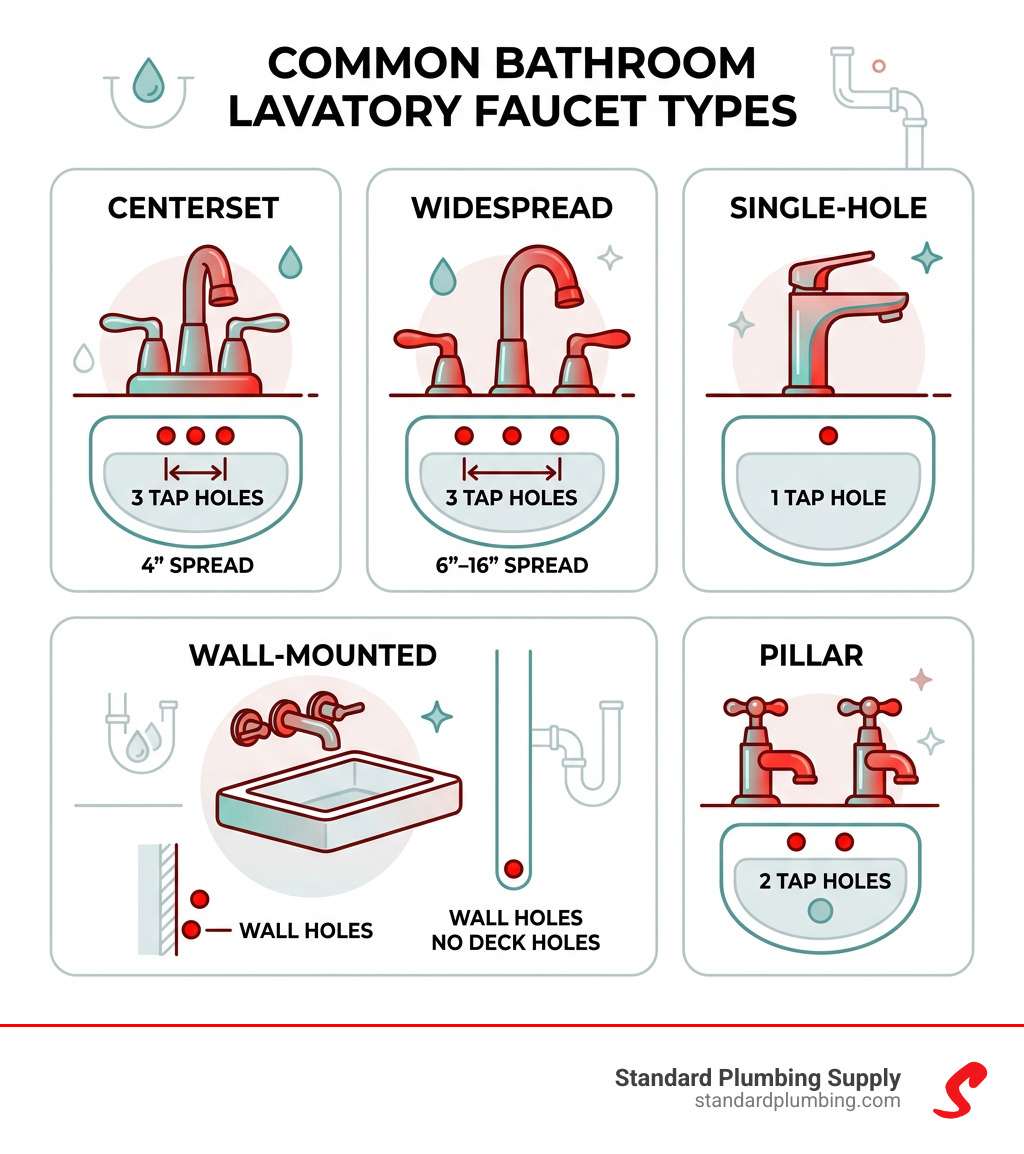
Here’s a quick overview of the most popular types to help you find the right fit:
| Faucet Type | Best For | Tap Holes Needed |
|---|---|---|
| Centerset | Standard vanities, everyday use | 1 or 3 (4″ spread) |
| Widespread | Larger vanities, custom countertops | 3 (6″–16″ spread) |
| Single-hole | Compact basins, modern style | 1 |
| Wall-mounted | Vessel sinks, minimalist bathrooms | Wall (no deck holes) |
| Pillar/separate | Traditional or low-pressure systems | 2 |
Beyond style, the right faucet also affects your water bill, ease of cleaning, and how long your fixture lasts. Modern faucets can cut water use by up to 40% compared to conventional models — a real win for both the environment and your wallet.
Whether you’re a contractor sourcing product for a client or a DIYer upgrading your own vanity, this guide covers everything you need to choose confidently.
I’m Jacob Reese, Vice President of Standard Plumbing Supply and a third-generation leader in our family’s wholesale plumbing business — I’ve spent my career helping contractors and homeowners find the right bathroom lavatory faucets for every project and budget. Let’s get into what matters most so you can make the right call the first time.
Essential Types of Bathroom Lavatory Faucets
When you begin your search for the perfect bathroom lavatory faucets, the sheer number of options can feel a bit like trying to drink from a fire hose. But don’t worry—once you break them down by how they mount and how they function, the choice becomes much clearer.
Mono Mixers and Single-Handle Faucets

The mono mixer is the undisputed king of the modern bathroom. These faucets use a single lever to control both flow and temperature. They are incredibly user-friendly, especially for children or those with limited mobility, as you can find your “sweet spot” temperature with one hand. If you are looking for a clean, minimalist aesthetic, a single-handle faucet is often the way to go.
Pillar Taps
Pillar taps are the traditional choice, consisting of two separate faucets—one for hot and one for cold. While they offer a classic, vintage look, they require two tap holes in your basin. They are often the best choice for older homes with low-pressure gravity-fed water systems, as they allow for maximum flow from each pipe.
Widespread vs. Centerset
These are the two most common configurations for multi-hole sinks.
- Widespread Faucets: These consist of three separate pieces: the hot handle, the cold handle, and the spout. They are typically spaced 8 to 16 inches apart. This setup offers a high-end, custom look and makes cleaning the deck between the components much easier. More info about widespread faucets can help you decide if this luxury style fits your vanity.
- Centerset Faucets: These have the handles and spout all mounted on a single base plate. They are designed for sinks with three holes drilled 4 inches apart (measured from the center of the outer holes). They are compact, budget-friendly, and very common in standard residential bathrooms. You can find more info about centerset faucets to see if they match your existing sink.
Mounting Styles: Deck, Wall, and Freestanding
- Deck-Mounted: The standard choice where the faucet sits directly on the sink rim or the countertop.
- Wall-Mounted: These are installed into the wall behind the sink. They provide a stunning, “floating” look and are perfect for vessel sinks (the ones that sit on top of the counter like a bowl). They also keep your countertops completely clear, making wipe-downs a breeze.
- Freestanding: Usually reserved for bathtubs, these floor-mounted faucets stand tall beside the tub, creating a spa-like focal point in larger bathrooms.
Selecting Bathroom Lavatory Faucets for High and Low Pressure Systems
One of the most common mistakes we see is choosing a faucet based purely on looks without checking the home’s water pressure. If you have a gravity-fed system (common in older multi-story homes), you might have “low pressure.” Installing a high-pressure mixer on a low-pressure system will result in a disappointing, weak trickle.
Always check the minimum bar requirements. Pillar taps usually handle low pressure well, while many modern “waterfall” or high-rise mixers require at least 1.0 bar to function correctly. If you’re unsure, you can consult with our experts regarding how certain models perform under different pressure conditions, though we always recommend visiting one of our SPS locations in Utah, Arizona, or Nevada to be sure.
Space-Saving Bathroom Lavatory Faucets for Small Ensuites
Not every bathroom is a sprawling master suite. For cloakrooms, powder rooms, or compact ensuites, every inch counts. This is where “mini” or “cloakroom” taps shine. These are scaled-down versions of standard mixers with a shorter “projection” (the distance the spout reaches into the sink).
Pairing a compact basin tap with a corner basin or a narrow vanity can make a small space feel much more functional. You can explore faucets and bathroom sink options at Standard Plumbing Supply to find dimensions that fit your specific layout.
Trending Finishes and Modern Aesthetics
The finish of your bathroom lavatory faucets is the “jewelry” of the room. While chrome remains the most popular choice due to its durability and classic shine, new trends are taking over.
- Matte Black: This is the current “it” finish for modern and industrial designs. Its bold, sophisticated, and surprisingly easy to keep clean if it has a quality coating. Check out more info about matte black finishes to see how they pop against white porcelain.
- Brushed Brass and Gold: For a touch of warmth and luxury, brushed brass is making a massive comeback. Unlike the shiny brass of the 80s, modern brushed finishes are subtle and elegant.
- Polished Nickel: This finish has a warmer, slightly golden undertone compared to the cool blue of chrome. Its a favorite for transitional bathrooms that bridge the gap between traditional and modern. If you have a vessel sink, more info about polished nickel vessel taps might be exactly what you need.
- Traditional Brass: For those restoring a historic home in places like Salt Lake City or Boise, more info about traditional brass styles can help maintain that authentic period feel.
Pro Tip: Look for finishes with PVD (Physical Vapor Deposition) coating. This process bonds the finish to the metal at a molecular level, making it incredibly resistant to scratches and corrosion. If you want a deeper dive into the coating itself, heres a helpful overview of physical vapor deposition.
Innovative Features in Modern Bathroom Lavatory Faucets
Modern technology has turned the humble tap into a high-performance machine.
- MinusFlow and WaterSense: Brands like Duravit have introduced MinusFlow technology, which can limit water consumption to less than 3.5 liters per minute (about 1 gpm). This achieves up to 40% water savings without sacrificing the feel of the water pressure. Many of our water-saving vessel faucets meet these strict EPA WaterSense criteria.
- Cold-Start Technology: This is a brilliant energy saver. In standard mixers, the “middle” position draws a mix of hot and cold water. Cold-start faucets default to 100% cold water in the center position, meaning your water heater doesn’t kick on unnecessarily when you’re just rinsing a toothbrush.
- Ceramic Disc Valves: Forget the old rubber washers that leak after a year. Modern faucets use diamond-hard ceramic discs that provide a watertight seal for decades.
- Infrared Sensors: Once reserved for airports, touchless faucets are becoming popular in homes for hygiene and water conservation.
- Adjustable Stream: Features like Duravits AquaControl allow you to adjust the angle of the water stream by up to 20 degrees, preventing splashing in shallow basins. For unique installations, more info about wall-mounted lever faucets can show you how lever control integrates with modern spout tech.
Installation and Compatibility Guide
Before you fall in love with a specific model, you need to make sure it actually fits your sink.
The “Hole” Truth
The most critical factor is the number of tap holes in your basin or countertop.
- Single Hole: Best for mono mixers.
- Three Holes (4-inch centers): Standard for centerset faucets.
- Three Holes (8-inch+ centers): Required for widespread faucets.
If you have a pedestal sink, like the Kohler Memoirs pedestal sink top, you must match the faucet to the pre-drilled 8-inch centers.
DIY vs. Professional Installation
Can you do it yourself? If you’re replacing a deck-mounted faucet with a similar model, it’s a very manageable DIY project. You’ll need a basin wrench, some plumber’s tape, and a bit of patience.
However, if you are moving from deck-mounted to wall-mounted, or installing a widespread bathroom set for the first time, you’ll likely need to move pipework behind the wall. In these cases, or if you’re dealing with high-end freestanding fillers, we strongly recommend hiring a professional plumber.
Compliance Matters
In our service areas—from California to Nebraska—compliance is key. Ensure your faucet is ADA compliant if accessibility is a priority, and look for low-lead certification to ensure your drinking water stays safe.
Maintenance and Long-Term Care
A high-quality faucet should last you 15 to 20 years, but only if you treat it right.
Finish Protection
The golden rule: Avoid harsh chemicals. Bleach and abrasive scouring pads can ruin a matte black or brushed brass finish in seconds. For most finishes, including durable chrome mixers, all you need is warm soapy water and a soft microfiber cloth.
Limescale Removal
If you live in an area with hard water (common in many of our Utah and Arizona locations), limescale is your enemy. It can clog aerators and stiffen handles.
- Aerators: Unscrew the aerator at the tip of the spout every few months and soak it in white vinegar to dissolve mineral buildup.
- Cartridges: If your faucet starts to drip, you don’t usually need a whole new faucet. You likely just need a replacement part or a new ceramic cartridge.
Frequently Asked Questions about Bathroom Taps
Can I install a wall-mounted tap on any basin?
Not necessarily. Wall-mounted taps require a basin without pre-drilled tap holes (or a way to cover them) and a spout long enough to reach comfortably over the sink. You also need to ensure there is enough space behind the wall for the valve and plumbing.
How do I know if my water pressure is high or low?
If you have a cold water tank in your attic and your shower feels weak, you likely have a low-pressure (gravity-fed) system. If you have a combi-boiler or an unvented cylinder, you likely have high pressure. You can buy a simple pressure gauge to test this, or ask one of our experts at an SPS store locator near you.
What is the benefit of a ceramic disc tap?
Unlike traditional rubber washers that wear out and cause leaks, ceramic discs are nearly diamond-hard. They require only a 1/4 turn to go from off to full flow, making them easier to use and much more durable over time.
Conclusion
Choosing the right bathroom lavatory faucets is about finding the perfect intersection of style, compatibility, and conservation. Whether you are looking for the water-saving benefits of MinusFlow technology or the bold aesthetic of a matte black widespread set, the right choice will serve you for decades.
At Standard Plumbing Supply, we’ve been helping the West build better bathrooms since 1952. With locations across nine states—from the sunny shores of San Diego to the snowy peaks of Jackson, Wyoming—we have the inventory and the expertise to help you get the job done right.
Ready to upgrade? Browse the full catalog of bathroom solutions or visit one of our showrooms today to see these stunning fixtures in person. Don’t let your bathroom’s potential go down the drain—tap into a better style today!
