
The Right Fit: What You Need to Know About 1 Inch PVC Pipe Connectors
1 inch PVC pipe connectors are one of the most widely used fittings in residential and commercial plumbing, irrigation, and DIY projects. Here’s a quick breakdown of what’s available:
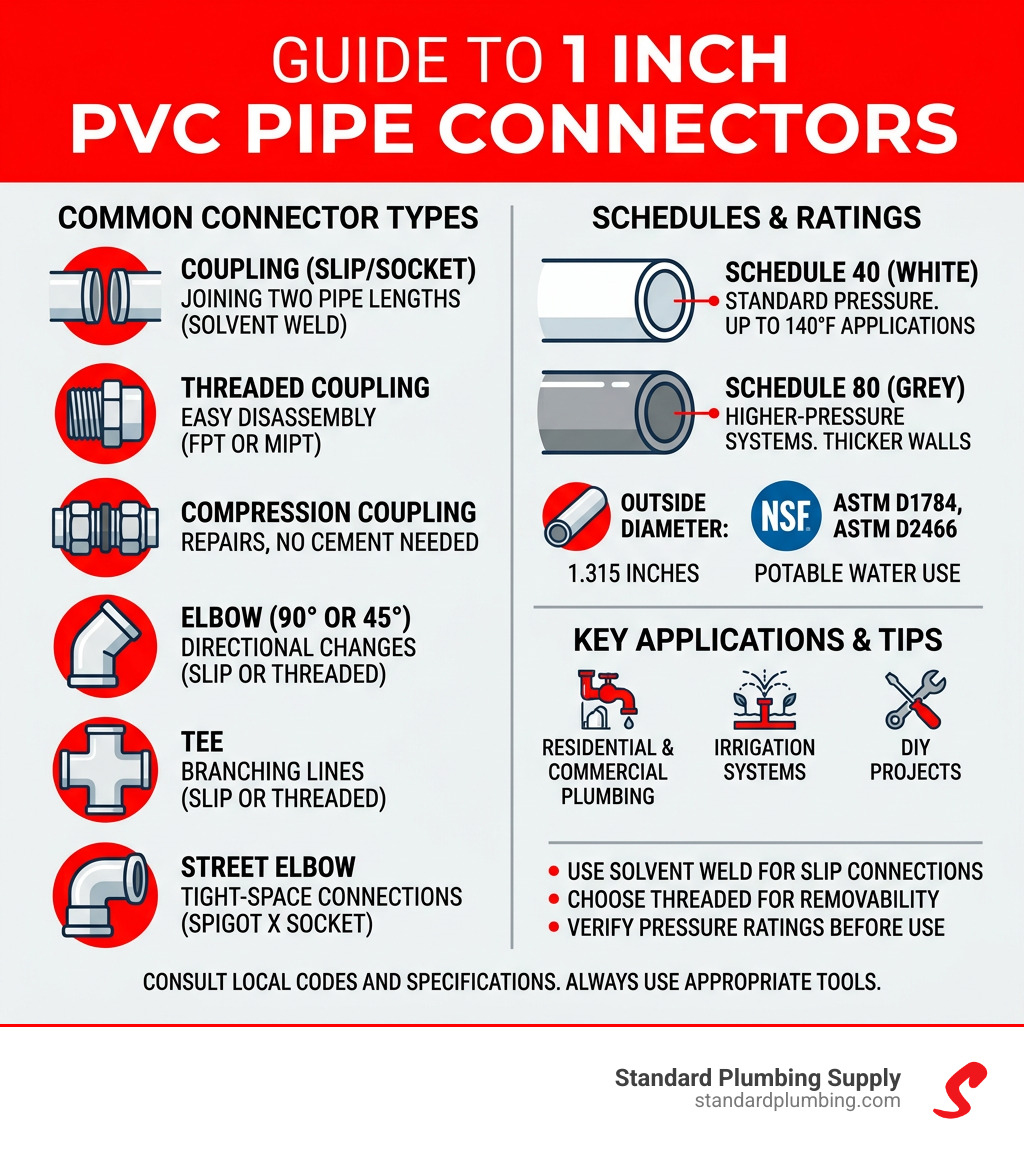
Most common types of 1-inch PVC connectors:
| Type | Connection Style | Best For |
|---|---|---|
| Coupling (slip/socket) | Solvent weld | Joining two pipe lengths |
| Threaded coupling | FPT or MIPT | Easy disassembly, threaded systems |
| Compression coupling | Gasket seal | Repairs, no cement needed |
| Elbow (90° or 45°) | Slip or threaded | Directional changes |
| Tee | Slip or threaded | Branching lines |
| Street elbow | Spigot x socket | Tight-space connections |
Key facts to know before you buy:
- Schedule 40 (white) handles standard pressure up to 140°F
- Schedule 80 (grey) has thicker walls for higher-pressure systems
- The actual outside diameter of 1-inch PVC pipe is 1.315 inches
- Look for NSF, ASTM D1784, and ASTM D2466 certifications for potable water use
- Prices range from under $1 for basic slip couplings to several dollars for specialty fittings
Whether you’re fixing a broken irrigation line, roughing in a plumbing system, or building a DIY project, the right connector makes all the difference.
I’m Jacob Reese, Vice President of Standard Plumbing Supply and a third-generation wholesale distributor — I’ve spent my career helping contractors and tradespeople source the right 1 inch PVC pipe connectors for every application imaginable. In this guide, I’ll walk you through everything you need to choose, compare, and install the best fittings for your job.
Quick 1 inch pvc pipe connectors terms:
Comparing Common 1 Inch PVC Pipe Connectors
When you walk into one of our stores in Utah, Idaho, or Arizona, you’ll see shelves lined with a dizzying array of 1 inch pvc pipe connectors. Choosing the right one depends entirely on how you plan to join the pipes.
Slip (Socket) vs. Threaded vs. Compression
The most fundamental choice is the connection method. Slip fittings, also known as socket fittings, are designed for “solvent welding.” You apply a primer and cement, slide the pipe into the fitting, and the two pieces chemically bond into one. A great example of a standard utility fitting is the 1-in-hub-retail-echr100, which is a staple for basic plumbing runs.
Threaded connectors, on the other hand, allow for mechanical joining. You’ll see terms like FPT (Female Pipe Thread) and MIPT (Male Iron Pipe Thread). These are essential when you need to connect PVC to metal valves or when you want the ability to take the system apart later without cutting the pipe.
Compression connectors use a gasket and a tightening nut to create a seal. These are lifesavers for repair work where you can’t easily dry the pipe for solvent welding or where there isn’t enough “play” in the line to slide on a traditional coupling.
Directional Fittings: Elbows and Tees
To navigate around corners or obstacles, you’ll need elbows. A 1-pvc-45deg-elbow-ss-417-010 provides a gentle turn, which helps maintain higher flow velocity and reduces the risk of clogs compared to a sharp 90-degree turn.
If you’re working in a tight spot, “street” elbows are your best friend. Unlike standard elbows that have two female ends, a street elbow has one male “spigot” end and one female “socket” end. This allows you to plug it directly into another fitting without needing a small “nipple” piece of pipe in between, saving precious inches of space.
For branching lines, Tees are the standard, while Crosses (four-way connectors) are more common in irrigation manifolds or furniture-grade DIY projects.
Technical Specifications and Standards
In professional plumbing, “close enough” doesn’t cut it. To ensure safety and longevity, 1 inch pvc pipe connectors must meet strict industry standards.
- ASTM D1784: This covers the rigid PVC compounds used to make the fittings.
- ASTM D2466: This is the specific standard for Schedule 40 PVC plastic pipe fittings.
- NSF 61 Certification: If you are running water to a kitchen sink or a drinking fountain, the fitting must be NSF-61 certified. This ensures that no harmful chemicals leach into the potable water supply.
One point of confusion for many DIYers is the actual size. A “1-inch” PVC pipe does not actually measure 1 inch on the outside. The actual outside diameter (OD) is 1.315 inches. Our 1-inch connectors are machined specifically to accommodate this OD, ensuring a snug fit that prevents leaks once the solvent cement is applied.
Performance of Schedule 40 1 Inch PVC Pipe Connectors
Schedule 40 fittings are the “standard” white connectors you see in most homes. They are designed for pressure applications (like your main water line or irrigation system) but have a temperature ceiling of 140°F.
One major advantage of these fittings is their flow efficiency. High-quality Schedule 40 connectors feature smooth interior walls that minimize friction loss. This means your pump doesn’t have to work as hard to move water through the system, which is a major factor in long-term energy savings for irrigation setups.
Durability of Schedule 80 1 Inch PVC Pipe Connectors
If you’re dealing with industrial settings or high-pressure environments, you’ll want to step up to Schedule 80. These are typically grey and have much thicker walls than their Schedule 40 counterparts.
The 1-pvc-tt-coupler-sch80-830-010 is built for heavy-duty use. While Schedule 40 is great for the average backyard, Schedule 80 is what we recommend for commercial pool systems or chemical processing lines. If you’re looking for a smaller transition in a high-pressure line, something like the 1-2-pvc-ss-cplr-sch80-829-005 provides that extra wall thickness needed to handle the stress.
Specialty Connectors and Repair Solutions
Sometimes a standard coupling isn’t enough. Maybe you’re building a dog agility course, or perhaps a tree root just cracked your main irrigation line.
Furniture Grade PVC
For DIYers, “Furniture Grade” PVC is a game-changer. Unlike plumbing-grade PVC, these fittings are UV-resistant, meaning they won’t turn brittle or yellow under the sun. They also lack the unsightly manufacturer markings found on plumbing pipe and come in various colors. However, a word of caution: never use furniture-grade PVC for pressurized water lines. They aren’t rated for it.
The Magic of Repair Couplings
If you’ve ever tried to repair a buried pipe, you know the struggle of getting enough movement to slide a coupling on. This is where the 1-ips-pvc-compression-coupler-n-110-10 shines. You can slide it over one end, align the pipes, and tighten the nuts to create a 330 PSI-rated seal (at 73°F).
For even more flexibility, the 4-slip-fix-pvc-repair-coupler-n-118-40 acts like a telescope. You can compress it to fit into a gap in the pipe and then extend it to lock the connection in place. It’s an essential tool to keep in your truck if you do a lot of irrigation work.
Best Practices for Installation
A fitting is only as good as the person installing it. At Standard Plumbing Supply, we see a lot of “failed” fittings that were actually just installed poorly. Here is the pro-approved workflow:
- Cut and Deburr: Use a PVC cutter for a square cut. Use a deburring tool or sandpaper to remove the “burrs” (little plastic flakes) from the edge. If you don’t, those flakes can get caught in the cement and create a leak path.
- Dry Fit: Always check the fit before applying cement. The pipe should go about 1/3 to 1/2 of the way into the fitting socket without force.
- Clean and Prime: Use a dedicated PVC primer. It softens the plastic, allowing the cement to bite deeper.
- Cement Quickly: Apply a thin layer of cement to the fitting and a thicker layer to the pipe. Don’t dawdle—PVC cement sets fast.
- Push and Twist: Push the pipe into the fitting and give it a quarter-turn. This ensures the cement is spread evenly. Hold it for 30 seconds to prevent the pipe from “pushing out” of the socket.
If you need to change sizes, use a bushing. For example, the 1-x-3-4-pvc-ss-bushing-837-131 allows you to drop from a 1-inch line to a 3/4-inch line. If you’re coming from a larger 1.5-inch main, the 1-1-2-x-1-pvc-ss-bushing-437-2-437-211 is the perfect adapter.
Frequently Asked Questions about 1 Inch PVC Connectors
What is the actual outside diameter of a 1-inch PVC connector?
As mentioned earlier, the nominal “1-inch” size refers to the internal flow capacity, not the physical measurement. The actual outside diameter of the pipe it connects to is 1.315 inches. The connector itself will have an outside diameter closer to 1-5/8 inches to account for the wall thickness.
Can I use furniture-grade PVC connectors for pressurized plumbing?
No. While furniture-grade PVC looks great and is very strong, it is not pressure-tested or NSF-certified for potable water. Using it in a plumbing system could lead to catastrophic bursts and potential chemical contamination of your water.
Are 1-inch PVC connectors suitable for hot water lines?
Standard PVC (Schedule 40 and 80) is only rated for temperatures up to 140°F. This makes it unsuitable for most indoor hot water lines (which can reach 120°F-140°F at the heater but require a safety margin). For hot water applications, you should use CPVC (Chlorinated Polyvinyl Chloride), which is usually tan-colored and rated for higher temperatures.
Conclusion
At Standard Plumbing Supply, we pride ourselves on being more than just a store—we’re your partner in getting the job done right. Whether you need a single coupling for a weekend repair or a pallet of Schedule 80 fittings for a municipal project, we’ve got you covered across our locations in Utah, Idaho, California, and beyond.
We offer competitive bulk pricing and specialized contractor discounts to help keep your project under budget. If you’re not sure exactly which of the hundreds of 1 inch pvc pipe connectors you need, just stop by one of our stores in cities like Salt Lake, Boise, Phoenix, or Riverside. Our experts are always ready to help you find the perfect fit.
