
Why Choosing the Right Cooling Heating Unit Matters for Your Home
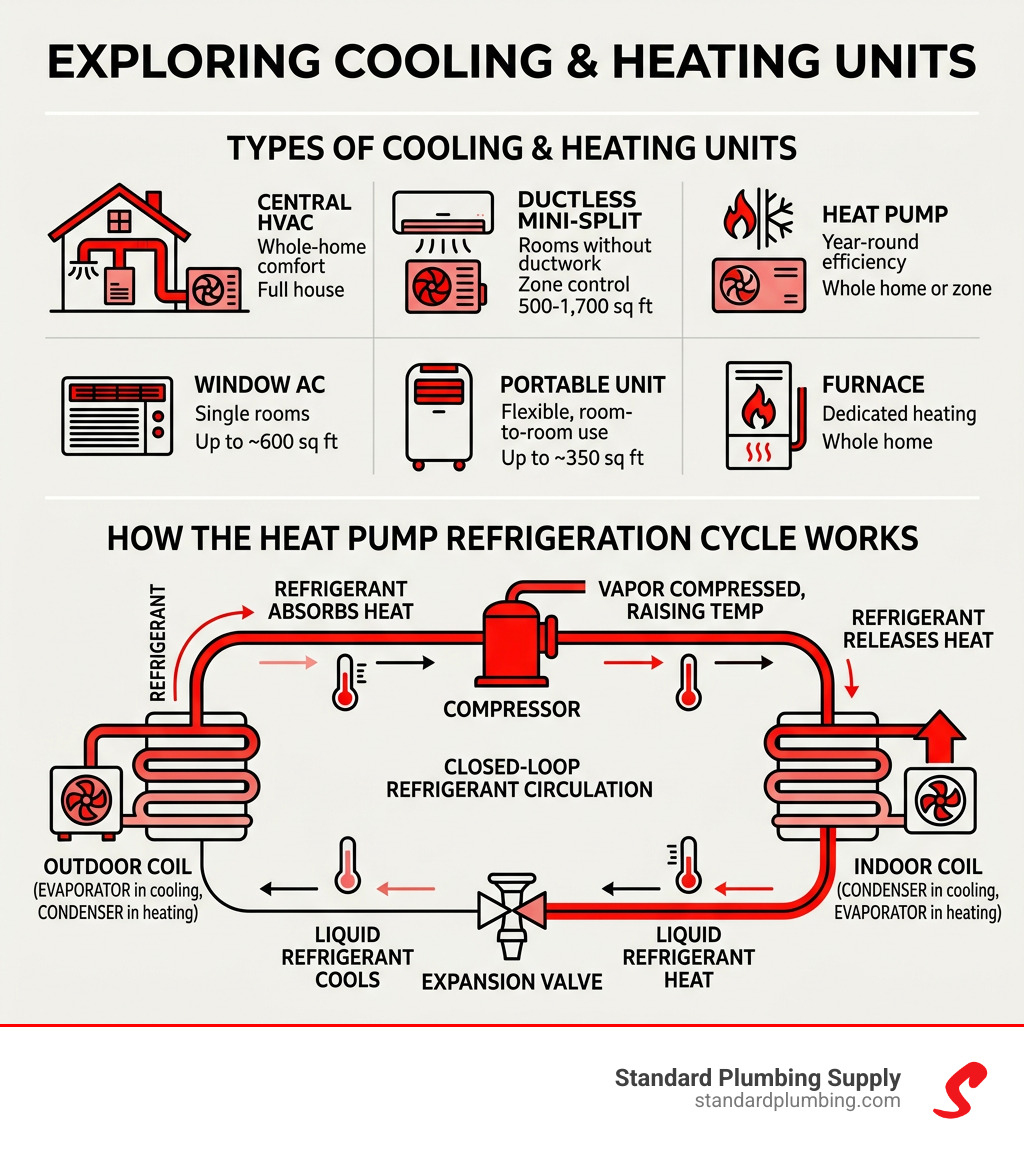
A cooling heating unit is any system that controls the temperature in your home — keeping you warm in winter and cool in summer. Here’s a quick look at the most common types:
| Unit Type | Best For | Typical Coverage |
|---|---|---|
| Central HVAC | Whole-home comfort | Full house |
| Ductless mini-split | Rooms without ductwork | 500–1,700 sq ft |
| Heat pump | Year-round heating & cooling | Whole home or zone |
| Window AC | Single rooms | Up to ~600 sq ft |
| Portable AC/heater | Flexible, room-to-room use | Up to ~350 sq ft |
| Furnace | Dedicated heating | Whole home |
Heating and cooling account for a significant portion of your home’s energy use. Getting the wrong unit — wrong size, wrong type, wrong efficiency rating — costs you money every single month.
The good news: there’s a right unit for almost every situation. Whether you’re retrofitting an older home, replacing a failing furnace, or adding comfort to a room your central system can’t reach, the options have never been better or more efficient.
I’m Jacob Reese, VP of Standard Plumbing Supply and a third-generation HVAC and plumbing supply professional — I’ve spent years helping contractors and DIYers find the right cooling heating unit for every kind of job. In the sections ahead, I’ll break down everything you need to make a confident decision.
Understanding the Main Types of Cooling Heating Unit Systems
When we talk about a cooling heating unit, we are looking at a broad spectrum of technology. In the Western United States—from the high deserts of Arizona and Nevada to the snowy peaks of Wyoming and Idaho—your choice of system depends heavily on your local climate and your home’s structure.
- Central HVAC Systems: These are the workhorses of the American home. They use a network of ducts to distribute air. Typically, this involves a split system: an outdoor condenser for cooling and an indoor furnace or air handler for heating.
- Heat Pumps: These are becoming the gold standard for efficiency. A heat pump doesn’t “create” heat; it moves it. In the summer, it pulls heat out of your house; in the winter, it pulls heat from the outside air and moves it indoors. Modern units, like the FJM R-32 Max Heat Outdoor Unit, are designed to handle multiple indoor zones while maintaining high efficiency.
- Furnaces: Usually powered by natural gas or propane, furnaces are excellent for the sub-zero winters we see in places like Salt Lake City or Boise. They provide a “forced air” heat that feels very powerful.
- Ductless Mini-Splits: These consist of an outdoor unit connected to one or more indoor air handlers via small refrigerant lines. They are perfect for additions or homes where running bulky ductwork is impossible.
- Window and Portable Units: These are budget-friendly, “plug-and-play” options. While a portable air conditioner with a heater is convenient for a small office or a rental, they are generally less efficient and noisier than permanent installations.
The Versatility of a Ductless Cooling Heating Unit
If you have a room that is always too hot or a basement that feels like an icebox, a ductless cooling heating unit is often the “magic wand” solution. Because they don’t rely on ducts, you don’t lose energy through leaky transitions in the attic or crawlspace.
One of the biggest advantages is zoning. You can set the temperature in your bedroom to 68°F while keeping the guest room at 72°F. This flexibility can save significant money on your utility bills. Units like the Daikin OTERRA 115V offer incredible efficiency (up to 20 SEER2) and can operate in cooling mode even when it’s 115°F outside—a must for our customers in Phoenix or Peoria.
High-Velocity Retrofit Solutions
For those living in vintage homes in areas like Sacramento or Salt Lake’s Avenues, traditional ductwork is often a dealbreaker. You don’t want to drop your beautiful lath-and-plaster ceilings just to fit a 12-inch metal duct.
This is where high-velocity systems, such as those from Unico, shine. They use 2-inch mini-ducts that consume 75% less space than standard ductwork. These small, flexible tubes can be snaked through walls and ceilings with minimal disruption, providing high-performance heating and cooling without ruining your home’s historic charm.
Key Performance Metrics: SEER2, HSPF2, and BTU Capacity
When you start shopping for a cooling heating unit, you’ll run into a “word soup” of acronyms. Let’s clear the air:
- BTU (British Thermal Unit): This measures the “size” or capacity of the unit. One “ton” of cooling equals 12,000 BTUs per hour.
- SEER2 (Seasonal Energy Efficiency Ratio): This measures cooling efficiency. The higher the number, the less electricity it uses. A unit like the R32 17.2 SEER2 2-Stage AC is a high-efficiency choice that balances upfront cost with long-term savings.
- HSPF2 (Heating Seasonal Performance Factor): This measures the efficiency of heat pumps in heating mode. Again, higher is better.
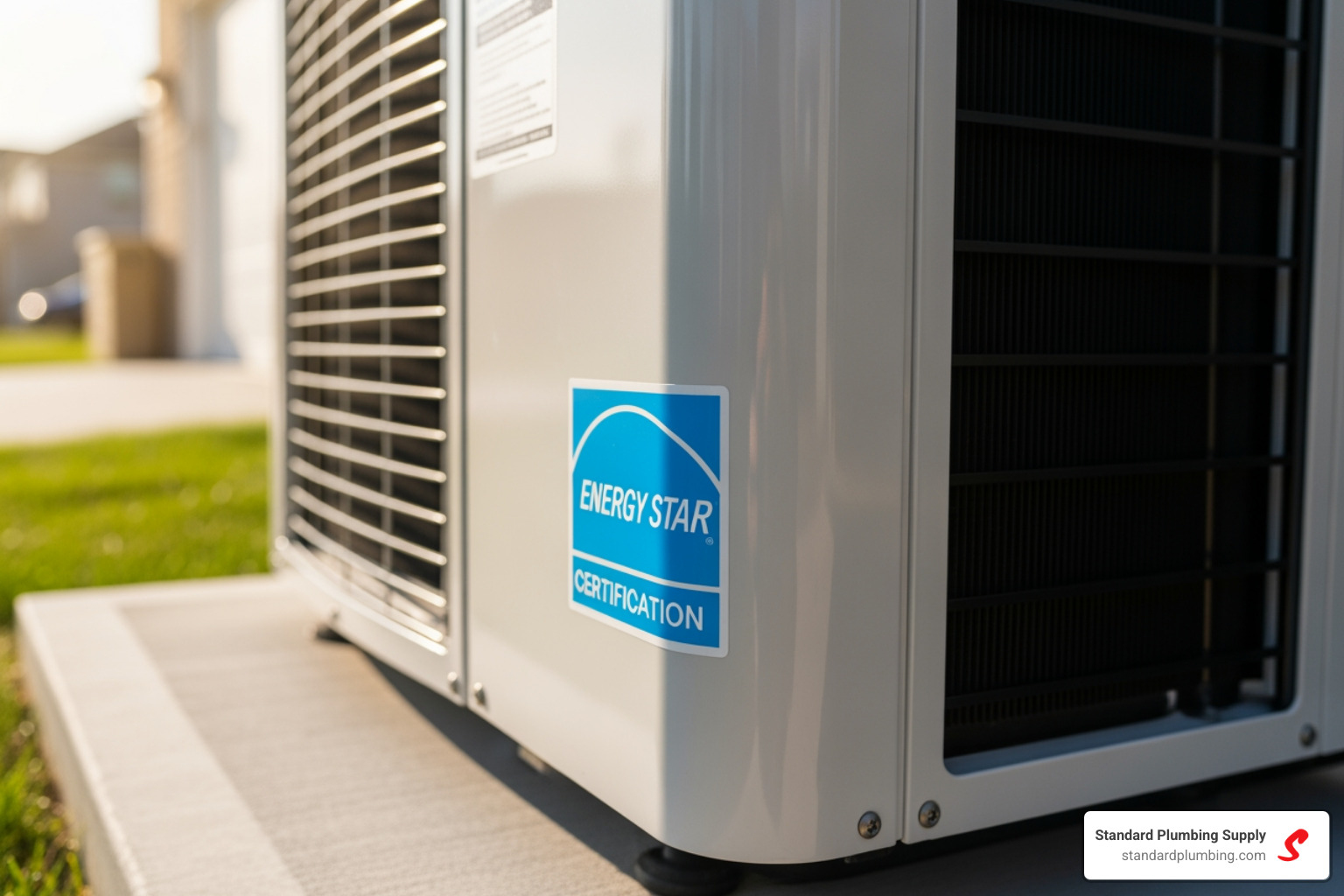
As of January 2023, the Department of Energy updated these standards to “SEER2” and “HSPF2” to better reflect real-world installation conditions. Always look for the ENERGY STAR label to ensure you’re getting a unit that meets strict efficiency guidelines.
Sizing Your Cooling Heating Unit with Manual J
“Bigger is better” is a dangerous myth in the HVAC world. If your cooling heating unit is oversized, it will “short cycle,” turning on and off rapidly. This leads to poor humidity control, uneven temperatures, and a shorter lifespan for the equipment.
To get it right, we recommend a Manual J Load Calculation. This isn’t just a guess based on square footage. It accounts for:
- The local climate (Phoenix heat vs. Wyoming wind).
- Directional orientation of your home.
- Insulation levels in your walls and attic.
- Number and type of windows.
For example, a home that previously used a 100,000 BTU furnace might only need a 36,000 BTU (3-ton) high-efficiency heat pump because the heat pump operates more consistently and efficiently.
Advanced Technology: Variable-Speed Compressors and Smart Controls
The biggest leap in comfort in the last decade has been the move from single-speed to variable-speed compressors.
- Single-Speed: Think of this like a light switch. It’s either 100% on or 100% off. This creates those “blasts” of cold air followed by periods of stillness.
- Two-Stage: This has a “high” and “low” setting, offering a bit more balance.
- Variable-Speed (Inverter): This is like a dimmer switch. The unit can run at 30%, 55%, or 100% capacity depending on exactly how much heating or cooling is needed. These systems are up to 30% more efficient than conventional models and are much better at removing humidity.
Pairing these units with smart controls, like the Rheem EcoNet system, allows you to manage up to 65% of your home’s energy use from your phone. You can receive maintenance alerts, track energy usage, and even detect leaks before they become disasters.
Low-GWP Refrigerants and Sustainability
The HVAC industry is currently undergoing a major shift toward more eco-friendly refrigerants. By 2025, the EPA is mandating the use of low Global Warming Potential (GWP) refrigerants like R-32 and R-454B.
We are already stocking these forward-thinking systems. For instance, the R32 2-Stage Gas Furnace uses modern technology to provide high-efficiency heating while reducing environmental impact. These new refrigerants aren’t just better for the planet; they often allow the equipment to operate more efficiently in extreme temperatures.
Cold-Climate Performance and Extreme Temperature Reliability
There was a time when heat pumps were only for the South. That time is over. “Cold-climate” or “Hyper Heat” units have changed the game for our customers in Idaho, Wyoming, and Northern Utah.
High-performance units, like the MRCOOL Central Ducted Hyper Heat, can maintain 100% heating capacity down to -13°F and continue operating all the way down to -22°F. This is achieved through advanced inverter technology and chassis heating cables that prevent ice buildup on the outdoor unit.
Installation, Maintenance, and Financial Incentives
The cost of a new cooling heating unit can range from $500 for a high-end portable unit to over $10,000 for a premium whole-home system. However, the “sticker price” is only half the story.
Professional vs. DIY Installation
While we love a good DIY project, most HVAC systems require professional installation to maintain the warranty and ensure safety. Handling refrigerants requires specialized licensing. However, some innovative brands like MRCOOL offer “Quick Connect” line sets that are pre-charged, making them much more accessible for homeowners who want to handle the mechanical placement themselves while staying within safety guidelines.
Maintenance Tips
To keep your unit running for 15–20 years, follow these simple steps:
- Change Filters: Every 1–3 months. This is the #1 reason for system failure.
- Clear Debris: Keep leaves and grass away from your outdoor unit.
- Clean Coils: Gently rinse the outdoor coils with a garden hose (not a pressure washer!) once a year.
- Professional Tune-ups: Have a pro check your refrigerant levels and electrical connections every spring and fall.
Financial Incentives
Don’t forget to look for rebates! Between federal tax credits (like the 25C credit which can offer up to $2,000 for heat pumps) and local utility rebates in states like California and Oregon, you can often knock thousands of dollars off the total cost. Many ENERGY STAR-certified units qualify for these significant savings.
Frequently Asked Questions about HVAC Units
What are common noise levels for indoor and outdoor units?
Modern indoor units are incredibly quiet, often operating between 21 and 30 decibels—that’s quieter than a whisper. Outdoor units have also improved; while older models might drone at 75 dB, high-end variable-speed units often stay around 55–60 dB, which is similar to a normal conversation.
How do portable units compare to permanent systems?
Portable units are great for temporary fixes or single rooms, but they are generally less efficient because they pull some of the air they just cooled back into the unit to cool the compressor, then exhaust it outside. Permanent systems like mini-splits or central air are more efficient, quieter, and provide better air filtration.
What maintenance is required for a mini-split?
Mini-splits require very simple maintenance. Most have “permanent” filters that you simply slide out, rinse in the sink, dry, and slide back in every few weeks. You should also ensure the outdoor unit stays clear of snow and debris and check the condensate drain line once a year to make sure it isn’t clogged.
Conclusion
Choosing the right cooling heating unit is one of the most important investments you’ll make in your home. From the high-velocity retrofits of historic homes to the hyper-efficient heat pumps that can handle a Wyoming winter, the technology exists to keep you comfortable while keeping your energy bills in check.
At Standard Plumbing Supply, we’ve been serving the West for decades. Whether you’re in Phoenix, Boise, or San Diego, we have the expertise and the inventory to help you find exactly what you need. Ready to upgrade your home comfort?
Explore our full HVAC catalog or use our store locator to find a local expert near you. We have locations across Arizona, California, Colorado, Idaho, Nebraska, Nevada, Oregon, Utah, and Wyoming—stop by and let us help you stay cool (or warm) all year long!
