
Why ADA Bathroom Grab Bars Are Required in Commercial Facilities
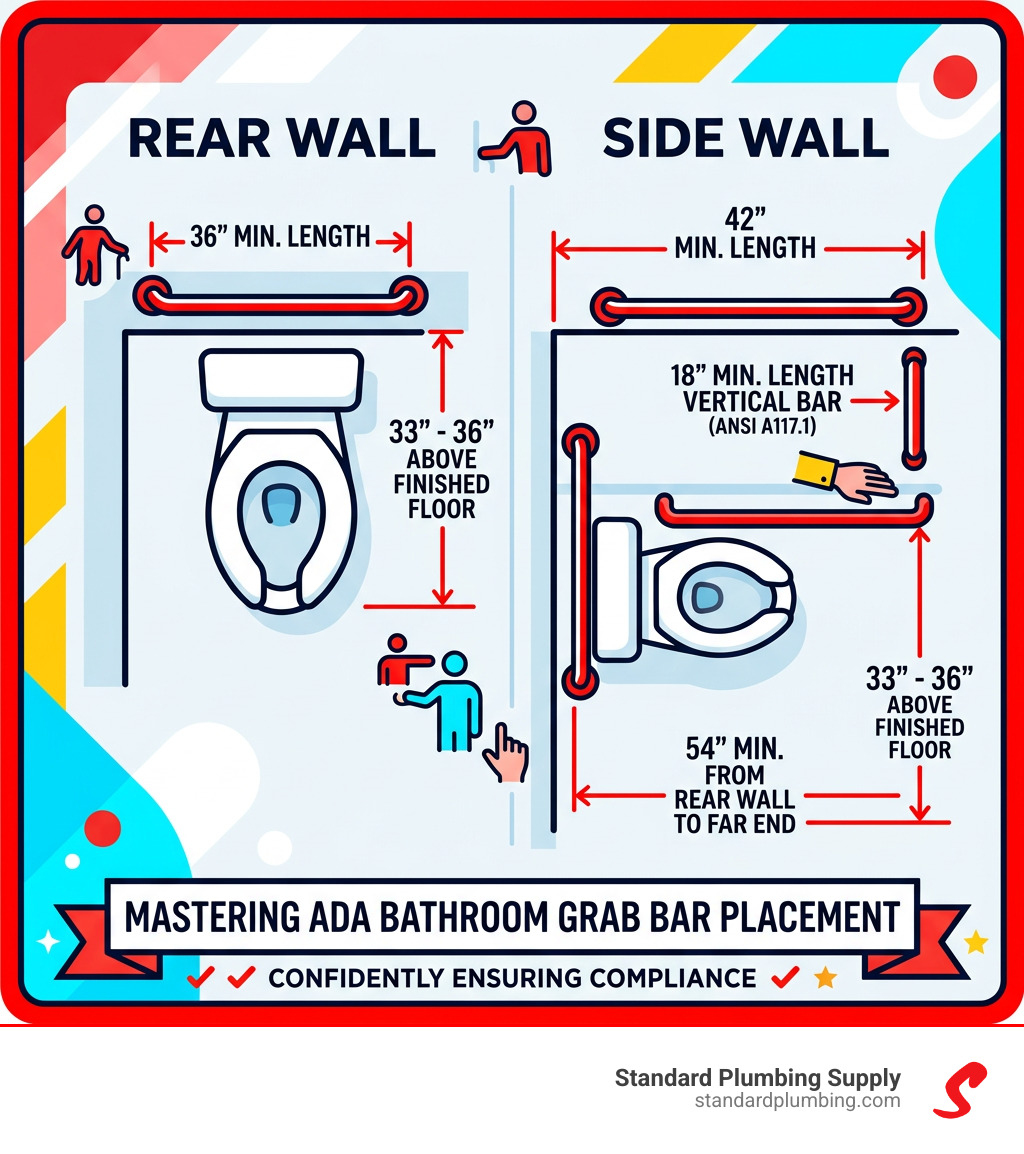
ADA bathroom grab bars are legally required safety fixtures in all accessible commercial restrooms across the United States. Here’s a quick overview of the core requirements:
| Feature | Requirement |
|---|---|
| Rear wall grab bar length | 36 inches minimum |
| Side wall grab bar length | 42 inches minimum |
| Mounting height (both bars) | 33-36 inches above finished floor |
| Load-bearing capacity | 250 lbs minimum |
| Side wall vertical bar length | 18 inches minimum (ANSI A117.1) |
Getting these specs right is not optional. Incorrect installation can delay your Certificate of Occupancy and stall an entire construction project.
The ADA (Americans with Disabilities Act) sets strict standards for grab bar placement, size, and strength in commercial bathrooms. These rules exist to protect people with mobility challenges — and to protect building owners from legal and inspection risk.
Whether you’re a contractor building a new facility or a project manager overseeing a renovation, understanding these requirements before you buy or install is critical.
I’m Jacob Reese, VP of Standard Plumbing Supply and a third-generation leader in the wholesale plumbing distribution industry — our team helps contractors and builders source the right ADA bathroom grab bars every day. In this guide, I’ll walk you through everything you need to know to get it right the first time.
Related content about ada bathroom grab bars:
Understanding ADA Bathroom Grab Bars and Commercial Requirements
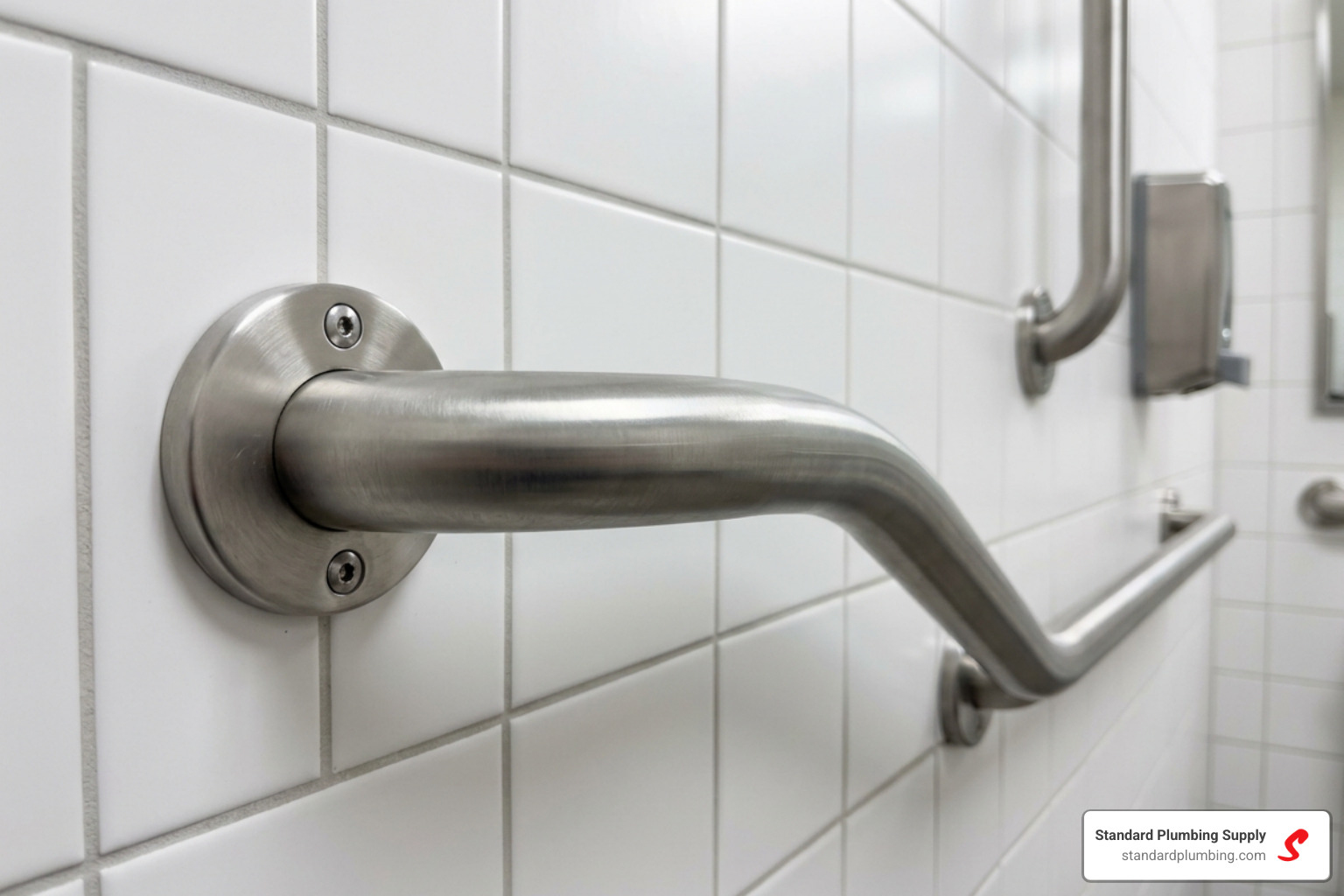
When we talk about ada bathroom grab bars, we aren’t just talking about a piece of metal screwed into a wall. In commercial plumbing, these are high-performance safety devices. By law, every accessible toilet room in a commercial facility must have these bars installed. This applies to restaurants in Salt Lake City, office buildings in Phoenix, and retail shops in Riverside.
The primary reason for these strict requirements is safety and independence. For someone using a wheelchair or living with limited mobility, a properly placed grab bar is the difference between safely using a restroom and risking a dangerous fall.
From a business perspective, compliance is a legal necessity. If your bathroom doesn’t meet these standards, you won’t be issued a Certificate of Occupancy (CO). That means you can’t open your doors for business, which can be a financial nightmare for any developer or business owner.
Load-Bearing Capacity and Structural Strength
One of the most important technical specs is the load-bearing capacity. According to ADA standards, a grab bar and its mounting hardware must be able to support at least 250 pounds of force. However, many high-quality ADA-compliant grab bars are tested to support 450 to 500 pounds, providing an extra margin of safety.
At Standard Plumbing Supply, we always recommend ensuring your wall backing is reinforced. A 500-pound rated bar is useless if it’s only screwed into thin drywall. You need solid blocking (usually 2×6 or 2×8 lumber) behind the wall surface to handle the leverage.
Residential vs. Commercial Safety Standards
While commercial buildings must follow the ADA, residential homes have more flexibility. However, many homeowners in our service areas—from Boise to San Diego—opt for ADA-compliant installations for “aging in place.”
In a home setting, you might prioritize aesthetics, but the principles of grab bars for safety and stability remain the same: stability is key. While a commercial inspector won’t knock on your door at home, installing bars to ADA standards is simply the best practice for long-term safety.
Impact on Building Inspections
We’ve seen it happen many times: a beautiful new commercial build is ready to open, but the inspector finds the rear grab bar is only 24 inches instead of 36, or it’s mounted 38 inches high. The result? A failed inspection and a delayed opening.
Incorrect placement is one of the most common reasons for inspection delays. This is why we provide detailed guides for our customers in Utah, California, and Arizona—getting it right the first time saves you thousands in labor and lost business time.
Technical Specifications for ADA Toilet Grab Bar Placement
Precision is the name of the game here. The ADA doesn’t give “ballpark” figures; they give exact ranges.
| Requirement | Rear Wall Bar | Side Wall Bar |
|---|---|---|
| Minimum Length | 36 inches | 42 inches |
| Mounting Height | 33–36 inches | 33–36 inches |
| Max Distance from Rear Wall | N/A | 12 inches |
| Extension from Centerline | 12″ (wall side) / 24″ (open side) | 54″ from rear wall |
The mounting height is measured from the finished floor to the top of the gripping surface. This 33–36 inch range is the “sweet spot” that allows most users to leverage their body weight effectively. For projects in the Golden State, you’ll want to pay close attention to the California ADA Toilet & Grab Bar Height Rules | Pass Inspection to ensure you meet state-specific nuances.
Exact Dimensions for ADA Bathroom Grab Bars
Let’s break down the placement for a standard toilet stall:
- Rear Wall Bar: This bar must be at least 36 inches long. It needs to be centered over the toilet, but not perfectly. It must extend at least 12 inches from the centerline of the toilet toward the side wall and at least 24 inches toward the open side.
- Side Wall Bar: This bar must be at least 42 inches long. It should be mounted no more than 12 inches from the rear wall and must extend at least 54 inches from the rear wall.
Exceptions for Limited Wall Space
Sometimes, architectural constraints make it impossible to fit a 36-inch bar on the rear wall. If there is a recessed fixture (like a flush valve or a bulky tank) that prevents the full length, the ADA allows for a shorter bar—typically 24 inches—provided it is centered on the toilet. However, you should only use this exception if it’s truly impossible to fit the standard size.
Vertical Grab Bars and Local Building Codes
You might have noticed a vertical bar on the side wall in some newer restrooms. This is where things get a bit “fun” with building codes.
While the federal ADA standards don’t explicitly require a vertical bar in every toilet stall, the ICC/ANSI A117.1 standard (which many local jurisdictions in our service areas like Las Vegas and Salt Lake City adopt) does require it.
When to Install a Vertical ADA Bathroom Grab Bar
A vertical grab bar should be at least 18 inches long. It is typically mounted on the side wall, with the bottom of the bar located between 39 and 41 inches above the floor. Its centerline should be 39 to 41 inches from the rear wall.
Even if you aren’t sure if your local code requires it, we often suggest installing one anyway. It’s an inexpensive addition that provides a huge amount of stability for users who have trouble standing up. Accessibility experts often suggest these to avoid any potential “comments” from city inspectors. For more on the philosophy of accessible design, check out Accessible Restrooms: More than Grab Bars.
ADA Bathroom Grab Bars for Shower and Tub Configurations
Showers are even more complex than toilets because the configuration depends on whether the stall is a Transfer Stall or a Roll-in Stall.
Transfer Stalls (36″ x 36″)
In a small transfer stall, the user moves from a wheelchair onto a seat.
- Grab Bars: You need an L-shaped bar (or two separate bars) that covers the control wall and at least half (18 inches) of the back wall.
- Height: Mounted 33–36 inches high.
- Seat: A folding or permanent seat must be 18 inches above the floor.
Roll-in Stalls (30″ x 60″)
In a roll-in stall, the user stays in their shower chair or rolls directly in.
- Grab Bars: These require a U-shaped configuration (or three separate bars) on all three walls.
- Controls: Shower controls must be placed between 38 and 48 inches high. In roll-in stalls, they are usually located on the back wall, 27 inches from the side wall.
For residents in Utah looking for specific home solutions, our team can help you find grab bars for shower and bath that meet your safety needs and provide excellent local installation ideas.
Installation Best Practices and Material Selection
When selecting ada bathroom grab bars, the material matters. Stainless steel is the industry standard for a reason: it doesn’t rust, it’s easy to clean, and it’s incredibly strong.
- Satin/Brushed Finish: This is the most popular for commercial use. It hides fingerprints and provides a decent grip.
- Peened Texture: This is a “roughed up” surface on the bar. It provides much better traction for wet hands, making it ideal for showers.
- Diameter: ADA bars must have an outside diameter of 1-1/4″ to 1-1/2″. This size is optimal for the human hand to grip securely.
For a high-end look that doesn’t sacrifice safety, consider something like the eclectic-12-grab-bar-k-26503-2bz, which offers a stylish finish while meeting structural needs.
Common Installation Mistakes to Avoid
- Improper Anchoring: Never use plastic “butterfly” anchors in drywall for a grab bar. You must hit a stud or use specialized heavy-duty toggle bolts designed for grab bars.
- Incorrect Height: Measuring from the floor before the tile is laid is a common error. Always measure from the finished floor.
- Insufficient Clearance: There must be exactly 1-1/2 inches of space between the bar and the wall. Too little space and a hand can’t grip it; too much space and an arm could get caught.
- Loose Cover Plates: Many decorative bars use concealed screws. If the cover plates pop off, it’s usually because the mounting tabs weren’t bent slightly for a tighter fit or a small bead of silicone wasn’t used.
You can find a variety of compliant options in our ADA-compliant grab bar catalog, but for professional-grade bulk orders and expert advice, our team at Standard Plumbing Supply is ready to help.
Frequently Asked Questions about ADA Grab Bars
What is the weight capacity for an ADA-compliant grab bar?
The federal ADA requirement is that the bar and its mounting system must support a minimum of 250 pounds. However, many commercial-grade bars are tested to 450 or 500 pounds. At Standard Plumbing Supply, we recommend choosing bars with a higher rating for high-traffic public restrooms.
Are vertical grab bars required by federal ADA law?
Technically, no. The 2010 ADA Standards for Accessible Design do not mandate a vertical bar. However, the ICC/ANSI A117.1 standard does require them, and because many states (like California and Utah) use ANSI as their building code foundation, you will likely need one to pass a local inspection.
Can I use a 24-inch grab bar on the rear wall?
Only as an exception. The standard requirement is 36 inches. You can only drop down to a 24-inch bar if there is a structural or plumbing obstruction (like a large recessed flushometer) that makes the 36-inch bar impossible to install.
Conclusion
Mastering ada bathroom grab bars is about more than just checking a box for an inspector; it’s about ensuring that everyone who enters your building can do so with dignity and safety. From the exact 33-36 inch mounting height to the 250-pound load requirement, these details matter.
At Standard Plumbing Supply, we’ve spent decades helping contractors across the Western U.S.—from the snowy peaks of Jackson, Wyoming, to the sunny streets of San Diego—get their plumbing and safety fixtures right. Whether you need a single satin-finish bar for a home remodel or a hundred peened bars for a new hospital wing, we have the stock and the expertise to support you.
Ready to finish your project? Browse our full catalog of ADA-compliant bathroom fixtures or visit one of our many locations in Utah, Idaho, Arizona, and beyond. We’ll help you find exactly what you need to stay compliant and keep your users safe.
