
Why Industrial Water Heaters Are Critical for Production
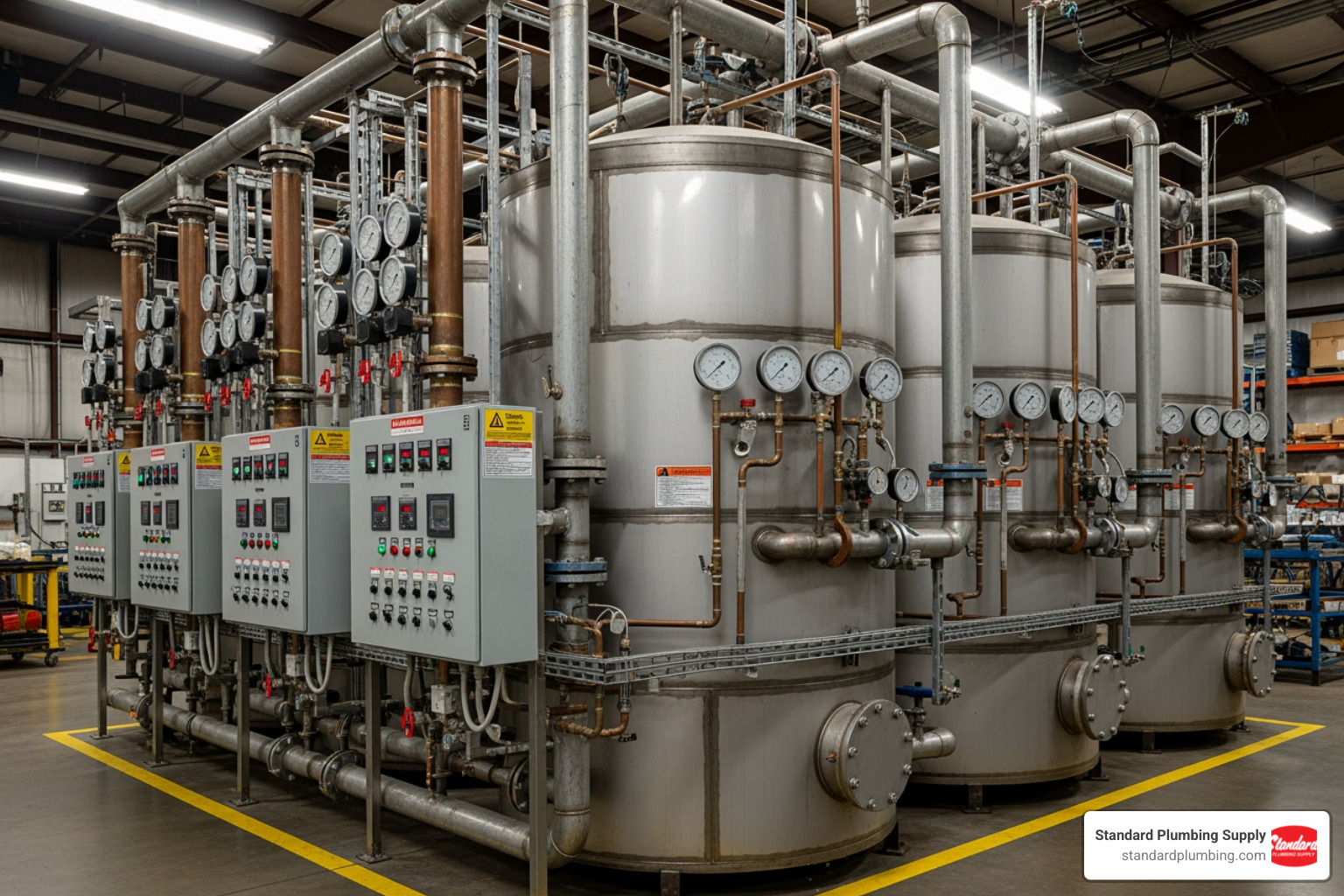
Industrial water heaters are the unsung heroes of countless commercial and industrial operations. These are not your average residential units; they are robust, specialized heating systems engineered to deliver massive volumes of hot water with precision and reliability. From manufacturing plants to large-scale hospitality, these systems must withstand continuous demand, maintain exact temperatures, and operate flawlessly in often harsh environments.
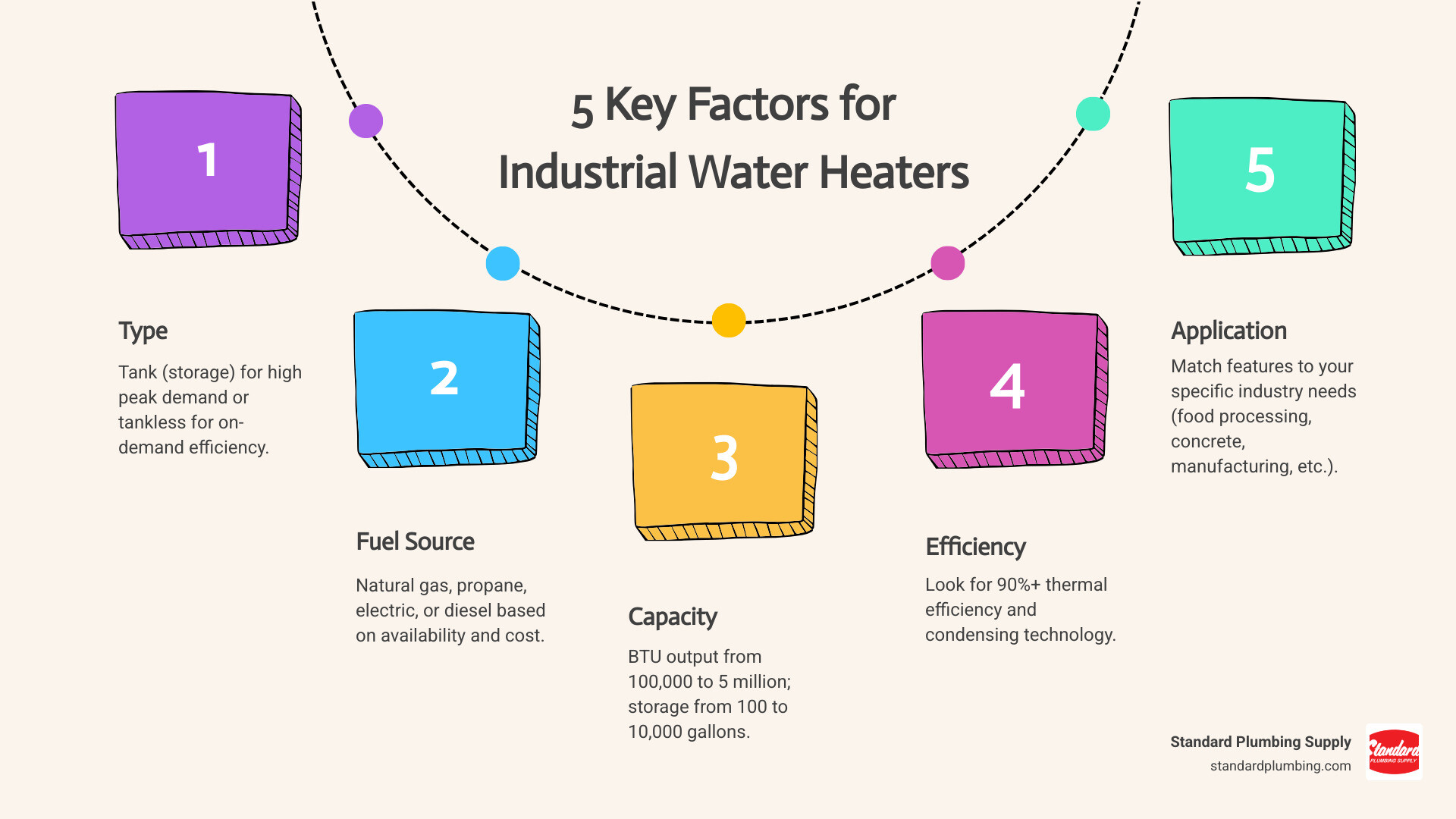
Quick Guide to Choosing Industrial Water Heaters:
- Type – Choose between a tank (storage) model to meet high, sudden demand, or a tankless (on-demand) unit for superior energy efficiency and a smaller footprint.
- Fuel Source – Select from natural gas, propane, electric, or diesel. Your choice will depend on local availability, utility costs, and infrastructure.
- Capacity – This is measured in BTU (British Thermal Units) for heating power and gallons for storage. Sizing must be precise to avoid shortfalls or energy waste.
- Efficiency – Aim for a thermal efficiency of 90% or higher. Condensing technology captures extra heat from exhaust gases, significantly boosting efficiency and lowering operating costs.
- Certifications – Non-negotiable for safety and compliance. Look for certifications like the American Society of Mechanical Engineers (ASME) Code for pressure vessels, UL/CSA for electrical safety, and National Board registration.
- Application – The best heater is one designed for your specific industry, whether it’s the high-sanitation needs of food processing or the high-volume demands of concrete production.
The right industrial water heater is a cornerstone of operational stability. In sectors like pharmaceutical manufacturing, a deviation in water temperature can ruin an entire batch. In food processing, inadequate hot water for Clean-In-Place (CIP) systems can lead to contamination and shutdowns. For concrete production, consistent water temperature is vital for quality control, especially in cold climates. In every case, reliable hot water is non-negotiable. Equipment downtime isn’t just an inconvenience; it translates directly to lost revenue, wasted materials, and idle labor. An undersized or inefficient system will constantly bleed money through high energy bills and limit your facility’s true production capacity.
This guide will walk you through the essential factors for selecting an industrial water heater that perfectly matches your facility’s demands. We’ll cover the core types (tank versus tankless), fuel options, sizing considerations, efficiency standards, safety certifications, and real-world applications across industries. You’ll learn which features matter most for your specific operation and how to balance upfront investment with long-term performance and cost savings.
I’m Jacob Reese, Vice President of Standard Plumbing Supply. For years, I’ve worked side-by-side with contractors, engineers, and facility managers to specify industrial water heaters for some of the most demanding commercial applications imaginable. From designing systems for sprawling resort complexes to outfitting specialized manufacturing plants, my focus has always been on helping customers find that perfect balance of reliable performance, maximum efficiency, and long-term value.
Understanding the Core Types: Tank vs. Tankless
Choosing between a tank (storage) and tankless (on-demand) industrial water heater is one of the foundational decisions for any commercial or industrial operation. Each type offers distinct advantages and is better suited for different applications, impacting everything from energy consumption and operational cost to available floor space and installation complexity.
When to Choose a Storage Tank Heater
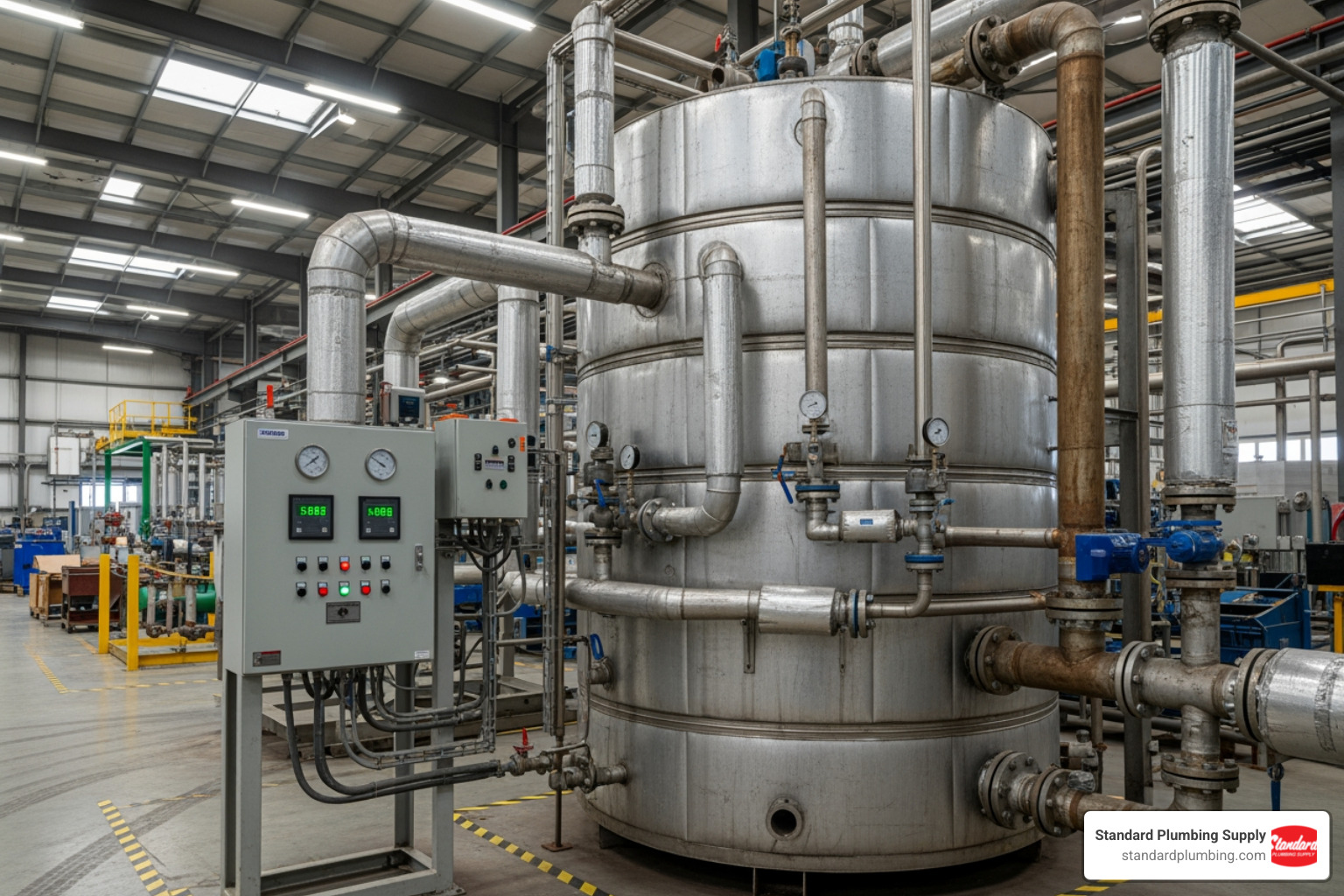
Storage tank industrial water heaters, often simply called “tank heaters,” are the traditional workhorses of the industry. They consist of a large, heavily insulated tank that heats and stores a significant volume of water, keeping it ready for immediate use.
Key characteristics and advantages:
- High Peak Demand: This is the primary strength of a tank heater. They excel in scenarios with high, sudden demands for hot water. If your operation experiences periods where a large quantity of hot water is needed almost simultaneously—think a hotel’s morning shower rush, a commercial laundry’s multiple machines starting a cycle, or a large-scale sanitation process in a food plant—a tank heater can deliver. It acts as a thermal battery, providing a ready reserve that a tankless system might struggle to match. Hubbell, for instance, offers storage capacities from 1 to 10,000 gallons, demonstrating the massive scale these units can achieve.
- Lower Initial Cost: Generally, the upfront investment for a storage tank heater tends to be lower than for a tankless system with a comparable peak flow rate capability. This can be a deciding factor for projects with tight capital budgets.
- Simpler Technology: While modern tank heaters incorporate advanced controls and high-efficiency burners, their core operation is often less complex than high-output tankless systems. This can translate to simpler installation, easier maintenance, and more straightforward troubleshooting for facility staff.
- Industries like Hospitality and Food Service: Hotels, resorts, large apartment complexes, and busy restaurants often benefit from the buffer provided by storage tanks to meet unpredictable guest and operational demand without interruption.
- Large-Scale Sanitation: Facilities requiring large, consistent batches of hot water for cleaning and sanitation, such as commercial kitchens, breweries, or industrial laundries, can rely on tank systems to provide the necessary volume instantly. For maintaining comprehensive sanitation, you might also consider more info about plumbing fixtures.
Primary Considerations: The main drawback is “standby heat loss”—energy consumed to keep the stored water hot even when not in use. While modern insulation is excellent, some heat loss is inevitable. They also have a significant physical footprint and weight, which must be factored into facility design and may require a dedicated mechanical room.
When to Choose a Tankless Heater
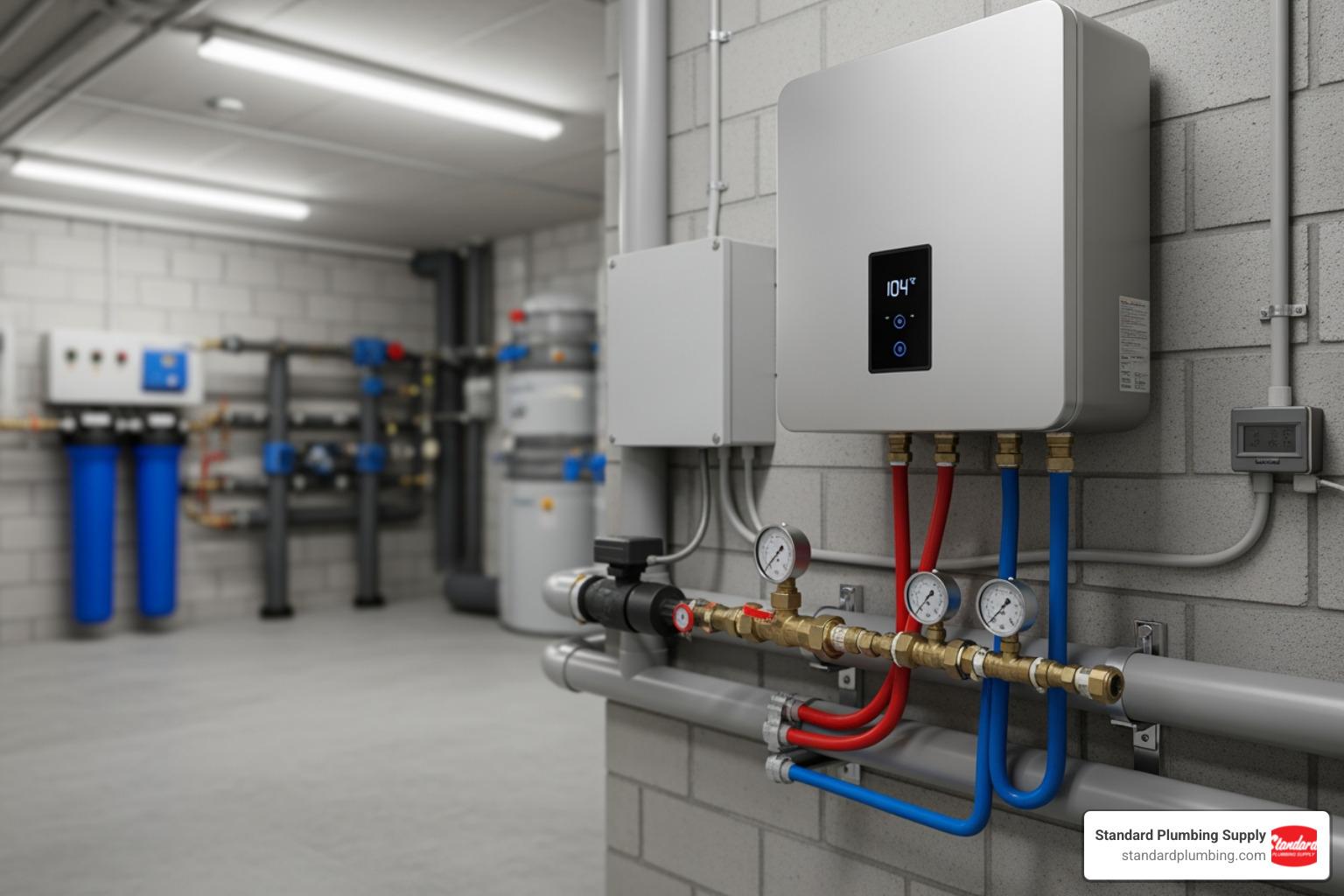
Tankless industrial water heaters, also known as “on-demand” heaters, represent a more modern approach. They heat water instantaneously as it flows through the unit, completely eliminating the need for a storage tank.
Key characteristics and advantages:
- Superior Energy Efficiency: By heating water only when it’s needed, tankless systems eliminate standby heat loss, which can result in significant energy savings over the unit’s lifespan. This makes them an excellent choice for facilities focused on sustainability and reducing operating costs. Armstrong International’s Flo-Direct® Gas-Fired Water Heater, for example, boasts instantaneous hot water generation with up to 99.7% (HHV) efficiency.
- Continuous, On-Demand Supply: For facilities that require a steady, continuous flow of hot water rather than large, intermittent bursts, tankless systems are ideal. As long as the demand is within the unit’s flow rate capacity, it will never run out of hot water. Sioux water heating systems, for example, are known for their ability to provide a continuous supply without preheating or recovery time, achieving a 100°F temperature rise in under five minutes.
- Compact and Space-Saving: Tankless units are significantly smaller than storage tanks and are often wall-mountable. This frees up valuable floor space, a critical advantage in crowded industrial facilities or when retrofitting older buildings.
- Point-of-Use Applications: Their small size makes them perfect for “point-of-use” installation, placing them directly where hot water is needed for a specific process or piece of equipment. This minimizes heat loss through long pipe runs and provides faster hot water delivery. For immediate access to hot water, consider more info about hot & cold water dispensers.
- Emergency Safety Showers: In critical safety applications, providing tepid water immediately is mandated by ANSI/OSHA standards. Tankless heaters are ideal for this, ensuring a consistent and endless supply of temperature-controlled water for emergency eyewash and safety shower systems. Models like the former Bradley CNA Series were designed for these scenarios, featuring durable NEMA 4 enclosures and multiple safety mechanisms.
Primary Considerations: The main limitation is the maximum flow rate at a given temperature rise. For very high-demand applications, multiple units may need to be installed in a parallel “cascaded” system, which can increase initial cost and complexity. The upfront cost for a single high-capacity unit is also typically higher than for a comparable tank heater.
Key Selection Criteria for Industrial Water Heaters
Selecting the right industrial water heater is more than just picking a model; it’s a strategic decision that impacts operational efficiency, cost, and safety. A thorough evaluation of your facility’s specific needs is crucial. We carefully consider sizing, fuel type, capacity, and efficiency to match the heater to the unique demands of your operation, ensuring long-term performance and a solid return on investment. Getting this choice right means uninterrupted production and predictable energy costs; getting it wrong can lead to bottlenecks, excessive utility bills, and premature equipment failure.
Fueling Your Operation: A Look at Industrial Water Heaters by Power Source
The choice of fuel source for your industrial water heater is one of the most critical decisions, significantly impacting long-term operating costs, your facility’s environmental footprint, and initial installation requirements. The best option depends on local utility availability and pricing, existing infrastructure, and specific operational goals.
Here’s a breakdown of the common options:
| Fuel Source | Advantages | Considerations |
|---|---|---|
| Natural Gas | – Typically the most cost-effective fuel source. – High-efficiency models (90%+) are widely available. – Clean-burning with lower emissions than propane or diesel. – Reliable supply via utility lines. |
– Requires access to a natural gas line. – Installation may require extensive piping and complex venting. – Subject to price fluctuations. |
| Propane (LP) | – Similar performance and efficiency to natural gas. – Ideal for locations without natural gas access. – Can be stored on-site in large tanks for a reliable supply. |
– Generally more expensive than natural gas. – Requires a large on-site storage tank and regular fuel deliveries. – Fuel price can be volatile. |
| Electric | – Often the lowest initial equipment cost. – No on-site emissions (zero NOx). – Simpler installation with no fuel lines or venting required. – Can achieve nearly 100% thermal efficiency. |
– Electricity is usually the most expensive energy source, leading to high operating costs. – High-capacity units require significant electrical infrastructure (high amperage, 3-phase power). – Vulnerable to power outages without a backup generator. |
| Diesel/Oil | – A powerful and effective option for remote or off-grid locations. – Fuel is readily available and can be stored on-site. – Can power very high-output heaters. |
– Highest emissions and environmental impact. – Requires on-site storage tanks, fuel delivery, and more frequent maintenance. – Fuel costs can be high and volatile. – Often subject to stricter environmental regulations. |
Natural Gas is often the default choice for facilities with access to a utility line. It provides a powerful, efficient, and relatively clean-burning fuel source that is typically the most economical for high-volume use. High-efficiency condensing gas heaters can achieve thermal efficiencies well over 95%, making them a smart long-term investment.
Propane (LP Gas) offers the same performance benefits as natural gas but with the flexibility of on-site storage. This makes it the go-to solution for rural or remote industrial sites that are not connected to the natural gas grid. While the fuel itself is more expensive, it provides energy independence and reliability.
Electric water heaters are valued for their simplicity and safety. With no combustion, there are no flue gases to vent and no on-site emissions, making installation easier and safer in certain environments. They can be highly efficient at the point of use. However, their major drawback is the high cost of electricity, which can make them prohibitively expensive to operate for large-scale, continuous heating applications. They are best suited for smaller, point-of-use applications or in regions with very low electricity rates.
Diesel or #2 Fuel Oil heaters are heavy-duty options reserved for the most demanding and remote applications where other fuel sources are unavailable. While capable of producing immense heating power, they come with the highest operating costs, greatest environmental impact, and most intensive maintenance requirements.
