
Understanding the Heart of Your Plumbing System
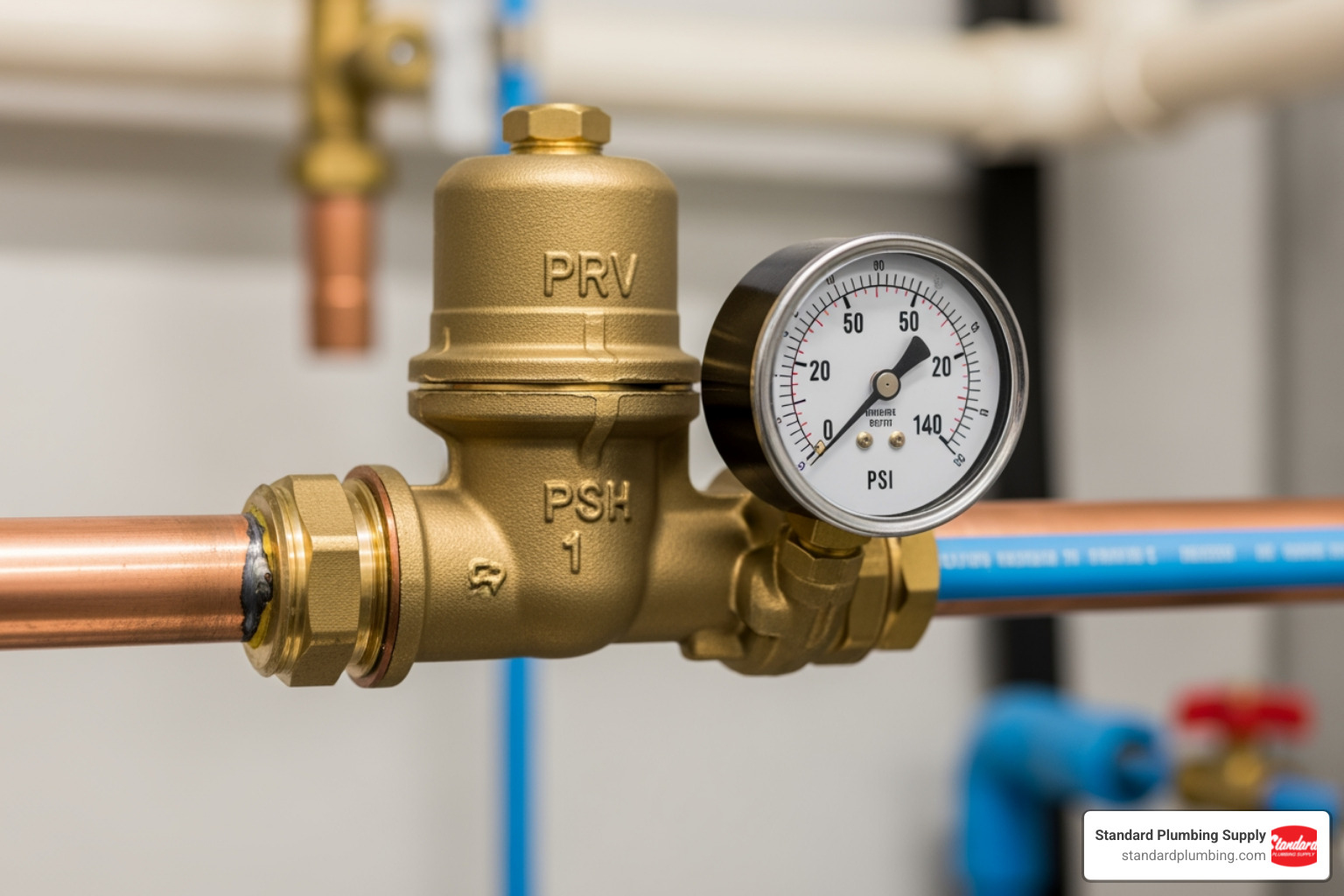
A pressure reducing valve (PRV) is a device that automatically lowers high incoming water pressure to a safe, consistent level for your plumbing system. Here’s what you need to know:
- What it does: Reduces water pressure from the municipal supply (which can range from 1 to 20+ bar) to a safe level (typically 25-75 psi)
- How it works: Uses a spring-loaded diaphragm that automatically adjusts to maintain steady downstream pressure
- Where it goes: Installed on your main water line, usually after the shutoff valve and before the water heater
- Why you need one: Protects pipes and appliances, prevents leaks, reduces water consumption, and lowers utility bills
- Main types: Direct-acting (for small applications) and pilot-operated (for larger, variable flows)
If you’ve ever heard hammering sounds in your pipes, experienced uncomfortably strong water flow from taps, or dealt with frequent plumbing leaks, high water pressure is likely the culprit. Municipal water pressure can vary dramatically—from 1 bar in some areas to 20 bar or more in others. Without proper regulation, this excessive pressure creates stress on your entire plumbing system, leading to burst pipes, damaged appliances, wasted water, and higher energy bills (roughly 30% of household water is heated, so reducing pressure significantly cuts heating costs).
A pressure reducing valve solves this problem by sitting in-line on your main water pipe and automatically maintaining a safe, steady pressure on the downstream side. Whether flow rates change or inlet pressure fluctuates, the PRV continuously adjusts to protect your system. Think of it as a shock absorber for your plumbing—constantly working to prevent damage before it happens.
I’m Jacob Reese, Vice President of Standard Plumbing Supply and a third-generation plumbing professional who’s spent decades helping contractors and homeowners select and install the right pressure reducing valves for their specific needs. From sweeping warehouses at age eight to now managing our Vendor Managed Inventory program across 60+ locations, I’ve seen how a properly selected PRV can save thousands in repair costs and extend the life of entire plumbing systems.
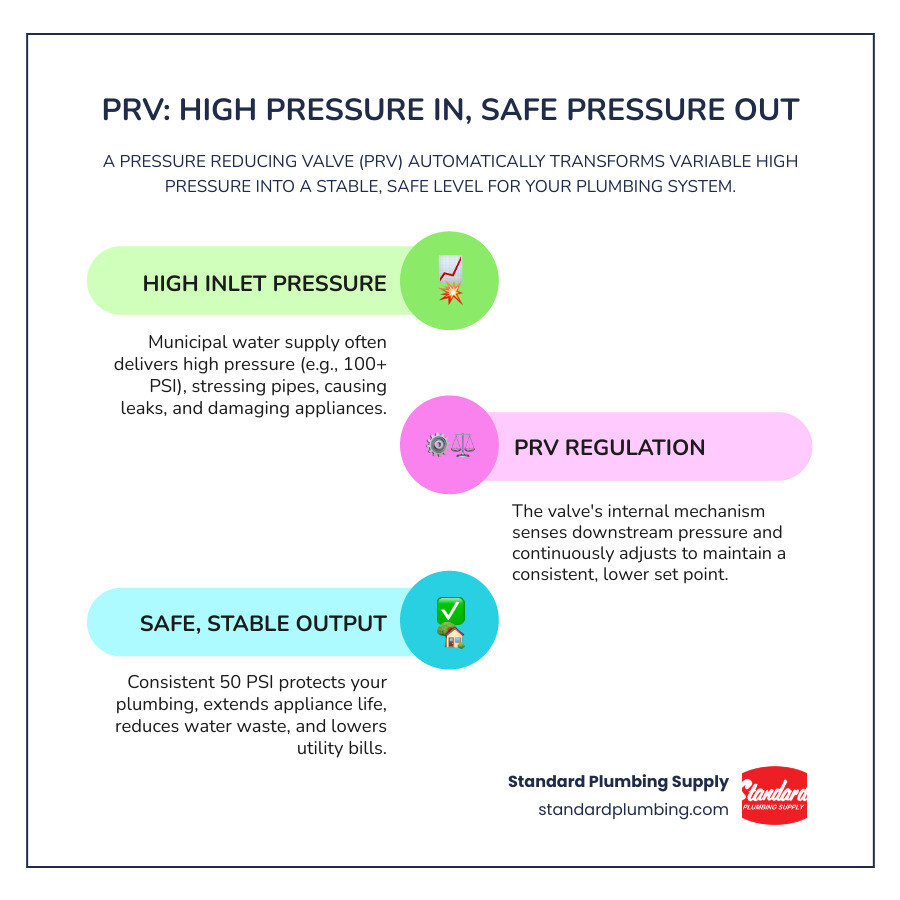
How a Pressure Reducing Valve Works
At its core, a pressure reducing valve is a clever mechanical device designed to take a high, often fluctuating, upstream pressure and deliver a consistent, lower downstream pressure. It’s not magic, but rather a precise balancing act of forces.
The valve constantly monitors the downstream pressure. If this pressure starts to creep up above the desired setting, the valve’s internal mechanism will begin to close, restricting the flow and bringing the pressure back down. Conversely, if the downstream pressure drops due to increased demand, the valve will open further, allowing more fluid through to maintain that steady set point. This continuous adjustment ensures system stability and safety, regardless of how much the inlet pressure or flow rate fluctuates.
This ingenious design means that even if the water pressure coming into your home in Salt Lake City or your commercial building in Las Vegas is wildly inconsistent, your internal plumbing system will experience a constant, safe pressure. You can learn more about how these valves control pressure fluctuations here: What are Pressure Reducing Valves (PRV)?
Key Components of a Pressure Reducing Valve
To understand how a PRV performs its pressure-regulating dance, let’s look at its main components:

- Valve Body: This is the main housing of the PRV, typically made from durable materials like brass, bronze, or stainless steel, designed to withstand the pressures and fluids it handles.
- Adjustment Screw/Nut: Located on top of the valve, this is how we set the desired downstream pressure. Turning it increases or decreases the tension on the spring.
- Spring: The spring provides the opposing force to the downstream pressure. Its tension, set by the adjustment screw, determines the desired outlet pressure.
- Diaphragm: A flexible, usually rubber or reinforced fabric, component that senses the downstream pressure. It moves up and down in response to pressure changes, transmitting this movement to the valve’s working parts.
- Piston/Stem: Connected to the diaphragm, the piston or stem transfers the diaphragm’s movement to the main valve seat, opening or closing the flow path.
- Valve Seat/Disc: This is the component that directly controls the flow of water. When the disc presses against the seat, flow is restricted or stopped; when it lifts, flow is allowed.
- Strainer (optional but common): Many PRVs include an integral strainer to filter out debris from the incoming water, preventing blockages and protecting the internal mechanisms.
The interplay between these components allows the PRV to continuously adjust its opening, ensuring that the pressure on the downstream side remains consistently at your desired setting.
The Balancing Act: Direct-Acting vs. Pilot-Operated
Not all PRVs are created equal, and the type you choose depends largely on your specific needs, particularly the flow rate and stability requirements of your system. The two primary types are direct-acting and pilot-operated.
Direct-Acting PRVs are the simpler of the two. They use a spring-loaded piston and diaphragm arrangement where the downstream pressure acts directly on the diaphragm. If the downstream pressure exceeds the spring tension, the diaphragm pushes against the spring, causing the valve to close. When the downstream pressure drops, the spring pushes the valve open. These valves are robust and reliable, often used for:
- Low-flow applications: Such as individual fixtures or small residential systems.
- Small-load applications: Sterilizers, unit heaters, humidifiers, and small process equipment in commercial or light industrial settings.
- Residential plumbing: Common in homes across our service areas in Arizona, California, Utah, and beyond, where they efficiently manage fluctuating municipal water pressure.
Pilot-Operated PRVs are more complex but offer greater precision and control, especially for larger flows and more demanding applications. Instead of the downstream pressure acting directly on the main valve, it acts on a smaller “pilot” valve. This pilot valve then controls a larger piston that operates the main valve. This two-stage process allows for:
- High-flow applications: They can handle much larger volumes of fluid more accurately.
- Industrial processes: Where precise pressure control is critical, such as in power generation (steam systems), chemical processing, or oil and gas refining.
- Steam systems: Essential for distributing steam safely and efficiently, especially when there are significant variations in steam usage, like during equipment startup.
- Large commercial or institutional buildings: Where consistent pressure is needed across extensive and complex plumbing networks, such as in hospitals in Salt Lake City or large hotels in Las Vegas.
While direct-acting valves are perfect for many of our customers in places like Boise or Sacramento, if you’re dealing with a large industrial system in Wyoming or a sprawling commercial complex in Phoenix, a pilot-operated PRV might be your best bet.
Pressure Reducing Valve vs. Pressure Relief Valve: What’s the Difference?
This is a common point of confusion, and for good reason! Both valves deal with pressure, and both are often abbreviated as PRV (though pressure relief valves are sometimes called SRV for Safety Relief Valve or PSV for Pressure Safety Valve). However, their functions are fundamentally different. Let’s clarify:
| Feature | Pressure Reducing Valve (PRV) | Pressure Relief Valve (SRV/PSV) |
|---|---|---|
| Primary Function | Proactive regulation: Continuously lowers and maintains a steady downstream pressure. | Reactive safety: Opens to release excess upstream pressure in an emergency. |
| Operation | Always active, constantly adjusting to maintain set pressure. | Dormant until upstream pressure exceeds a set safety limit, then opens fully. |
| Purpose | Protects downstream equipment and plumbing from high pressure, ensures consistent flow. | Prevents catastrophic overpressure events, protecting the system and people. |
| Fluid Action | Regulates flow through the system, keeping pressure constant. | Vents fluid out of the system to relieve dangerous pressure buildup. |
| Analogy | A dimmer switch for pressure, keeping it at a comfortable level. | A circuit breaker for pressure, tripping when it gets too high. |
A pressure reducing valve is like a careful gatekeeper, ensuring that only a safe, manageable amount of pressure passes through to your plumbing system. It’s always working, subtly opening and closing to keep things just right.
A pressure relief valve, on the other hand, is a last-resort safety device. It’s designed to protect your system from catastrophic failure due to sudden, dangerous spikes in pressure. When the pressure exceeds a critical threshold, it “relieves” that excess pressure, often by discharging fluid to a safe location. It’s an emergency failsafe, not a day-to-day regulator.
Both types of valves are crucial for different aspects of plumbing safety and efficiency. We carry a range of options for both, including quality pressure relief valves like this one: More info about pressure relief valves
Common Applications and Benefits
Pressure reducing valves are unsung heroes in countless fluid and gas systems. From our homes in Boise to the busy commercial kitchens in Las Vegas, PRVs ensure everything runs smoothly and safely.
- Residential Plumbing: This is where most of us encounter PRVs. They reduce high municipal water pressure to a safe level (typically 50-70 PSI) for household use, protecting everything from our washing machines and dishwashers to our showerheads and faucets. This is particularly important in areas like Salt Lake City or Phoenix where mains supply pressure can be quite high.
- Commercial Buildings: Think about a multi-story hotel in Reno or a large office complex in Sacramento. PRVs are essential for maintaining consistent water pressure across all floors and units, preventing excessive pressure on lower levels and ensuring adequate pressure on upper floors. They also protect extensive commercial plumbing systems and appliances from damage.
- Industrial Systems: In industrial settings across Idaho, Oregon, or Wyoming, PRVs are vital for controlling steam, air, gases, and various liquids. They protect sensitive equipment, ensure process efficiency, and improve safety in complex operations.
- Fire Protection Systems: Maintaining precise water pressure in fire protection systems is critical. PRVs ensure that sprinklers and hoses deliver water effectively without over-pressurizing the system’s components.
- Water Distribution Networks: Large-scale water distribution systems often use PRVs to manage pressure zones, ensuring that different areas receive water at appropriate and safe pressures.
You can explore a variety of PRV options for different applications right here: More info about PRVs
Why You Need a PRV
The benefits of installing a pressure reducing valve are extensive, touching on everything from preventing costly repairs to saving you money on utility bills.

- Prevents Pipe Damage: High water pressure puts immense strain on your pipes and connections. Over time, this can lead to leaks, bursts, and premature pipe failure. A PRV limits this stress, extending the lifespan of your entire plumbing infrastructure. We’ve seen countless instances in homes and businesses across Nevada and California where a PRV saved thousands in potential water damage.
- Protects Appliances: Your washing machine, dishwasher, water heater, and even your refrigerator’s ice maker are designed to operate within specific pressure ranges. Excessive pressure can damage internal components, seals, and hoses, leading to breakdowns and costly repairs. A PRV acts as a guardian for these valuable investments.
- Reduces Water Hammer: That annoying “banging” sound in your pipes when you turn off a faucet or an appliance fills with water? That’s water hammer, caused by sudden changes in water flow under high pressure. A PRV can significantly reduce or even eliminate this, protecting your pipes and providing a quieter home environment.
- Lowers Utility Bills:
- Water Savings: With regulated pressure, you’re less likely to have fixtures flowing at unnecessarily high rates. This means less water wasted down the drain, especially during activities like showering or washing dishes.
- Energy Savings: As we mentioned, roughly 30% of the water used in a typical household is heated. When your water pressure is too high, you consume more hot water than necessary, forcing your water heater to work harder. By reducing pressure, a PRV can significantly lower the amount of energy required to heat your water, leading to noticeable savings on your energy bill.
- Consistent Water Flow: Ever had a shower that suddenly blasts you with cold water or loses pressure when someone flushes a toilet? A PRV helps stabilize your home’s water pressure, providing a more consistent and enjoyable experience at all your fixtures.
Choosing the Right Pressure Reducing Valve for Your System
Selecting the perfect pressure reducing valve isn’t a one-size-fits-all decision. To ensure optimal performance and longevity for your plumbing system, consider these crucial factors:
- Pipe Size: This is fundamental. The PRV’s connection size (inlet and outlet diameter) must match your existing plumbing. Common sizes include 1/2″, 3/4″, 1″, 1-1/4″, 1-1/2″, and 2″. An improperly sized valve can restrict flow or fail to regulate pressure effectively.
- Required Pressure Range: What downstream pressure do you need? Most residential applications aim for 50-70 PSI, but industrial or specific commercial uses may vary. Ensure the valve you choose can be adjusted to your desired set point (e.g., 25 to 75 psi adjustable range, with a maximum pressure rating of 300 psi or more).
- Flow Rate (GPM): Consider the maximum gallons per minute (GPM) your system demands. The PRV must be able to handle this flow without excessive pressure drop or noise.
- Fluid Type (Water, Steam, Gas): While we primarily discuss water PRVs, specialized valves exist for steam, air, and other gases. Always match the valve to the fluid it will regulate.
- Material: The valve’s construction material is vital for durability and safety.
- Brass/Bronze: Common and durable for water applications.
- Lead-Free Materials: Crucial for potable water applications to comply with health and safety standards like the United States Safe Drinking Water Act. Many of our suppliers, like Watts or Wilkins, offer lead-free options.
- Dezincification-Resistant Bronze: Offers superior durability and corrosion resistance, especially important in certain water conditions.
- Stainless Steel: Used for highly corrosive environments or specific industrial needs.
- Connection Type: How will the valve connect to your pipes?
- FIP (Female Iron Pipe) / NPT (National Pipe Taper): Standard threaded connections.
- Sweat: For soldering copper pipes.
- Push-to-Connect (PTC): Convenient for PEX, copper, or CPVC.
- Barb: For PEX tubing.
- Flanged: Common in larger commercial or industrial applications.
- Union Connections: Allow for easier installation and removal for maintenance without cutting pipes.
- Application: Is it for potable water, non-potable water, a heating system, or a specific industrial process? Knowing the application helps narrow down features like temperature ratings (e.g., typically 33°F to 180°F) and material requirements.
Don’t hesitate to consult with our experts at Standard Plumbing Supply in any of our locations, from Orem to Phoenix, to help you steer these choices. We’re here to ensure you get the right PRV for your specific needs.
Installation and Maintenance for Your Pressure Reducing Valve
Installing a pressure reducing valve correctly is crucial for its performance and the overall health of your plumbing system. While we always recommend professional installation, especially for complex systems, understanding the process can be helpful.
- Proper Location: The PRV should typically be installed on the main water line where it enters your home or building, after the main shutoff valve and before any branches to fixtures or water heaters. It’s often found near the water meter in basements, garages, or utility closets.
- Installation Steps:
- Shut off the main water supply to the property.
- Drain the pipes by opening a faucet at the lowest point of your system.
- Cut into the main line where the PRV will be installed.
- Position the valve ensuring the flow direction arrow on the valve body points towards your fixtures.
- Secure the valve using the appropriate connection type (threaded, sweat, push-to-connect). Union fittings are highly recommended for easier future maintenance.
- Slowly turn the water back on and check for any leaks.
- Regular Inspection: Once installed, a PRV is designed to work quietly in the background, but like any mechanical device, it benefits from regular checks. We generally recommend getting PRVs properly checked every couple of years for systems in daily use. This helps catch potential issues before they become major problems.
Signs of a Failing PRV
A failing pressure reducing valve can cause a host of frustrating and potentially damaging plumbing issues. Keep an eye out for these tell-tale signs:
- Fluctuating Pressure: If your water pressure constantly changes, going from strong to weak and back again, your PRV might be struggling to maintain a consistent output.
- Low Water Flow: A significant and unexplained drop in water pressure throughout your home or at specific fixtures could indicate the PRV is stuck in a partially closed position or is blocked.
- No Water Flow: In severe cases, a completely failed PRV can totally cut off the water supply to your home.
- Hammering Noises: If you start hearing banging or hammering sounds in your pipes, especially when water is turned on or off, it could be a sign of high pressure, indicating your PRV is no longer regulating effectively.
- Leaks from the Valve: Any visible leaks around the PRV itself are a clear sign of a problem and require immediate attention. Internal components like diaphragms or seals can degrade over time, leading to these leaks.
- Excessive Water Consumption/High Bills: If your water usage or bills suddenly spike without a change in habits, it might be due to the PRV failing to reduce pressure, leading to more water flowing through fixtures than necessary.
Basic Maintenance and Adjustment
Regular maintenance and timely adjustments can significantly extend the life of your pressure reducing valve and ensure your plumbing system remains protected.
- Checking Pressure: The most important step is to periodically check your downstream pressure with a pressure gauge. This will tell you if your PRV is still operating within your desired range. You can attach a gauge to an outdoor spigot or a utility sink faucet.
- Cleaning Strainers: Many PRVs have an internal strainer designed to catch debris. Over time, this strainer can become clogged, affecting performance. If your PRV has one, it may need occasional cleaning, which often involves shutting off water, removing a cap, and rinsing the screen.
- Adjusting the Set Pressure: To adjust your PRV:
- Locate the adjustment screw or nut, usually on the top of the valve.
- Use a wrench or screwdriver (depending on the model) to turn the screw clockwise to increase the pressure or counter-clockwise to decrease it.
- Always check the system pressure with a gauge after making adjustments to ensure it’s within safe operating limits (typically 50-70 PSI for residential).
- Professional Servicing: While some basic checks can be done by a homeowner, we highly recommend professional servicing from a qualified plumber every few years. They can inspect internal components, diagnose subtle issues, and ensure your PRV is functioning optimally. Our teams in places like Salt Lake City, Boise, and Phoenix are always ready to help.
Frequently Asked Questions about Pressure Reducing Valves
We hear a lot of questions about pressure reducing valves from our customers across Arizona, Utah, and all our service areas. Here are some of the most common ones:
How do I adjust the pressure on my PRV?
Adjusting the pressure on your pressure reducing valve is a straightforward process, but it requires a pressure gauge to ensure accuracy.
- Locate the Adjustment Screw: This is typically on the top of the PRV. It might be a large hex nut or a screw that requires a flathead screwdriver.
- Attach a Pressure Gauge: Connect a water pressure gauge to an accessible faucet or hose bib in your home, preferably one that’s downstream of the PRV and not too far away (like an outdoor spigot).
- Adjust the Screw:
- To increase pressure: Turn the adjustment screw clockwise.
- To decrease pressure: Turn the adjustment screw counter-clockwise.
- Check the Gauge: After each small adjustment, open a faucet for a few seconds to equalize the pressure, then close it and check the reading on your pressure gauge. Repeat until you reach your desired pressure, typically between 50-70 PSI for residential applications.
Make small adjustments and recheck the pressure each time. Patience is key!
How long does a pressure reducing valve last?
The average lifespan of a pressure reducing valve can vary significantly, but generally, you can expect a quality PRV to last between 10 to 15 years. However, several factors can influence its longevity:
- Water Quality: Hard water, high mineral content, or water with sediment can accelerate wear and tear on internal components like diaphragms and valve seats, leading to blockages or leaks.
- Usage Frequency: PRVs in systems with constant, high flow rates or frequent pressure fluctuations might wear out faster than those in less demanding applications.
- Inlet Pressure: Consistently very high incoming pressure puts more stress on the valve’s internal mechanisms.
- Valve Material and Quality: Higher quality materials, like dezincification-resistant bronze, and robust designs tend to last longer.
- Proper Installation and Maintenance: A correctly installed and regularly inspected PRV is more likely to reach its maximum lifespan.
If your PRV is showing signs of failure (fluctuating pressure, hammering, leaks), it’s time for a replacement, regardless of its age.
Where is the PRV typically located in a house?
In most homes across our service areas, the pressure reducing valve is strategically placed at the point where the main water line enters the property. This ensures that all water distributed throughout your home is at a regulated pressure.
Common locations include:
- Near the Water Meter: Often, it’s installed just after the main water meter, either outside in a meter box or inside a basement or utility room.
- After the Main Shutoff Valve: It will always be downstream of your home’s main water shutoff valve.
- Before the Water Heater: While it regulates pressure for the entire home, it’s particularly important for the water heater, so it’s usually installed before the water line reaches the heater.
- Basements, Garages, or Utility Closets: These are common indoor locations where the main water line makes its way into the house.
If you’re unsure where your PRV is, or if you even have one, our team at any Standard Plumbing Supply location, from Salt Lake City to Reno, can help you locate it or determine if one is needed.
Protect Your Plumbing and Save Money
In summary, a pressure reducing valve is a small but vital component for the health and efficiency of your plumbing system. By regulating your water pressure, you safeguard your entire investment – your pipes, fixtures, and expensive appliances.
The benefits are clear: improved safety, extended equipment lifespan, reduced water waste, lower energy consumption, and significant long-term savings on repairs and utility bills. Whether you’re a homeowner in Las Vegas or managing a commercial property in Portland, Oregon, a properly functioning PRV is indispensable.
At Standard Plumbing Supply, we are committed to providing high-quality plumbing solutions and expertise. We understand the unique needs of our communities across Arizona, California, Colorado, Idaho, Nebraska, Nevada, Oregon, Utah, and Wyoming. Our team is ready to help you find the perfect pressure reducing valve and any other plumbing supplies you need.
Protect your plumbing, save money, and enjoy consistent, safe water pressure. Our team is ready to help you find the perfect pressure reducing valve for your needs.
