
The Best Condensing Tankless Water Heaters Worth Buying Right Now
The best condensing tankless water heaters on the market today come from a short list of proven brands. Here’s a quick look at the top picks:
| Model | UEF | Max GPM | Best For |
|---|---|---|---|
| Rinnai SENSEI RX160iN | 0.96 | 9.0 | Smart features & flexibility |
| Navien NPE-210A2 | 0.95 | 11.1 | Built-in recirculation |
| Takagi TK-540X3-PIH | 0.93 | 10.0 | Scale prevention & high altitude |
| Lochinvar LTI-240X3-P | 0.94 | 4.7 | Long-term efficiency |
| Rinnai SENSEI RX Series | up to 0.98 | 9.0 | Peak efficiency |
If you’re replacing a leaking tank heater or planning a new build, a condensing tankless unit is one of the smartest upgrades you can make. These units squeeze nearly all the heat out of combustion gases before venting them – hitting efficiency ratings as high as 0.98 UEF. That means less gas burned and lower monthly bills.
Unlike traditional tank heaters that constantly heat stored water, condensing tankless models only fire up when you turn on the tap. And because they last up to twice as long as tank models, the long-term value is hard to ignore.
Still, not every model fits every home. Flow rate, water hardness, venting setup, and household size all matter – and picking the wrong unit can mean cold showers or costly repairs down the road.
I’m Jacob Reese, Vice President of Standard Plumbing Supply and a third-generation wholesale distributor serving contractors and DIYers across the Western U.S. – and helping customers find the best condensing tankless water heater for their specific situation is something our team does every day. Let’s walk through the top models so you can make a confident, informed choice.
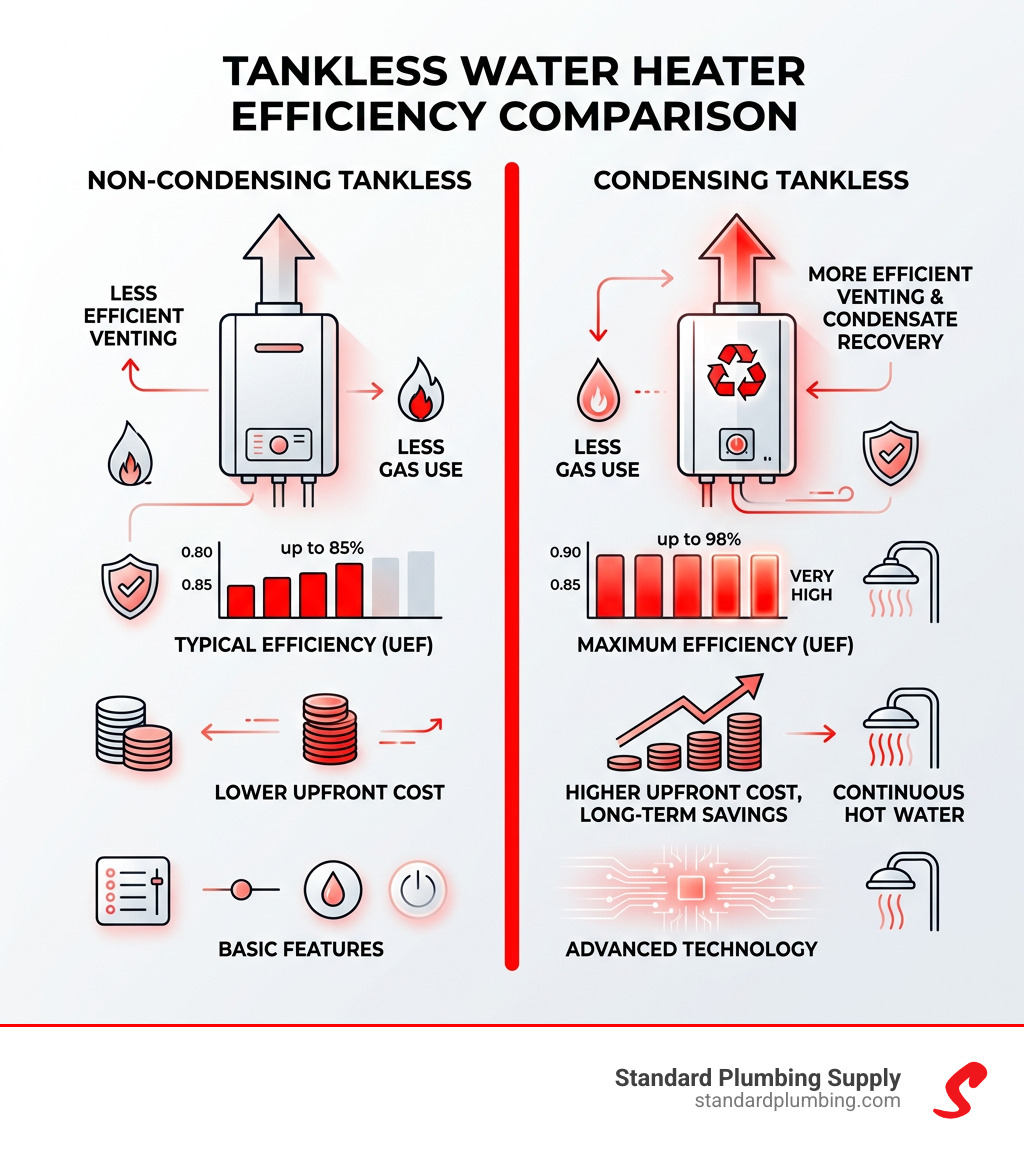
Best condensing tankless water heater word roundup:
Why Choose the Best Condensing Tankless Water Heaters?
When we talk to customers in our stores from Salt Lake City to Sacramento, the first question is usually: “Is the extra cost for a condensing unit worth it?” The short answer is yes, especially if you value efficiency and long-term savings.
A best condensing tankless water heater differs from a standard model by using a secondary heat exchanger. In a non-condensing unit, the exhaust gases are incredibly hot—often over 300°F—and that heat is simply wasted out the vent. Condensing units capture that “waste” heat to pre-heat the incoming cold water. This process cools the exhaust so much that it turns into a liquid (condensate), which is why these units require a drain line.
The results are impressive. While a standard tankless unit might have a Uniform Energy Factor (UEF) around 0.81, the NPE-150S2 ultra-high efficiency condensing technology and similar models reach up to 0.98 UEF. This means 98% of the energy you pay for goes directly into heating your water.
Beyond the bills, there are installation perks. Because the exhaust is cool, you can often use inexpensive PVC or polypropylene venting instead of expensive stainless steel. Plus, most modern condensing units are Energy Star certified and Ultra-Low NOx compliant, making them better for the environment and eligible for various tax credits and rebates in states like California and Oregon.
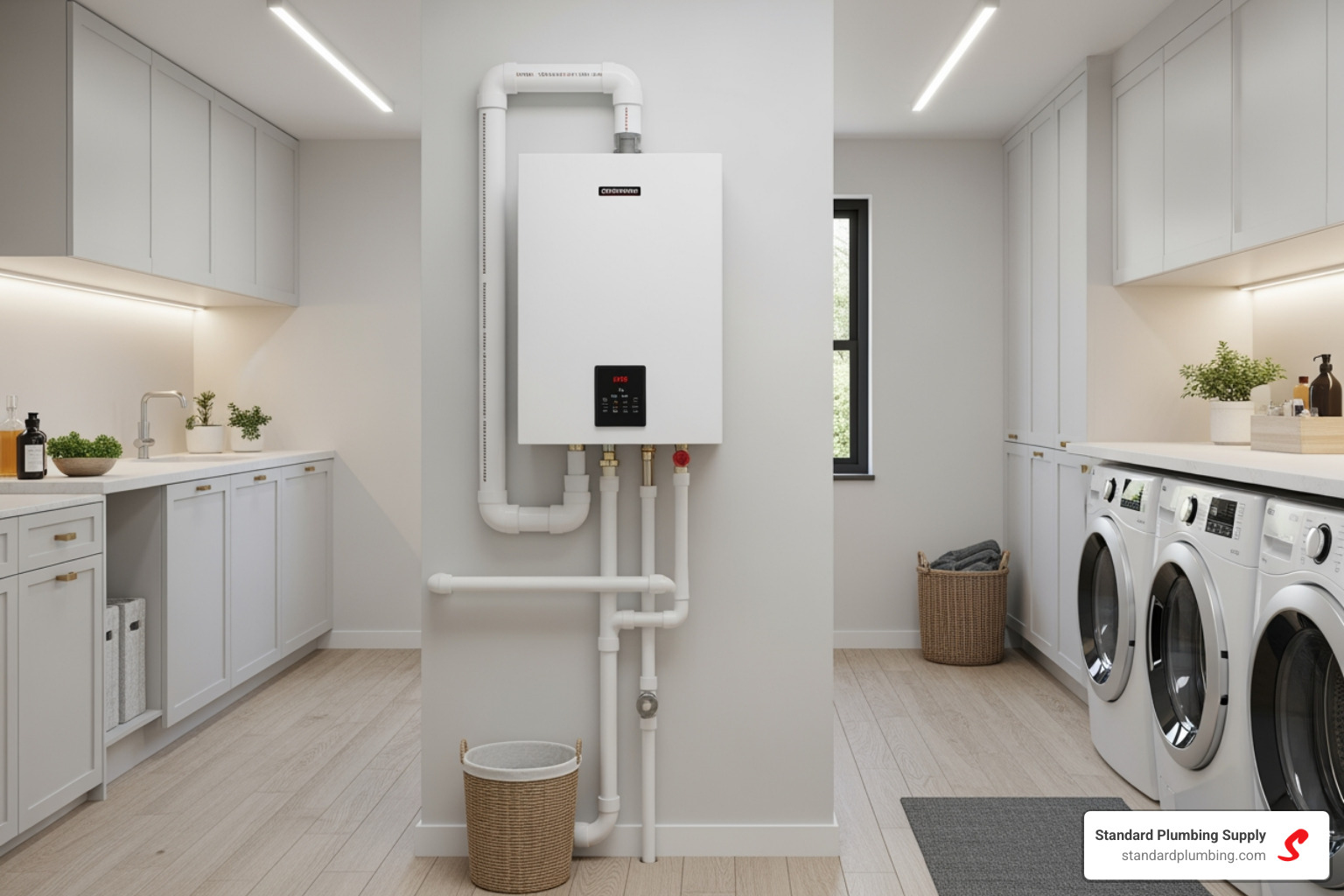
Top-Rated Models: Finding the Best Condensing Tankless Water Heater for Your Home
Selecting the best condensing tankless water heater involves looking at flow rates (GPM), durability, and specialized features like smart controls or built-in pumps. At Standard Plumbing Supply, we carry the heavy hitters that pros trust.
Rinnai SENSEI RX: The Best Condensing Tankless Water Heater for Smart Features
The Rinnai SENSEI RX series is a game-changer for versatility. The RX160iN model, for instance, offers a 9.0 GPM flow rate and a 0.96 UEF. What makes it one of the best condensing tankless water heater options is the Smart-Sense adaptive gas valve. This technology allows the unit to adjust to either Natural Gas or Liquid Propane without a conversion kit – a huge win for installers.
It also features “Versa-Vent,” which allows for indoor or outdoor installation flexibility. With Wi-Fi monitoring via the Rinnai Central app, you can track your energy usage or even schedule your recirculation pump from your phone. For those in high-altitude areas like Park City or Jackson, this unit is certified for operation up to 10,200 feet.
Navien NPE-210A2: The Best Condensing Tankless Water Heater for Built-in Recirculation
If you’re tired of waiting two minutes for hot water to reach the master shower, the Navien NPE-210A2 is likely your winner. It features Navien’s “ComfortFlow” technology, which includes a built-in buffer tank and an integrated recirculation pump. This setup eliminates the “cold water sandwich” effect (that annoying burst of cold water between hot cycles) and provides nearly instant hot water.
According to the Navien NPE-210A2 product specifications, it delivers a 0.95 UEF and handles high-demand households with ease. It’s also known for its superior high-altitude performance, making it a favorite in our Colorado and Wyoming locations.
Takagi and Lochinvar: Scale Prevention Leaders
Hard water is the number one enemy of any tankless system. Scale buildup can reduce efficiency by 10% in just 18 months. Brands like Takagi and Lochinvar have tackled this with “X3 Technology.”
The Takagi TK-540X3-PIH offers a massive 10.0 GPM flow rate and integrated scale prevention that extends the unit’s life up to three times longer than standard models. Similarly, the Lochinvar X3 series provides “like-new” performance for the life of the product without requiring frequent descaling. You can see the details in the Lochinvar X3 scale prevention brochure (PDF). These units are perfect for the hard water regions we serve in Arizona and Utah.
Critical Installation and Maintenance Requirements
Installing the best condensing tankless water heater isn’t exactly a “plug-and-play” project. There are four critical areas you need to get right:
- Gas Line Sizing: Tankless units have high BTU requirements (up to 199,000 BTU). While some models like the Navien NPE-2 series can run on a 1/2-inch gas line in certain conditions, many require a 3/4-inch line to prevent the unit from starving for fuel when it fires up.
- Venting: Condensing units produce acidic condensate. You must use approved venting materials like PVC or CPVC and ensure the vent is sloped back toward the unit so the liquid can be captured and drained.
- Condensate Neutralizer: Because the liquid produced is acidic, it can eat through metal pipes in your home’s drain system. We always recommend a neutralizer kit to balance the pH before it hits your plumbing.
- Descaling: Unless you have a unit with X3 technology, you’ll need to perform a vinegar flush every 12 to 18 months. This involves a submersible pump, a bucket, and several gallons of food-grade white vinegar to dissolve mineral deposits.
Maintenance Tool Checklist:
- Submersible utility pump
- Two 5-foot rubber hoses
- 5-gallon bucket
- 3-4 gallons of white vinegar
- Isolation valves (these make the job 100x easier!)
Sizing Your Unit for Endless Hot Water
Sizing is the most common place where DIYers go wrong. You don’t size a tankless unit by how many gallons it holds (since it holds zero); you size it by temperature rise and peak demand.
In colder climates like Boise or Missoula, the incoming groundwater might be 40°F. If you want a 120°F shower, the heater has to raise the temperature by 80 degrees. This “rise” lowers the GPM the unit can produce. In Phoenix, where groundwater might be 70°F, that same unit will produce much more hot water.
| Fixture | Typical GPM |
|---|---|
| Low-flow Showerhead | 1.5 – 2.0 |
| Standard Showerhead | 2.5 |
| Kitchen Faucet | 1.5 |
| Dishwasher | 1.0 |
| Washing Machine | 2.0 |
For a 1-bathroom home, a 160,000 BTU unit (like the Rinnai RX160) is usually plenty. For a 3-shower household where everyone gets ready at the same time, you’ll want a 199,000 BTU unit to ensure no one gets a “cold surprise.”
Frequently Asked Questions
Do condensing tankless water heaters work during power outages?
No, not by default. While they use gas to heat the water, they need electricity for the digital control board, sensors, and the electric igniter. If the power goes out, you’ll have water flow, but it will be cold. Many homeowners in storm-prone areas install a small battery backup (UPS) or a dedicated backup generator to keep the hot water flowing during outages.
How often should I descale my condensing tankless unit?
For most homes, every 12 to 18 months is the sweet spot. However, if your water is exceptionally hard (over 12 grains per gallon), you might need to do it annually. Ignoring this can void your warranty and lead to a cracked heat exchanger—an expensive “whoopsie.”
Is a water softener required for a tankless water heater?
While not strictly “required” by law, many manufacturers will void your heat exchanger warranty if your water hardness exceeds a certain threshold (usually 11-12 grains) and you don’t have treatment. If you live in a hard water area, a water softener is the best insurance policy for your investment. If you can’t install a softener, look for models with X3 scale prevention technology.
Conclusion
Upgrading to the best condensing tankless water heater is an investment in your home’s comfort and efficiency. Whether you’re looking for the smart technology of a Rinnai, the instant gratification of a Navien recirculation system, or the rugged durability of a Lochinvar with scale protection, there is a perfect fit for your household’s needs.
At Standard Plumbing Supply, we’ve been helping Western families keep the hot water running for decades. With over 100 locations across the West – from the high deserts of Arizona to the mountains of Idaho – our experts are ready to help you size your system and pick the right accessories for a professional-grade installation.
Ready to make the switch? Use our store locator to find a branch near you, or browse our selection online to find the best condensing tankless water heater at Standard Plumbing Supply. Prefer to call? Find your nearest branch phone number and hours on our store locator page.
