
The Best 4 Valve Water Timers (Beyond the Obvious Choice)
If you’re looking for a quick answer, here are the most reliable 4 valve water timer options available today:
| Timer | Best For | Power | IP Rating | Warranty |
|---|---|---|---|---|
| Melnor HydroLogic 4-Zone | Home gardens, well water | 2 AA batteries | Standard | 7 years |
| Claber Hydro-4 | Underground/above-ground, large gardens | 2 AAA batteries | IP68 | Seasonal |
| Orbit Multi-Valve LCD | Budget-friendly, drip + sprinkler | 2 AA batteries | Standard | 2 years |
| Rain Bird SST400in | Wired indoor control, large zones | 120V AC | Indoor | Standard |
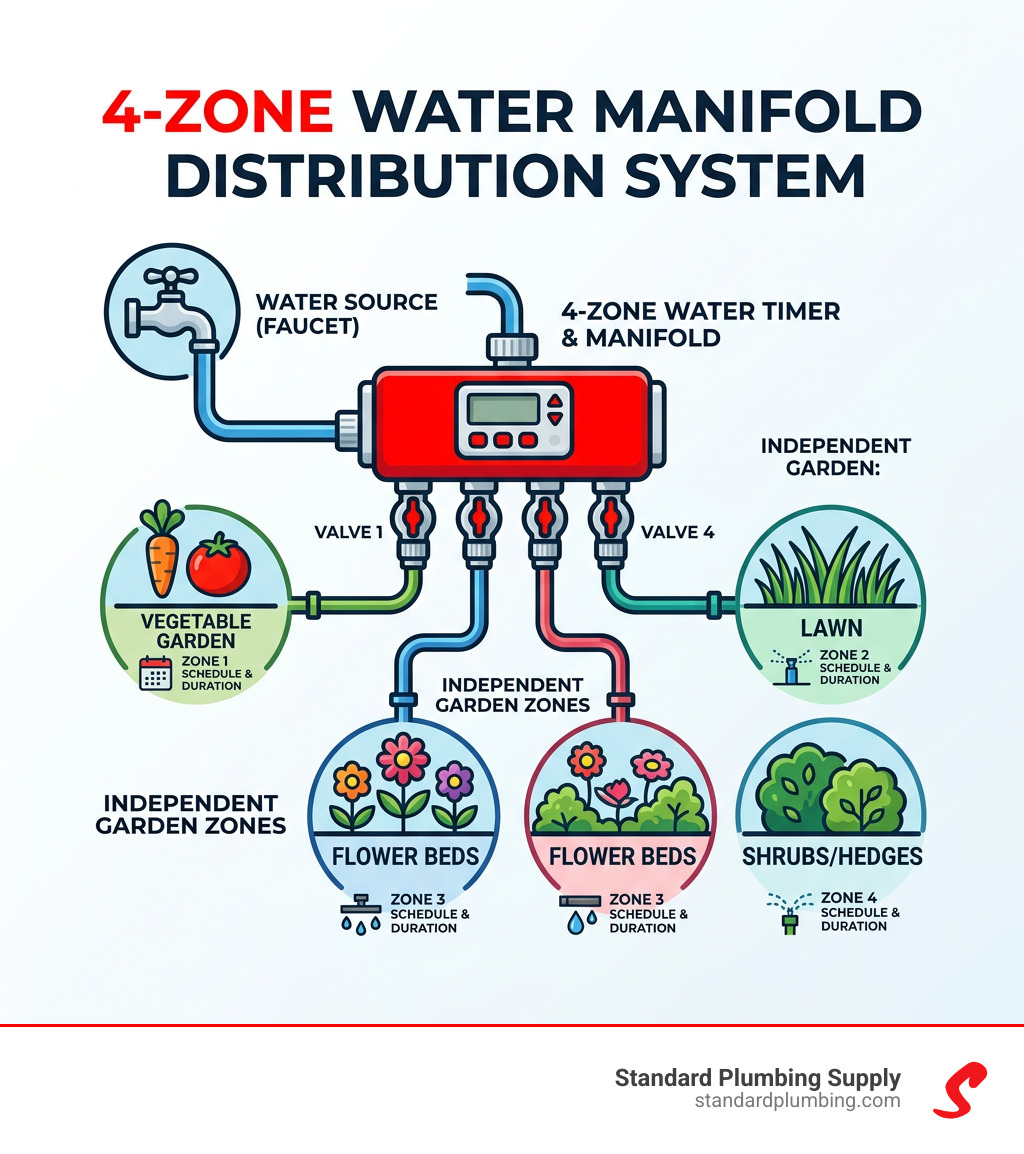
A 4 valve water timer lets you run up to four separate watering zones from a single outdoor faucet — each on its own schedule, its own duration, and its own frequency. That means your vegetable garden, lawn, flower beds, and drip lines can all get exactly what they need, automatically, without you touching a hose.
The problem? Most homeowners default to one or two well-known brands, then end up frustrated with stuck valves, frozen screens, or leaks after just a season or two. There are better options out there — and knowing what to look for makes all the difference.
I’m Jacob Reese, Vice President of Standard Plumbing Supply, and through my work supplying irrigation components to contractors and DIYers across the Western U.S., I’ve seen which 4 valve water timers hold up in the field and which ones end up back on the shelf. Let me walk you through the options worth your money.
Why a 4 Valve Water Timer is the Ultimate Garden Upgrade
If you have ever tried to manage a lawn, a vegetable patch, and a row of shrubs using a single hose, you know the “thirst struggle” is real. A 4 valve water timer acts as the brain of your yard, turning one standard outdoor faucet into a sophisticated distribution hub.
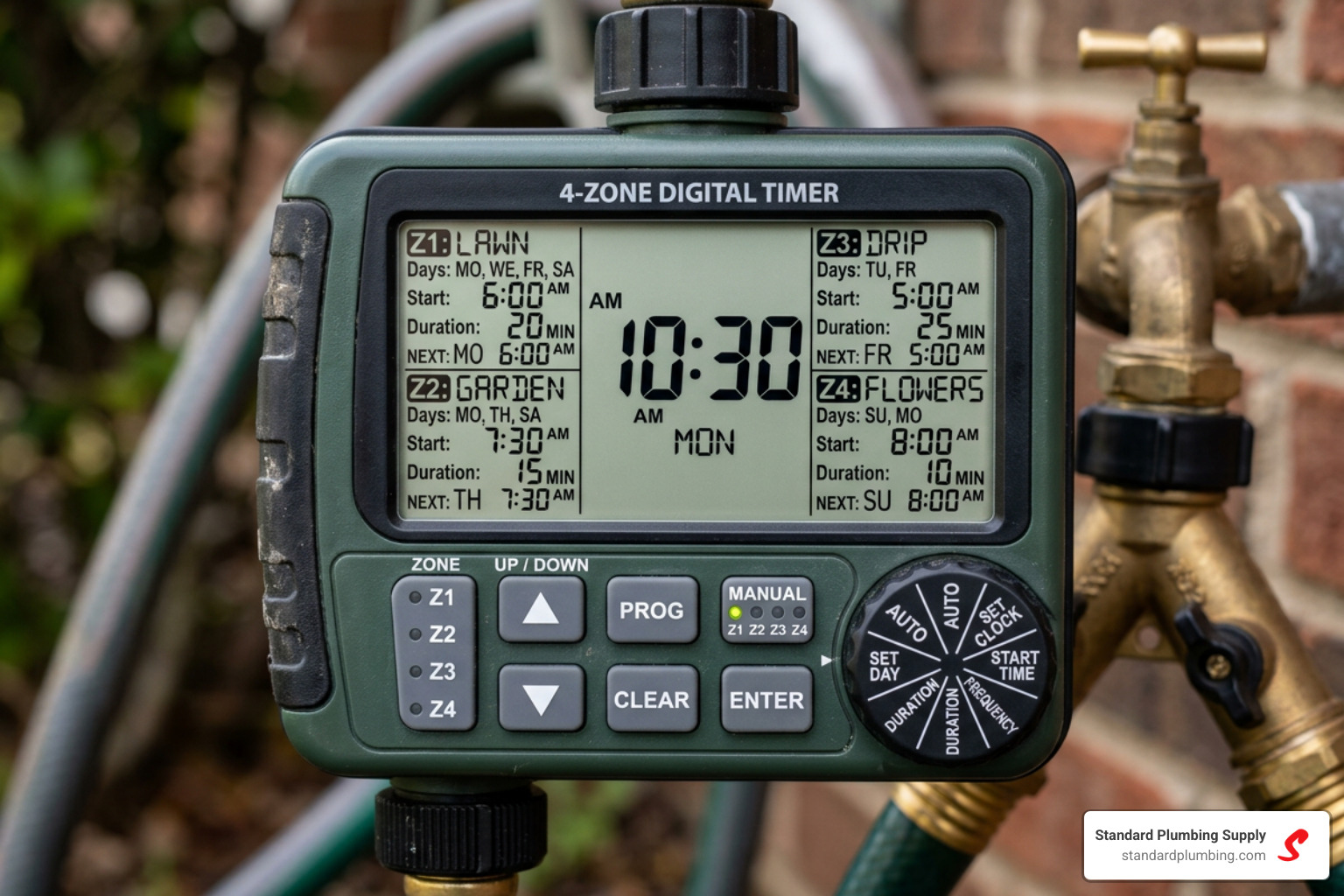
The beauty of these systems lies in independent control. Unlike simple splitters, a 4-zone timer manages water flow sequentially. This is crucial because most residential water lines don’t have enough pressure to run four sprinklers at once. By rotating through zones 1, 2, 3, and 4, the timer ensures each area receives the full flow rate (typically ranging from 0.5 to 6.5 gallons per minute) and stays within the optimal pressure range of 25 to 100 PSI.
Whether you are nourishing delicate tomatoes daily or soaking the lawn every three days, these timers handle the heavy lifting. Many high-quality models feature high-flow valves that don’t restrict your water pressure, allowing for custom durations from a quick 1-minute mist to a deep 240-minute soak.
Exploring Reliable Multi-Zone Irrigation Timers
When we talk about reliability at Standard Plumbing Supply, we look at how these units handle the elements. In states like Utah, Nevada, and Arizona, the sun and hard water are brutal on plastic components.
One standout in the reliability category is the Melnor HydroLogic series. What sets it apart isn’t just the 7-year limited warranty, but the dirt-resistant valves. If you are on a well system in rural Idaho or Wyoming, sand and small particles can easily jam a standard valve. Melnor’s design is specifically built to handle these particulates without sticking open and flooding your yard.
Another innovative approach comes from the Claber Hydro-4. This isn’t just a timer; it’s a self-contained valve box. It carries an IP68 rating, meaning it is dust-tight and can actually be submerged in water. This allows for shallow underground installation-perfect for those who want a clean look without a bulky manifold hanging off the side of the house. If you want a quick primer on how these protection ratings work, the Ingress Protection rating standard is a helpful reference.
Key Features to Look for in a 4 Valve Water Timer
When you’re shopping for a 4 valve water timer, don’t just look at the price tag. Look for these specific features that ensure the unit survives more than one summer:
- Rain Delay: Look for flexible options. Some timers offer a standard 24, 48, or 72-hour delay, while premium models like the Melnor allow you to pause watering for up to 31 days.
- Battery Life: Most units run on 2 AA or AAA batteries. A reliable timer should last an entire watering season on one set. Look for models with a “low power protection” feature that prevents the valves from opening if there isn’t enough juice to close them again.
- Build Quality: An IP54 waterproof rating is the baseline for outdoor use, protecting against splashes and dust. Rust-proof inlets (often made of metal or reinforced polymer) prevent the common issue of the timer snapping off the faucet.
- User Interface: Large LCD screens and tactile dials make programming much easier in the bright afternoon sun.
Programming Your 4 Valve Water Timer for Maximum Efficiency
Programming doesn’t have to be a headache. Most modern timers use a 12/24-hour format and allow you to set multiple start times per day-often up to four per zone.
For those of us in the Western states with heavy clay soil, the “Soil Soak” or ECO mode is a game-changer. Instead of running a zone for 30 minutes straight and watching half the water run off into the gutter, ECO mode breaks the cycle into shorter bursts with “soak breaks” in between. This ensures the water actually reaches the roots.
You can also customize frequency cycles based on local water restrictions, choosing specific days of the week, odd/even dates, or cyclical intervals (e.g., every 3 days).
How to Install and Maintain Your 4-Zone System
Installation is generally a DIY affair. Most 4 valve water timer models feature a standard 3/4″ FHT (Female Hose Thread) inlet that screws directly onto your faucet.
Pro Tip: Always hand-tighten the connection. Using a wrench on plastic threads is a one-way ticket to a stripped inlet. To ensure a leak-free seal, check that the rubber washer is seated flat inside the inlet. If you notice a drip, it’s often a hardened washer rather than a broken timer; these are cheap and easy to replace.
Maintenance and Winterization: In our service areas—from the cold winters of Nebraska to the high altitudes of Colorado—winterization is non-negotiable. Before the first frost hits, you must:
- Remove the timer from the faucet.
- Remove the batteries to prevent corrosion.
- Drain all water from the internal valves.
- Store the unit in a dry, climate-controlled area like a garage or basement.
| Feature | Battery-Operated (Hose-End) | Wired Indoor (e.g., Rain Bird SST) |
|---|---|---|
| Installation | Seconds; no tools required | Requires wiring to valves and outlet |
| Location | Directly on the outdoor faucet | Indoor (Garage/Shed) |
| Power Source | 2 AA or AAA batteries | 120V AC Plug-in |
| Best Use | Garden hoses, flower beds, DIY drip | Permanent in-ground sprinkler systems |
| Reliability | High, but sensitive to sun/ice | Highest; electronics stay protected |
Troubleshooting Your 4 Valve Water Timer
Even the best gear can have an off day. Here are the most common issues we see at our store locations:
- Valve Sticking: If water is trickling out when the timer is “off,” there might be debris in the valve. Try running the manual cycle for a few minutes to flush it out.
- Screen Freezing: Intense UV exposure can “cook” an LCD. If possible, choose a model with a protective cover or install it in a shaded spot.
- Plastic Stripping: If the manifold feels loose, check the threads. If you’ve stripped the plastic, you may need a replacement manifold.
- Signal Interference: For “Smart” timers, ensure your Wi-Fi hub is within range and not blocked by thick masonry walls.
Frequently Asked Questions about 4-Zone Timers
Can I use a 4-valve timer for both drip irrigation and sprinklers?
Absolutely. In fact, this is the best way to use them. You can dedicate Zone 1 to your lawn’s oscillating sprinklers (high flow) and Zone 2 to a drip irrigation system for your flower pots (low flow). Just keep in mind that drip systems often require a pressure regulator (usually to 25 PSI) and a filter, which should be installed after the timer on that specific line. You can find specialized parts for this through professional irrigation support channels.
How long do the batteries typically last in these units?
With high-quality alkaline batteries, you should easily get a full 6-month watering season. We always recommend replacing them at the start of spring, regardless of the “low battery” indicator, to avoid mid-summer failures. Cold weather significantly drains battery life, which is another reason to store the unit indoors during winter.
What is the difference between IP54 and IP68 ratings?
This is all about “Ingress Protection.” IP54 means the timer is protected against dust and water splashes from any direction (standard rain). IP68, found on premium units like the Claber Hydro 4, means the unit is completely dust-tight and can be continuously submerged in water. If you plan on burying your valve box or if your faucet is in a flood-prone area, IP68 is the way to go.
Conclusion
Upgrading to a 4 valve water timer is one of the smartest moves you can make for your home garden. It saves water, protects your plants from your own forgetfulness, and gives you back your weekend mornings. While there are many brands out there, focusing on build quality, warranty, and specific features like ECO mode will ensure you get a system that lasts.
At Standard Plumbing Supply, we’ve been helping folks across the West build better gardens for decades. Whether you’re in Salt Lake City, Boise, or San Diego, our experts are ready to help you find the right parts for your project. If you’re ready to automate your yard, you can Shop Sprinkler and Irrigation Tools online or visit one of our many locations to see these timers in person.
Happy watering!
