
Why Instant Hot Water at Your Sink Matters
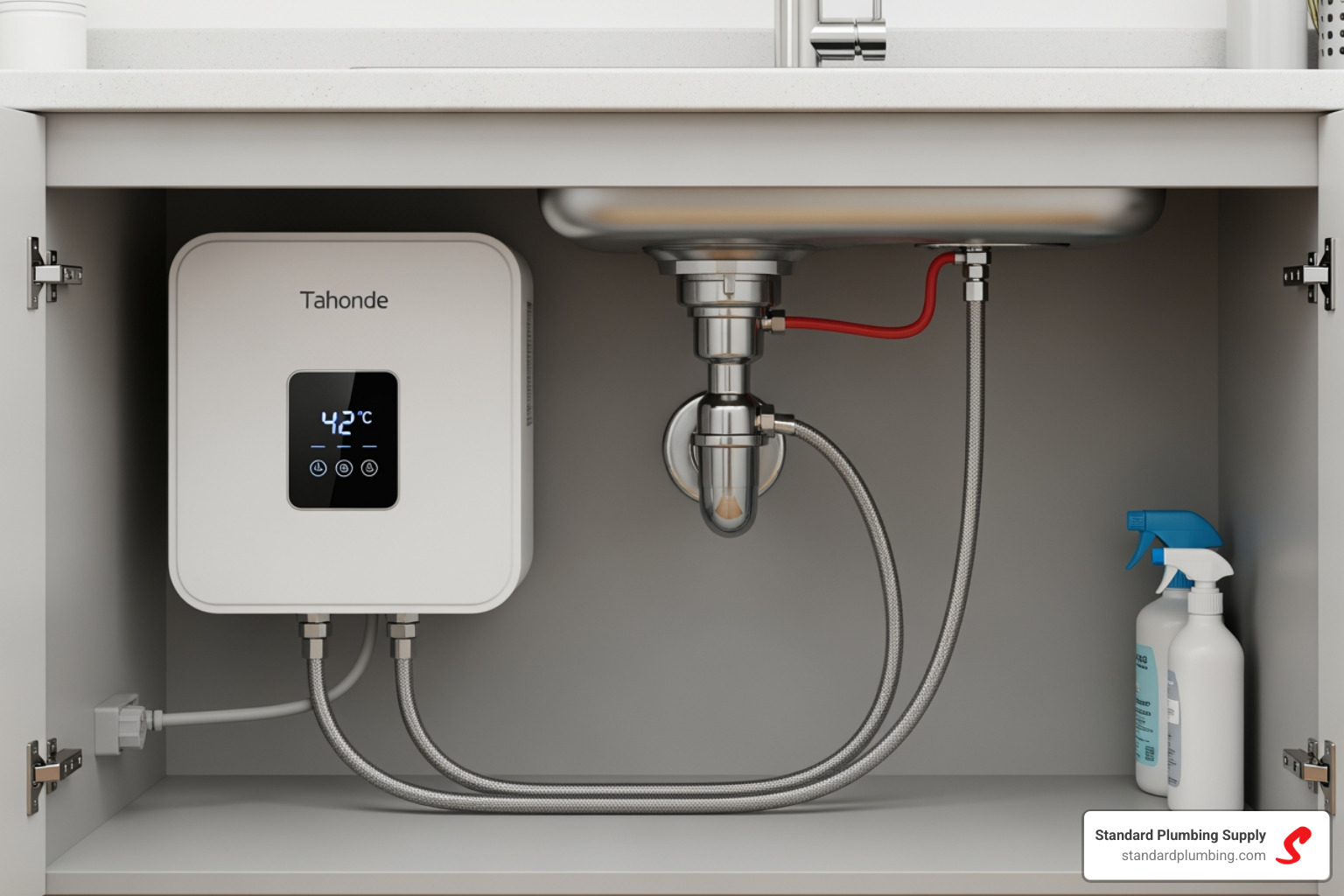
An under sink tankless water heater 220v delivers instant hot water right where you need it, without the wait or wasted water from long pipe runs. Here’s what makes these units a smart choice for your home:
- Higher Power Output: 220V units typically range from 3.5kW to 27kW, providing faster heating and higher flow rates than 120V models
- Instant Hot Water: No more running the tap for a minute waiting for warm water to arrive
- Energy Efficiency: Only heats water on demand, eliminating standby heat loss from storage tanks
- Space-Saving Design: Compact units mount easily under sinks, freeing up valuable cabinet space
- Best For: Kitchen sinks, bathroom vanities far from your main heater, workshop areas, or small office kitchenettes
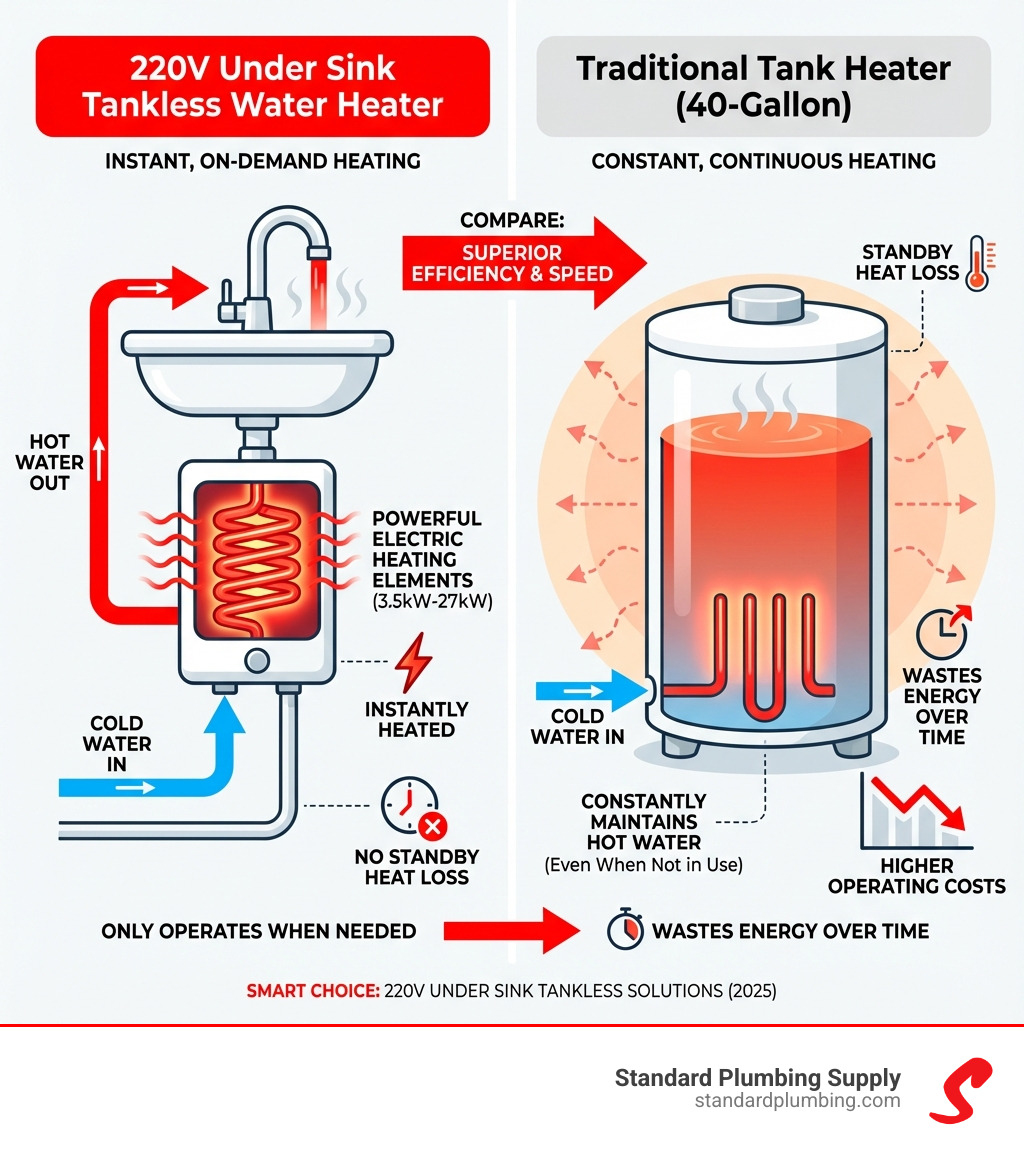
These point-of-use heaters work by heating water instantly as it flows through the unit. When you turn on your hot water tap, cold water enters the heater, passes over powerful electric heating elements, and emerges hot—all in seconds. Unlike traditional tank heaters that constantly maintain 30-50 gallons of hot water (even when you’re not using it), tankless models only operate when needed.
The 220V specification is crucial. While 120V “plug-in” models exist, they’re limited to about 1.5kW and can only raise water temperature modestly. A 220V unit can deliver 6.5kW or more, providing enough power to comfortably serve a kitchen sink or bathroom faucet even in colder climates where incoming groundwater might be 40-50°F.
Popular models like the Titan SCR2 series offer flow rates from 1.5 to 2.5 GPM at 220V/240V, while larger units can reach 4+ GPM. Prices typically range from $245 to $500, with professional installation required due to the electrical demands (usually a dedicated 60-amp circuit with 6 AWG wiring).
I’m Jacob Reese, Vice President of Standard Plumbing Supply and a third-generation plumbing professional who’s worked with contractors installing under sink tankless water heater 220v systems across the Western United States for years. Through hands-on experience and feedback from thousands of installations, I’ve seen how the right point-of-use heater transforms daily routines and cuts energy waste.
The Power of Point-of-Use: Key Benefits
When we talk about the benefits of an under sink tankless water heater 220v, we’re really talking about convenience, efficiency, and smart space utilization. These compact powerhouses are designed to deliver hot water exactly when and where you need it, making them an excellent solution for various applications in homes and businesses across our service areas, from the busy kitchens of California to the remote cabins of Wyoming.
Why Choose a 220V Under Sink Tankless Water Heater?
The “220V” in under sink tankless water heater 220v is a game-changer. It signifies a higher power output compared to its 120V counterparts, which translates directly into superior performance. Why does this matter?
- Higher Power Output: With power ratings that can soar from 3.5 kW up to 27 kW, these units can handle significant heating demands. For instance, a GE04SNLPDG model offers 3.5 kW, while a GE27DNHPDG model boasts a powerful 27 kW. This higher wattage means they can heat water more effectively and maintain temperature even when the incoming water is quite cold.
- Faster Temperature Rise: Imagine turning on the tap and getting hot water almost instantly. A 220V unit heats water much faster because of its greater electrical capacity. This is particularly beneficial in colder climates where groundwater temperatures can drop significantly.
- Supports Higher Flow Rates: More power means more hot water, faster. Models like the Rheem Professional Classic Series RTEX-13 kW can provide 1.3 – 2.3 GPM (Gallons Per Minute), while the RTEX-24 kW can deliver 2.4 – 4.3 GPM. This is crucial for applications like a kitchen sink where you might need a decent flow for washing dishes.
- Suitable for Colder Climates: In states like Idaho, Colorado, or Wyoming, where winter brings frigid temperatures, the incoming water can be very cold. A 220V unit has the muscle to raise that water to a comfortable temperature, ensuring consistent hot water performance regardless of the season. For example, a Titan SCR2 N-120 can achieve a 48°F rise at 2.0 GPM.
- Consistent Performance: Thanks to self-modulating technology (a feature in many GE models, for instance), these heaters adjust their power consumption to match the hot water demand. This ensures a consistent output temperature, preventing those annoying hot-then-cold fluctuations you might experience with less advanced systems.
Energy and Water Conservation Explained
One of the most compelling reasons our customers choose an under sink tankless water heater 220v is its remarkable energy and water efficiency.
- Eliminates Standby Heat Loss: Traditional tank water heaters constantly heat and reheat a large volume of water, even when no one is using it. This process leads to “standby heat loss,” where energy is wasted simply keeping the water hot. Tankless units, by contrast, only activate when hot water is requested. This “on-demand” heating significantly reduces energy waste.
- Heats Water Only on Demand: This is the core principle of tankless technology. You get hot water only when you need it, and the unit only consumes energy during those moments. This targeted heating translates to lower utility bills. Many models, like those from Rheem, boast impressive UEF (Uniform Energy Factor) ratings, with electric models reaching up to 0.96, indicating high energy efficiency.
- Reduces Wait Time for Hot Water: Beyond energy savings, there’s the immediate benefit of convenience. Long pipe runs from a central water heater mean you often have to let water run for a while before it gets hot. This wastes precious water. By installing an under sink tankless water heater 220v right at the point of use, you drastically cut down on this waiting time, saving gallons of water with every use. Imagine the water saved at a busy kitchen sink in a restaurant in Las Vegas or a home in Phoenix!
- Lower Utility Bills: The combination of eliminating standby loss and heating only on demand directly results in lower electricity consumption, leading to noticeable savings on your monthly energy bills.
Maximizing Your Space
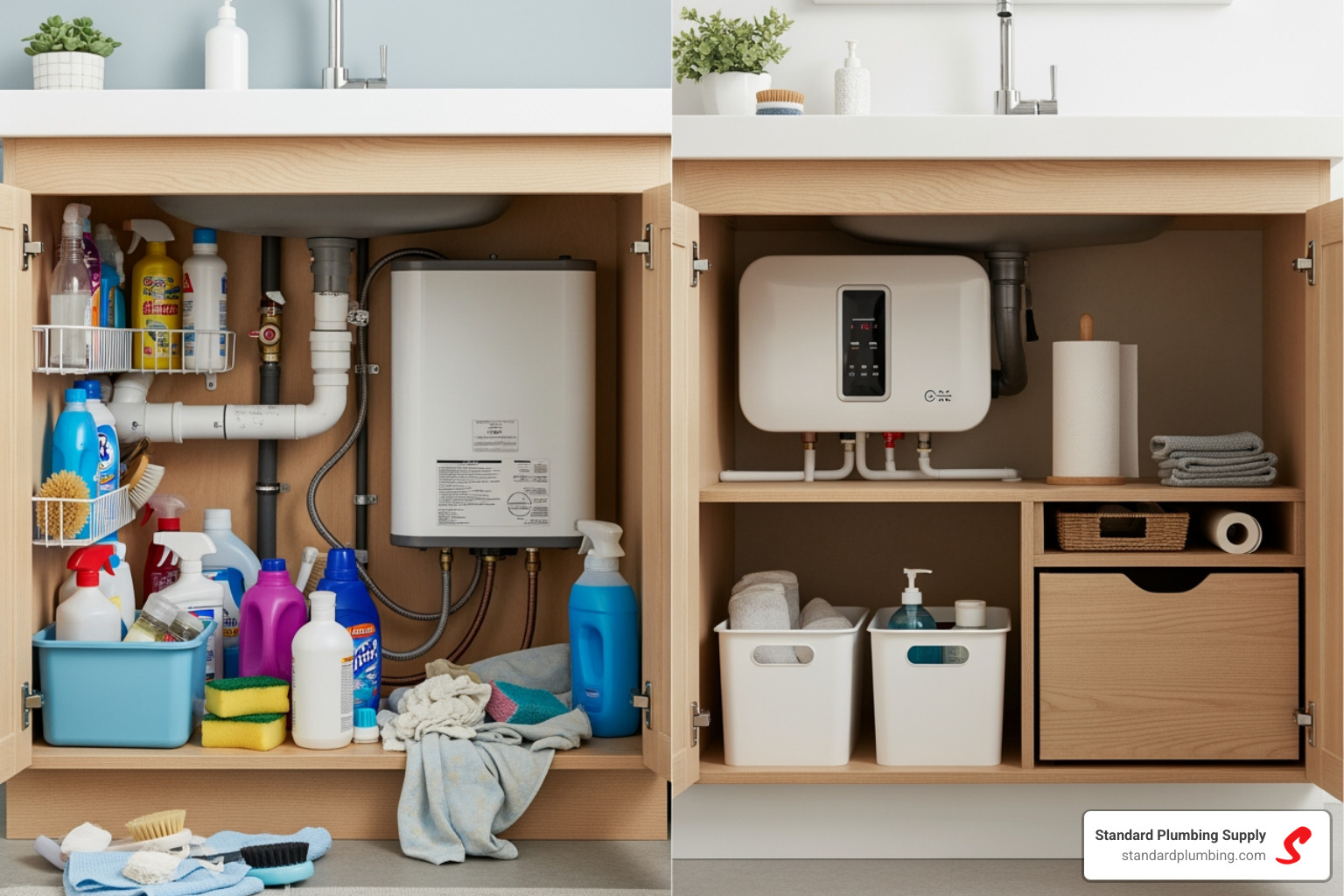
Space is a luxury, especially in modern homes and commercial spaces. One of the less obvious, but highly appreciated, benefits of an under sink tankless water heater 220v is its compact size.
- Frees Up Cabinet Space: Unlike bulky tank water heaters that can monopolize an entire cabinet or utility closet, under-sink tankless units are remarkably small. For example, the Titan N-120S measures a mere 7″W x 10″H x 2.75″D. This leaves valuable space free for cleaning supplies, plumbing access, or whatever else you need to store.
- No Bulky Tank: The absence of a large storage tank is key. This slim profile allows for discreet installation, keeping your living or working areas uncluttered.
- Lightweight Design: These units are also lightweight (e.g., the Titan N-120S weighs just 8 lbs), making them easier to handle during installation and less likely to strain existing cabinetry.
- Wall-Mountable: Many models are designed to be mounted directly to the cabinet wall, further optimizing space and keeping the floor clear. This is perfect for small kitchens in Salt Lake City apartments or compact bathrooms in San Diego.
Key Features to Look For in a 220V Unit
Choosing the right under sink tankless water heater 220v involves understanding a few key technical specifications. These features dictate how well the unit will perform for your specific needs, whether it’s a busy kitchen sink or a rarely used handwashing station.
Understanding Flow Rate (GPM) and Temperature Rise
These two metrics are intimately linked and are perhaps the most critical for sizing your tankless water heater.
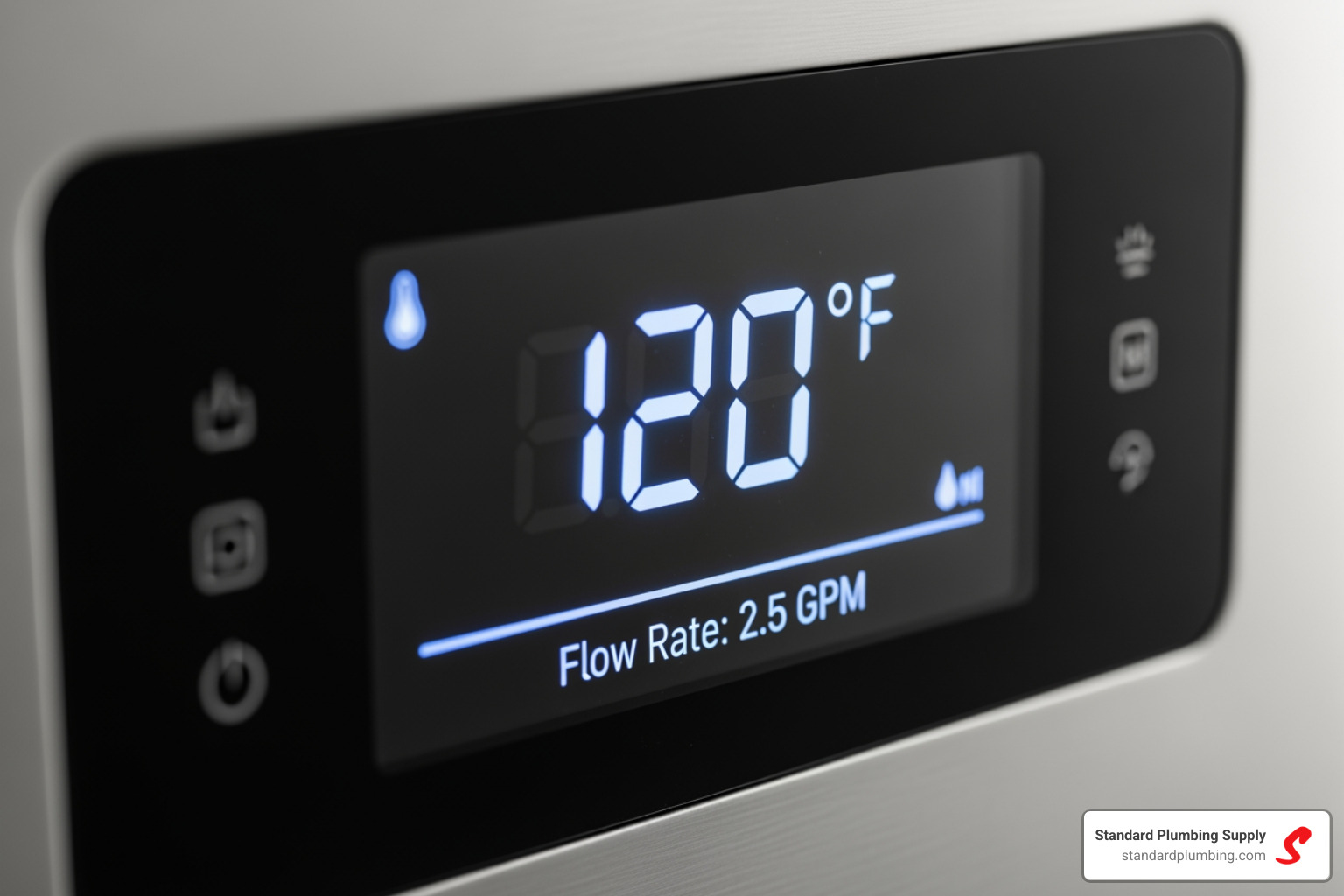
- GPM (Gallons Per Minute) Ratings: This tells you how much hot water the unit can deliver per minute. For an under-sink application, you generally won’t need a massive GPM, but it’s important to match it to your fixture’s demand. Our research shows units with flow rates ranging from 0.8 GPM up to 4.3 GPM for specific electric models. For example, a TITAN SCR-2 3.2 kW delivers 1.5 GPM, while a 6.5 kW version can push 2.5 GPM.
- Groundwater Temperature Impact: This is a crucial factor, especially in areas with significant seasonal temperature swings like Utah or Nevada. The colder your incoming water, the more power (kW) a heater needs to achieve a desired temperature rise at a certain flow rate. For instance, a unit that provides a 40°F rise at 2 GPM in warm California might only provide a 20°F rise at the same GPM in cold winter conditions in Idaho.
- Sizing for Your Fixture:
- A typical kitchen faucet might draw 1.5-2.0 GPM.
- A bathroom sink faucet usually draws 0.5-1.0 GPM.
- For hand washing or light dishwashing, a unit with 1.5-2.5 GPM like the TITAN SCR-2 6.5 kW (2.5 GPM) is often sufficient.
- Temperature Rise Calculation: This refers to how many degrees Fahrenheit the heater can raise the incoming water temperature. Manufacturers provide charts, like those for the Titan SCR2 N-120, showing temperature rise at various GPMs. For example, the N-120S can provide an 83°F rise at 1.0 GPM, but only a 21°F rise at 4.0 GPM. This helps us understand real-world performance based on your local groundwater temperature.
Power (kW) and Self-Modulating Technology
The power rating, measured in kilowatts (kW), directly correlates to the heating capacity of the unit.
- kW Ratings from 3.5kW to 27kW: As we’ve seen, electric tankless heaters come in a wide range of power outputs. Smaller units like the GE04SNLPDG at 3.5 kW are perfect for a single, low-flow sink. Larger units, such as the GE27DNHPDG at 27 kW, might be overkill for a single under-sink application but illustrate the range of power available in 220V models.
- Matching kW to Demand: It’s essential to select a kW rating that can meet your hot water needs. Too low, and you’ll get lukewarm water or insufficient flow. Too high, and you’re paying for capacity you don’t need (and possibly overstressing your electrical panel).
- Energy Optimization with Self-Modulating Technology: This advanced feature, common in Rheem and GE models, allows the heater to adjust its power usage based on the incoming water temperature and the desired output temperature. This means the unit only uses the energy necessary to heat the water to your set point, optimizing energy efficiency and ensuring consistent output temperature. It’s like having a smart thermostat for your water heater!
- Consistent Output Temperature: Thanks to self-modulating technology, you won’t experience sudden drops in water temperature. The heater continuously monitors and adjusts, providing a steady flow of hot water at your chosen temperature.
- Scale Reduction Technology: Some advanced units, including certain GE models, incorporate scale reduction technology. This is particularly valuable in areas with hard water, like many parts of Arizona or Utah. Scale buildup can reduce efficiency and shorten the lifespan of heating elements, so features that mitigate this are a big plus.
How 220V POU Heaters Compare to Other Options
Navigating water heaters can feel like a maze, but understanding the differences between types, especially for under-sink applications, helps clarify your choices. We often get questions about how under sink tankless water heater 220v units stack up against other common solutions.
220V Tankless vs. 120V “Plug-in” Models
The primary distinction here lies in power and performance.
- Power Limitations of 120V: Most 120V electric tankless heaters are designed for very low-flow applications, like a single handwashing sink. They typically have a lower wattage, often around 1.3 kW (like the Stiebel Eltron SHC 2.5, 4, or 6, which are 1300W and 11.3A). This limits their ability to significantly raise the water temperature, especially with colder incoming water or higher flow demands.
- Higher Performance of 220V: A under sink tankless water heater 220v, with its higher wattage (e.g., 3.2 kW to 27 kW), can provide a much greater temperature rise and higher flow rates. This makes them suitable for kitchen sinks, where you might need hot water for washing dishes, or even a small utility sink that sees frequent use.
- Electrical Requirements Difference: 120V units often plug into a standard 15A outlet, making installation simpler. 220V units, however, require a dedicated 220V/240V circuit with a specific breaker and wire gauge, which usually necessitates professional electrical work.
- Application Suitability: If you need hot water for a single, very low-flow faucet for occasional handwashing, a 120V unit might suffice. But for any task requiring a consistent flow of genuinely hot water, the 220V model is the clear winner.
Tankless vs. Under Sink Mini-Tank Heaters
This is another common comparison, as both are compact, point-of-use solutions.
- On-Demand vs. Stored Hot Water: This is the fundamental difference. A tankless unit heats water as it flows, meaning truly endless hot water within its GPM capacity. A mini-tank heater (like the Stiebel Eltron SHC series) stores a small volume of hot water (2.5, 4, or 6 gallons). Once that stored water is depleted, you have to wait for the tank to refill and reheat.
- Standby Loss Comparison: While mini-tanks are much more efficient than full-sized tank heaters, they still experience some standby heat loss because they are constantly maintaining a small volume of hot water. Tankless units, with their on-demand nature, eliminate standby loss entirely, making them inherently more energy-efficient in this regard. The Stiebel Eltron SHC mini-tanks, for example, have standby losses ranging from 0.37 to 0.43 kW/day.
- Flow Rate Limitations of Mini-Tanks: Mini-tanks typically have lower flow rate capabilities and are limited by their storage capacity. Once the tank is empty, the flow becomes cold. Tankless units are limited by their GPM rating and temperature rise capability, but they can provide hot water continuously up to that limit.
- Recovery Time: For mini-tanks, recovery time is the period it takes to heat a fresh tank of cold water. The Stiebel Eltron SHC 6, for instance, has a recovery time of 45 minutes for its 6-gallon capacity. Tankless units don’t have a “recovery time” in the same sense; they heat instantly.
- Lifespan Differences: Both types can offer good lifespans with proper maintenance, but the direct heating of a tankless unit often means fewer components constantly under pressure or temperature fluctuations compared to a tank that cycles on and off.
Here’s a quick comparison table to summarize:
| Feature | 220V Tankless | 120V Tankless | Mini-Tank Heater |
|---|---|---|---|
| Power Output (kW) | 3.2 kW – 27 kW | ~1.3 kW – 3.0 kW | ~1.3 kW |
| Typical GPM | 1.5 GPM – 4.3 GPM | 0.5 GPM – 1.0 GPM (very low flow) | Limited by tank size (initial burst, then slow) |
| Installation Needs | Dedicated 220V/240V circuit, professional | Standard 120V outlet, simpler | Standard 120V outlet, simpler |
| Best Use Case | Kitchen sinks, multiple low-flow fixtures | Single handwashing sink, very low demand | Single sink, intermittent use, booster for long runs |
| Cost (Unit only) | $245 – $500+ | $150 – $300 | $100 – $300 |
| Standby Loss | None (heats on demand) | None (heats on demand) | Minimal (keeps small tank hot) |
Installation and Maintenance for Your Under Sink Tankless Water Heater 220V
Proper installation and routine maintenance are key to ensuring your under sink tankless water heater 220v operates safely, efficiently, and for its full expected lifespan. Given the electrical demands, professional installation is almost always recommended.
Installation Essentials for an Under Sink Tankless Water Heater 220V
Installing a 220V electric appliance requires specific electrical and plumbing expertise. We at Standard Plumbing Supply always emphasize the importance of having a qualified professional handle these installations.
- Dedicated 220V/240V Circuit: This is non-negotiable. A 220V/240V tankless water heater draws significant power, far more than a standard 120V circuit can handle. It requires its own dedicated circuit directly from your electrical panel.
- Double-Pole Breaker: Depending on the unit’s wattage, you’ll need a specific double-pole breaker. For example, Titan SCR2 N-120 and N-120S models typically require a 60 Double Pole breaker. Larger units will require even higher amperage breakers (e.g., GE models can require multiple 40 Amp circuits).
- Proper Wire Gauge (e.g., 6 AWG): The electrical wiring leading to the unit must be of the correct gauge to safely carry the required amperage. For a 60 Amp breaker, 6 AWG wire is commonly specified, but always consult local electrical standards and the manufacturer’s instructions. Incorrect wire sizing can be a serious fire hazard.
- Plumbing Connections (1/2″ or 3/4″ NPT): Most under-sink models will have standard 1/2″ NPT (National Pipe Taper) water connections. Some larger models might use 3/4″ connections. Ensure your plumbing is ready for these connections. We carry a variety of components, including a Water Heater Kit 3/4 to help with seamless installation.
- Access Professional Training Resources: For our professional installers, resources like Rheem’s Training programs offer invaluable insights into best practices for installation and service, ensuring every job is done right.
It’s crucial to consult your local professional for guidance on voltage, amperage, breaker, and wire size, as these may vary depending on local electrical codes in Arizona, California, Colorado, Idaho, Nebraska, Nevada, Oregon, Utah, and Wyoming.
Routine Maintenance and Expected Lifespan
Like any appliance, an under sink tankless water heater 220v benefits from regular care to maintain optimal performance and extend its life.
- Descaling in Hard Water Areas: Many of our service areas, especially in the Western United States, have hard water. Minerals in hard water can build up as scale on the heating elements, reducing efficiency and eventually damaging the unit. Annual descaling (flushing with a vinegar solution or specialized descaling agent) is highly recommended in these areas.
- Flushing the Unit Annually: Even in soft water areas, flushing the unit once a year helps remove any sediment or debris that may have accumulated. This simple process can prevent blockages and maintain flow.
- Checking Connections: Periodically inspect water and electrical connections for any signs of leaks or corrosion. Addressing small issues early can prevent larger, more costly repairs down the line.
- Lifespan of 10+ Years: With proper installation and consistent maintenance, you can expect an under sink tankless water heater 220v to last 10-20 years, often outliving traditional tank water heaters.
- Warranty Considerations: Always be aware of your unit’s warranty. For example, Titan models typically offer a 1-year warranty on electrical components and a generous 10-year warranty on water components. GE offers a 5-year limited replacement warranty. Adhering to maintenance schedules is often a condition of warranty validity.
Frequently Asked Questions about 220V Under Sink Heaters
We hear a lot of great questions about these versatile units. Here are some of the most common ones we encounter:
Can a 220V under-sink unit supply a whole house?
Generally, no. An under sink tankless water heater 220v is specifically designed for point-of-use applications. While powerful for its size, it’s not intended to meet the hot water demands of an entire home, which typically involves multiple showers, washing machines, and dishwashers running simultaneously.
However, a robust under-sink unit can capably supply hot water to multiple low-flow fixtures simultaneously, such as a kitchen sink and a nearby handwashing sink. For whole-home solutions, you would need a much larger, dedicated whole-home tankless water heater (which would also be 220V/240V but with significantly higher kW and GPM ratings).
What does “temperature rise” mean?
“Temperature rise” is a critical concept for tankless water heaters. It refers to the number of degrees Fahrenheit (or Celsius) the heater can increase the incoming water temperature at a given flow rate.
For example, if your incoming groundwater is 50°F and you want 105°F water for your sink, you need a temperature rise of 55°F. The manufacturer’s specifications will tell you what GPM the unit can achieve at that required temperature rise. If you live in a colder climate (like parts of Utah or Colorado in winter), you’ll need a unit capable of a higher temperature rise compared to someone in a warmer climate (like Southern California or Arizona) where incoming water is naturally warmer. It’s the most important factor in sizing your unit correctly.
Is professional installation necessary?
Yes, for an under sink tankless water heater 220v, professional installation is highly recommended, and often required by local codes. Here’s why:
- Involves High-Voltage Electrical Work: Connecting a 220V appliance to your home’s electrical system is not a DIY task for the inexperienced. It requires installing a dedicated circuit, a double-pole breaker, and specific wire gauges. Mistakes can lead to electrical fires, shock hazards, or damage to your home’s electrical system.
- Plumbing Connections: While plumbing might seem straightforward, ensuring leak-free connections and proper water flow is essential for the unit’s performance and to prevent water damage.
- Ensures Safety and Code Compliance: A professional installer understands local building and electrical codes (which can vary even within states like California or Idaho) and will ensure your installation meets all safety standards. This protects your home and ensures you pass any necessary inspections.
- Validates Warranty: Many manufacturers require professional installation for their product warranties to remain valid. Attempting a DIY installation could void your warranty, leaving you responsible for any future repairs.
At Standard Plumbing Supply, we partner with experienced professionals across our regions who are experts in these installations, ensuring peace of mind for our customers.
Find the Right Fit for Your Home
A under sink tankless water heater 220v offers a powerful, efficient, and space-saving solution for instant hot water right where you need it. By understanding your flow rate needs and electrical capacity, you can choose a unit that provides endless hot water while saving energy and space. For expert advice and to explore a wide range of plumbing solutions, trust the professionals. Standard Plumbing Supply has the parts and expertise to help with your next project.
