
Essential Types of 1 1 2 Galvanized Pipe Fittings
#
1 1 2 galvanized pipe fittings are widely available from professional plumbing supply distributors and specialized online retailers. Here’s a quick summary of your best options:
| Source | Best For | Price Range |
|---|---|---|
| Standard Plumbing Supply | Contractors, DIY, bulk orders, wholesale pricing | Competitive wholesale |
| Local plumbing supply houses | Same-day availability, trade accounts | Varies |
Common types available in 1-1/2 inch galvanized:
- Couplings
- 90-degree and 45-degree elbows
- Tees and crosses
- Floor flanges
- Nipples (various lengths)
- Reducing couplings and bushings
- Caps, plugs, and unions
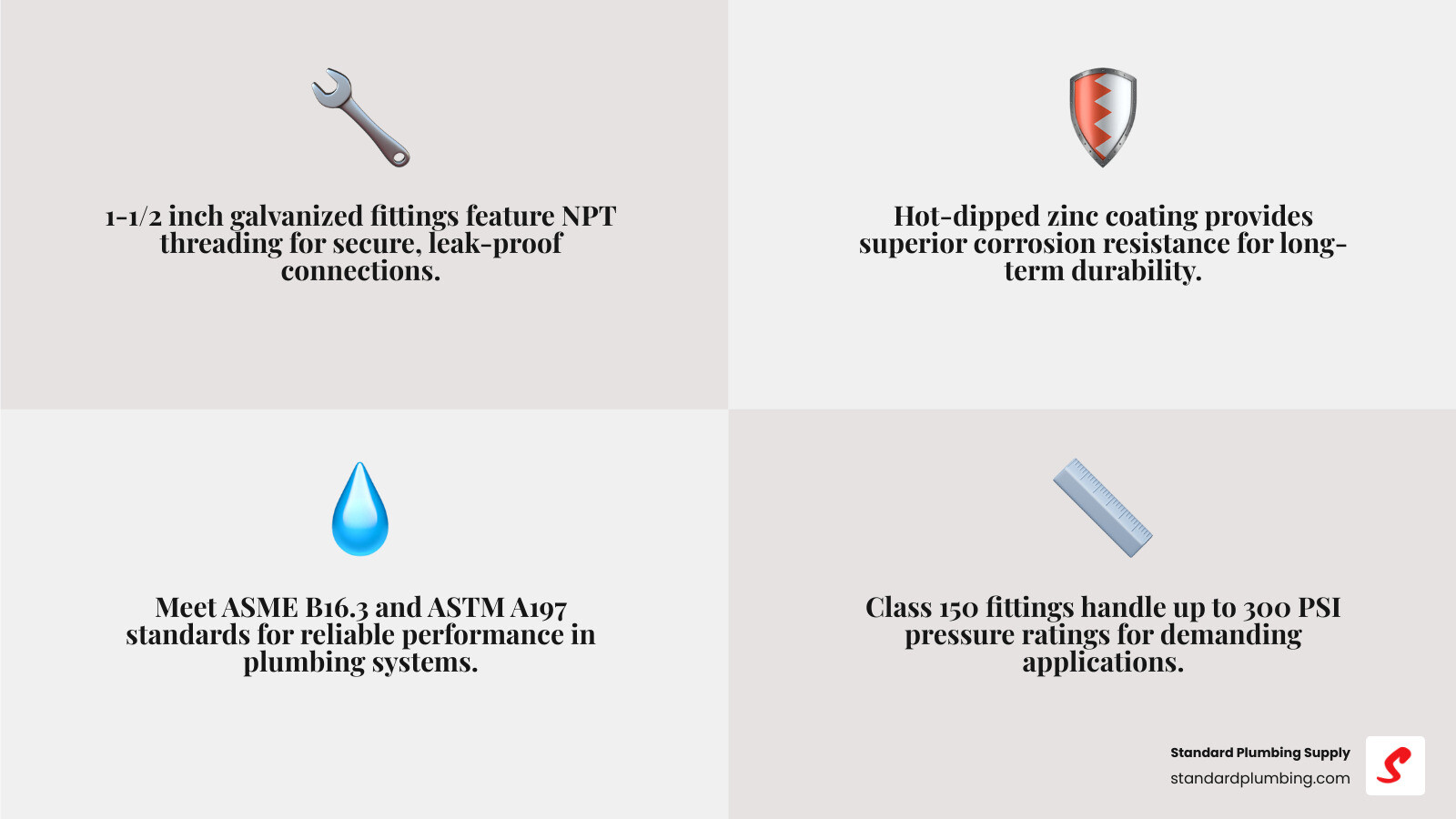
These fittings are made from galvanized malleable iron or galvanized carbon steel, with a zinc coating that resists corrosion. Most are threaded with NPT connections and meet standards like ASME B16.3 and ASTM A197.
They’re used in water supply lines, drainage systems, fire protection, and even DIY industrial-style furniture.
I’m Jacob Reese, Vice President of Standard Plumbing Supply — a third-generation, family-owned wholesale distributor where I’ve spent my career sourcing and supplying 1 1 2 galvanized pipe fittings to contractors and tradespeople across the Western United States. In this guide, I’ll walk you through exactly where to buy these fittings, what to look for, and how to make sure you’re getting the right product for your project.
Learn more about 1 1 2 galvanized pipe fittings:

When you walk into one of our Standard Plumbing Supply locations—whether you are in Salt Lake City, Boise, or Phoenix—you’ll see that 1 1 2 galvanized pipe fittings come in a dizzying array of shapes. Each serves a very specific purpose in a piping “skeleton.”
The most fundamental piece is the 1-1/2″ Galvanized Coupling. We use these to connect two lengths of pipe in a straight line. If you are working on a long run of water supply line, you’re going to need a handful of these. They are typically 100% pressure tested to ensure they won’t leak under the stress of a pressurized system.
Next up are the elbows. When your plumbing needs to take a turn, you reach for a 90-degree or 45-degree elbow. Sometimes, however, you need to transition from a larger main line to a smaller branch. That is where 1-1/2″ x 3/4″ Reducing Elbows come into play. These are fantastic for residential irrigation or specific industrial setups where flow volume needs to be adjusted mid-turn.
If you need to split your line into two directions, you’ll want 1-1/2″ Galvanized Tees. These create a T-junction, allowing water to flow straight through while also branching off at a 90-degree angle.
For those of you working on structural projects or drainage, floor flanges are a staple. A galvanized floor flange provides a flat surface to secure a pipe to a floor or wall. While they are plumbing-grade, we see them used just as often for heavy-duty shelving brackets or table legs.
Sometimes you don’t need a turn or a branch; you just need to connect two pipes of different sizes. We stock 1-1/2″ x 1-1/4″ Reducing Couplings to bridge that gap smoothly.
Finally, every system needs a way to close off. Caps and plugs are the “dead ends” of the plumbing world. A cap fits over the male threads of a pipe, while a plug—like these 1/2″ Galvanized Plugs—screws into a female fitting.
Selecting the Right 1 1 2 Galvanized Pipe Fittings for Residential Use
In residential plumbing, safety and compatibility are the names of the game. Most 1 1 2 galvanized pipe fittings use NPT (National Pipe Thread) connections. You’ll encounter two main types: FPT (Female Pipe Thread) and MPT (Male Pipe Thread). Knowing which is which prevents that frustrating moment of realizing you have two “male” ends and nothing to join them.
If you are working on a system that carries drinking water, lead-free compliance is non-negotiable. Look for fittings certified to NSF/ANSI 61-4. This ensures the zinc coating and the underlying metal don’t leach harmful substances into your morning coffee. Many modern galvanized fittings are hot-dipped and treated specifically to be “potable water safe.”
Transitioning between sizes in a tight space? 1-1/2″ x 3/4″ Hex Bushings are a lifesaver. They screw into a larger 1-1/2 inch opening and provide a smaller 3/4 inch threaded hole, saving you the bulk of a full-sized reducing coupling.
Industrial Standards for 1 1 2 Galvanized Pipe Fittings
For our industrial customers in the oil, energy, or fire protection sectors, “close enough” doesn’t cut it. These fittings must meet rigorous standards to ensure they won’t fail under pressure.
- ASTM A197: This is the standard specification for cupola malleable iron. It ensures the metal has the right ductility and strength.
- ASME B16.3: This covers the dimensions and ratings for malleable iron threaded fittings.
- UL/FM Approval: If you’re installing a fire sprinkler system, your insurance company and the local fire marshal will look for the UL (Underwriters Laboratories) and FM (Factory Mutual) stamps.
Interestingly, while many of these are labeled as “Class 150” (rated for 150 PSI), they are often UL/FM approved at up to 300 PSI for fire protection applications. If you’re looking for the full technical data sheets on these ratings, make sure to upgrade your browser to view the high-resolution PDFs and CAD drawings often provided by manufacturers like Matco-Norca or Southland.
Technical Specifications and Pressure Ratings
Understanding the “Class” of a fitting is vital. Most residential and light commercial work uses Class 150 fittings. However, heavy industrial sites might require Class 300 for high-pressure steam or chemical lines.
| Specification | Class 150 | Class 300 |
|---|---|---|
| Max Pressure (Water/Oil/Gas) | 300 PSI | 600-2000 PSI |
| Steam Pressure | 150 PSI | 300 PSI |
| Material Standard | ASTM A197 | ASTM A197 |
| Thread Standard | ASME B1.20.1 | ASME B1.20.1 |
The manufacturing process is equally rigorous. High-quality 1 1 2 galvanized pipe fittings undergo 100% air testing under water to check for pinhole leaks. They also conform to ASTM A153 for the hot-dipped zinc coating, which provides that signature silver-grey corrosion resistance.
When you’re dealing with larger setups, you might need to step down from a 3-inch main line. We provide 3″ x 1-1/2″ Galvanized Bushings that meet all ISO 9001 quality certifications. These are often verified by independent labs to ensure the chemical composition of the iron is exactly what it’s supposed to be.
Primary Applications in Plumbing and Industry
Where do all these 1 1 2 galvanized pipe fittings actually end up?
- Water Supply Lines: Before copper and PEX became the standard, galvanized steel was the king of home water lines. We still sell massive amounts of it for repairs in older homes across the West, from Ogden to Riverside.
- Fire Protection: Because galvanized iron can withstand high heat better than plastic, it is a go-to for fire sprinkler systems in warehouses and commercial buildings.
- Oil and Energy: The corrosion resistance of the zinc coating makes these fittings ideal for outdoor oil and gas lines where they are exposed to the elements.
- DIY Furniture and Decor: This has exploded in recent years. We see customers using floor flanges, tees, and even 1/2″ x 1-1/2″ Black Nipples (sometimes mixed with galvanized for a two-tone look) to build everything from coffee tables to curtain rods.
- Drainage and Structural Supports: 1-1/2 inch is a beefy size, making it perfect for handrails, temporary scaffolding, or drainage lines that need to withstand physical impact.
Installation Best Practices and Tools
Installing 1 1 2 galvanized pipe fittings is a bit of a workout compared to gluing PVC. You’re going to need some muscle and the right tools.
- Pipe Wrenches: You need two. One to hold the pipe (the “backup” wrench) and one to turn the fitting. For 1-1/2 inch pipe, we recommend at least an 18-inch wrench for proper leverage.
- Thread Sealant: Never skip this. You can use Teflon tape (look for the thicker pink or yellow tape for better results) or a liquid pipe dope. These don’t just seal leaks; they act as a lubricant so you can get the threads tight enough.
- Deburring: If you cut your own pipe, use a reamer to remove the sharp burrs from the inside. This prevents turbulence in the water flow and keeps debris from catching in the line.
- Torque: You want these tight, but don’t go crazy. Malleable iron is tough, but it can crack if you use a six-foot cheater bar on your wrench.
If you are running a long line and need to bridge a gap, consider using nipples. We carry everything from “close” nipples (where the threads almost touch in the middle) to massive 1/2″ x 30″ Galvanized Nipples for those long reaches.
Frequently Asked Questions
Are 1-1/2 inch galvanized fittings safe for drinking water?
Yes, provided they are certified as lead-free and meet NSF/ANSI 61 standards. Modern galvanized fittings are hot-dipped in high-purity zinc to prevent corrosion and ensure water safety. However, in very old systems, galvanized pipes can eventually corrode from the inside out, potentially affecting water pressure and quality over several decades.
What is the difference between galvanized and black iron fittings?
The primary difference is the coating. Galvanized fittings have a zinc coating to prevent rust, making them ideal for water and outdoor use. Black iron fittings have no coating (other than a light oil) and will rust quickly if exposed to moisture. Black iron is typically reserved for natural gas or propane lines. Never use black iron for water lines.
How do I choose between malleable iron and steel nipples?
Malleable iron is used for the “fittings” (the elbows, tees, and couplings) because the casting process allows for complex shapes. Nipples, however, are usually made from Schedule 40 steel pipe that has been threaded on both ends. Both are equally durable for standard 150 PSI plumbing applications.
Conclusion
Whether you are a professional contractor in Boise or a DIY enthusiast in San Diego, getting the right 1 1 2 galvanized pipe fittings is essential for a leak-free, long-lasting project. At Standard Plumbing Supply, we pride ourselves on carrying a deep inventory of these parts so you aren’t stuck waiting for a shipment while your project sits idle.
From high-pressure industrial unions to the simple floor flange for your new desk, we have the expertise and the stock to help you get the job done right. If you’re ready to get started, you can browse our full selection and Shop 1-1/2 inch galvanized pipe fittings online or visit one of our many locations across the West. We offer competitive bulk pricing for large projects and shipping options that get your parts to the job site fast.
Stop by and see us—we’d love to help you find exactly what you need!
