
Hard Water Is Quietly Damaging Your Home — Here’s What to Do About It
The aquatrol water softener is one of the most reliable whole-house solutions for fighting hard water damage in residential plumbing systems. If you’re trying to decide whether it’s the right fit for your home, here’s a quick summary:
Aquatrol AQT-56SE Water Softener — At a Glance:
| Feature | Detail |
|---|---|
| Grain Capacity | 32,000 grains (26,000 effective with 20% reserve) |
| Best For | 1-2 bathrooms, up to 4 people |
| Regeneration Modes | Timer, Meter Immediate, Meter Delayed |
| Control Valve Warranty | 5 years |
| Mineral Tank Warranty | 10 years |
| Monthly Electricity Cost | ~$0.10 |
| Potential Soap Savings | Up to 65% |
| Appliance Life Improvement | Up to 30% longer with soft water |
Hard water carries dissolved calcium and magnesium minerals. Over time, those minerals build up inside your pipes, water heater, dishwasher, and washing machine. Appliances running on hard water can wear out up to 30% faster than those using soft water. Clothing and linens can lose their quality sooner too — soft water can extend fabric life by up to 33%.
The Aquatrol system solves this through a process called ion exchange — swapping those hard minerals for sodium using resin beads inside a mineral tank. The result is cleaner, softer water flowing through every tap in your home.
I’m Jacob Reese, Vice President of Standard Plumbing Supply, and I’ve spent years helping contractors and homeowners find the right water treatment solutions — including the aquatrol water softener. In this review, I’ll walk you through everything you need to know to decide if it’s right for your home.
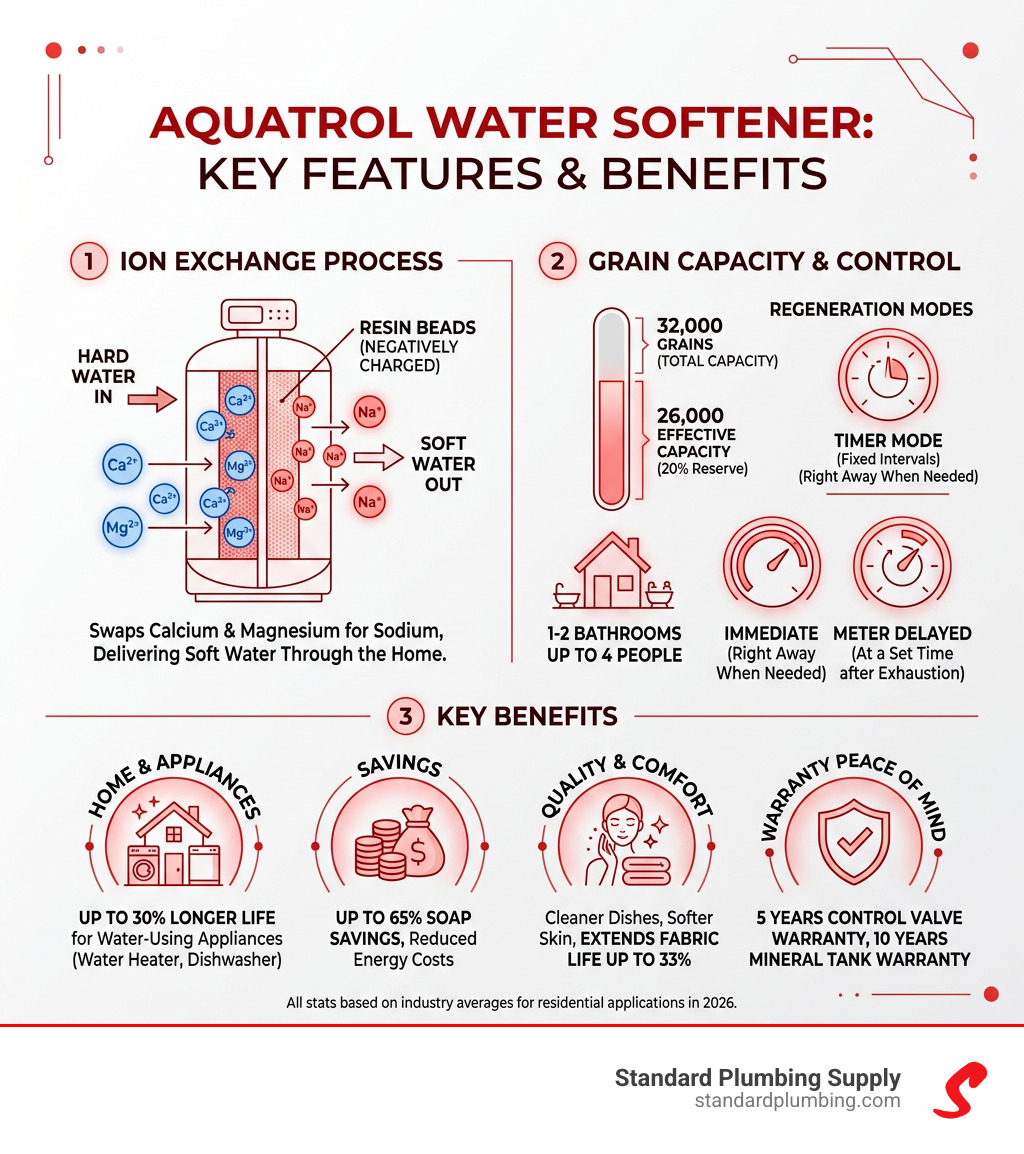
Understanding the Aquatrol Water Softener AQT-56SE
When we look at the heart of an aquatrol water softener, we are really looking at the AQT-56SE control valve. This isn’t just a piece of plastic; it’s a sophisticated command center designed to manage your home’s water quality with minimal intervention.
The valve body is constructed from Noryl, a high-performance material known for being non-corrosive and UV-resistant. This is crucial because water softeners often live in garages or basements where humidity and environmental stressors can eat away at lesser equipment. The AQT-56SE features a bright, backlit digital display that makes it easy to read even in a dark corner of the utility room.
One of the standout features of the Aquatrol Water Treatment Products line is the efficiency of the electronics. The system uses a single motor to drive all valve functions, which keeps power consumption incredibly low. In fact, running this system costs about 10 cents per month in electricity. Furthermore, the control valve uses permanent memory storage. If the power goes out in your neighborhood, you don’t have to worry about the system “forgetting” its settings. Once power returns, it resumes exactly where it left off.
Core Benefits of Softened Water for Your Home
Investing in an aquatrol water softener isn’t just about preventing spots on your glasses; it’s a financial decision that pays dividends across your entire household. Based on industry data, using soft water and pure soap products can increase the life of your clothing, towels, and linens by up to 33%. Hard water minerals act like tiny pieces of sandpaper, grinding away at fabric fibers every time you run a load of laundry. Soft water stops that abrasion.
The savings extend to your cleaning cabinet as well. Soft water allows soap to lather much more effectively. Research suggests that households can reduce their cleaning product bills by up to 65% because you simply need less detergent, shampoo, and dish soap to get the job done.
At the core of this performance is the AQUATROL Premium Grade Water Softening Resin. This high-purity cation resin is specifically designed to swap out calcium and magnesium ions for sodium ions. It offers exceptional kinetic behavior and chemical stability, ensuring that even under high flow rates, your water remains consistently soft.
Technical Configuration and System Sizing
Choosing the right aquatrol water softener requires a bit of “water math.” You don’t want a system so small that it regenerates every night, but you also don’t want one so large that the water sits stagnant.
The standard residential setup consists of two main tanks: the mineral tank (where the resin lives) and the brine tank (where you add the salt). For a typical household with 1 to 2 bathrooms and up to 4 people, a 32,000-grain system is often the “sweet spot.”
Programming the Aquatrol Water Softener Control Valve
The AQT-56SE offers three primary regeneration modes to fit your lifestyle:
- Timer Mode (Time Clock Delayed): The system regenerates on a set schedule (e.g., every 3 days) regardless of how much water you’ve used.
- Meter Immediate: This is great for high-demand scenarios. As soon as the system detects that the softening capacity is used up, it starts a regeneration cycle.
- Meter Delayed: This is the most popular residential setting. The system tracks your water usage and waits until a pre-set time (usually 2:00 AM) to regenerate once it senses the capacity is low.
The programming process is straightforward, involving an eight-step sequence to set the time of day, hardness levels, and cycle durations. Default settings usually include a 15-minute backwash and a 60-minute brine draw to ensure the resin is thoroughly cleaned and recharged.
Sizing Your Aquatrol Water Softener Correctly
To find your perfect size, follow this formula: [Number of People] x [75 Gallons/Day] x [Compensated Hardness] = Daily Grains.
“Compensated Hardness” is a fancy way of saying you need to account for more than just calcium. If your water test shows iron or manganese, you must multiply those parts per million (ppm) by 4 and add that number to your grains per gallon (gpg) hardness.
For example, if you have 4 people and 10 gpg hardness with 2 ppm of iron, your compensated hardness is 18 (10 + [2×4]). 4 people x 75 gallons x 18 = 5,400 grains per day. A 32,000-grain unit actually has an “effective” capacity of about 26,000 grains (leaving a 20% reserve). In this scenario, the system would regenerate roughly every 5 days, which is the ideal frequency for maintaining resin health.
Installation and Maintenance Best Practices
Installing an aquatrol water softener is a manageable DIY project for those with basic plumbing skills, but there are a few “must-dos” to ensure longevity. First, the unit needs a firm, level base close to a drain. We recommend using at least 1/2″ piping for the drain line, though 3/4″ is better for long runs or high flow rates.
Key Installation Components:
- Bypass Valve: Always install a bypass. This allows you to turn off water to the softener for maintenance while still having hard water available for the rest of the house.
- Safety Float: The brine tank should include a safety float to prevent accidental overflows.
- Pressure Check: Ensure your home’s pressure is between 25 and 120 PSI. If it’s too high, you’ll need a pressure-reducing valve.
- Brine Grid: Before adding salt for the first time, add water to the brine tank until it is about 1 inch above the grid plate.
For maintenance, we suggest a yearly cleaning of the brine tank to prevent “salt bridging” (where a hard crust of salt forms, preventing the water from reaching the salt below). Also, check your seals and O-rings annually to ensure everything remains watertight.
Frequently Asked Questions about Aquatrol Systems
How do I initiate an immediate regeneration cycle?
If you’ve had guests over and used more water than usual, you might want to regenerate the system right away. Simply press and hold the “Cycle” button for 5 seconds while the valve is in the service position. The system will begin the backwash phase immediately.
What is the warranty coverage for Aquatrol components?
Aquatrol offers robust protection for their systems. The AQT-56SE control valve comes with a 5-year warranty, while the mineral pressure tank is covered by a 10-year warranty. This provides long-term peace of mind that your investment is protected against manufacturing defects.
What are the common causes for a loss of water capacity?
If you notice your water feels “hard” again sooner than expected, check the brine tank first. You might have a salt bridge, or you might simply be out of salt. Another common cause is a fouled resin bed, often due to high iron levels. In these cases, using a resin cleaner or increasing the regeneration frequency can help.
Conclusion
At Standard Plumbing Supply, we’ve seen how a quality aquatrol water softener can transform a home’s plumbing health. From saving you money on soaps to extending the life of your expensive appliances, the benefits are clear. With a 10-year tank warranty and a 5-year valve warranty, these systems are built to last.
Whether you are in Boise, Salt Lake City, or Sacramento, our team is ready to help you find the right parts and systems for your specific water needs. If you’re looking for a top-tier alternative, you can also Protect your home with a Manor Softener System available through our stores. Stop by one of our locations across the West, and let’s get your pipes the protection they deserve!
