
The Smart Plumber’s Secret: What an AAV Plumbing Vent Actually Does
An aav plumbing vent is a one-way mechanical valve that lets air into your drain pipes — without cutting another hole in your roof.
Quick answer: Here’s what you need to know at a glance:
| Question | Answer |
|---|---|
| What does AAV stand for? | Air Admittance Valve |
| What does it do? | Lets air into drain pipes to prevent siphoning and sewer gas entry |
| Where is it installed? | Locally at the fixture — under a sink, in a wall, or in an attic |
| Does it replace your main roof vent? | No — every building still needs at least one roof stack vent |
| Common uses | Island sinks, remodels, mobile homes, remote fixture groups |
| Typical cost | $20–$50 for most residential applications |
Every drain in your home needs air to flow properly. Without it, water drains slowly, pipes gurgle, and sewer gases can creep back inside. Traditionally, that air came from a pipe punched through your roof. But that means more holes, more flashing, more potential leaks.
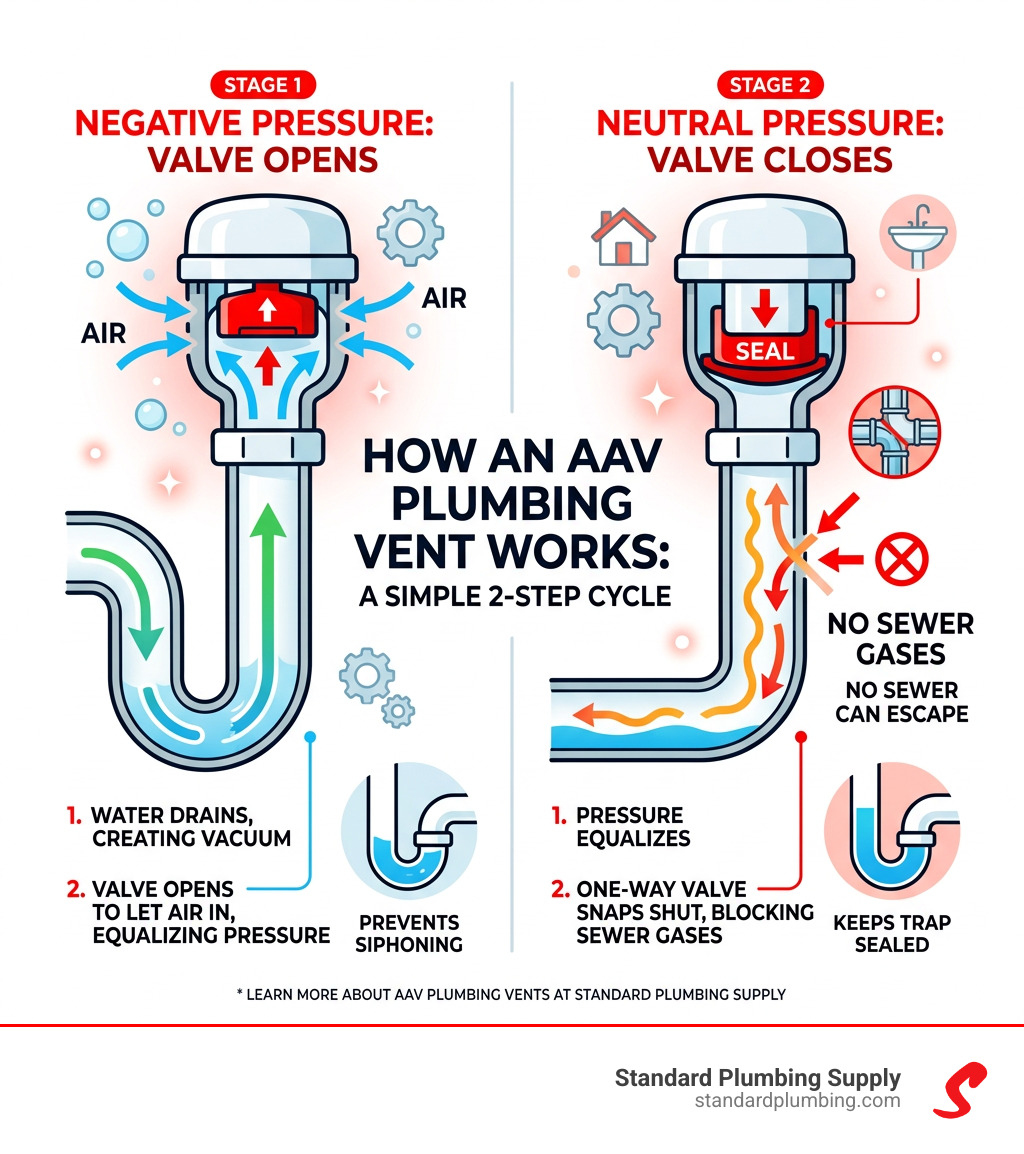
An AAV solves that problem locally — right at the fixture — using a simple gravity-operated seal. When water drains and creates negative pressure, the valve opens to let air in. When pressure equalizes, it snaps shut, blocking sewer gases from coming back through.
Think of it like the tiny hole on a to-go coffee cup lid. Without it, liquid barely flows. With it, air enters and everything moves freely.
The concept is simple. The code requirements, sizing, and installation details are where things get nuanced — and that’s exactly what this guide covers.
I’m Jacob Reese, Vice President of Standard Plumbing Supply and a third-generation leader in the wholesale plumbing industry. Through decades of working alongside contractors and tradespeople across the Western U.S., I’ve seen how the right aav plumbing vent can save time, money, and a lot of unnecessary roof work. Let’s break down everything you need to know to use them correctly.
What is an AAV Plumbing Vent and How Does It Work?
To understand an aav plumbing vent, you first have to understand the Drain-Waste-Vent (DWV) system. Think of your plumbing like a straw filled with water. If you put your thumb over the top of the straw, the water stays put. Why? Because a vacuum has formed. To get that water to move, you have to lift your thumb and let air in.
In your home, the “thumb” is the lack of air. Without venting, rushing water creates negative pressure that can actually suck the water right out of your P-traps. Once that trap is dry, there is nothing stopping sewer gases from wafting into your living room.
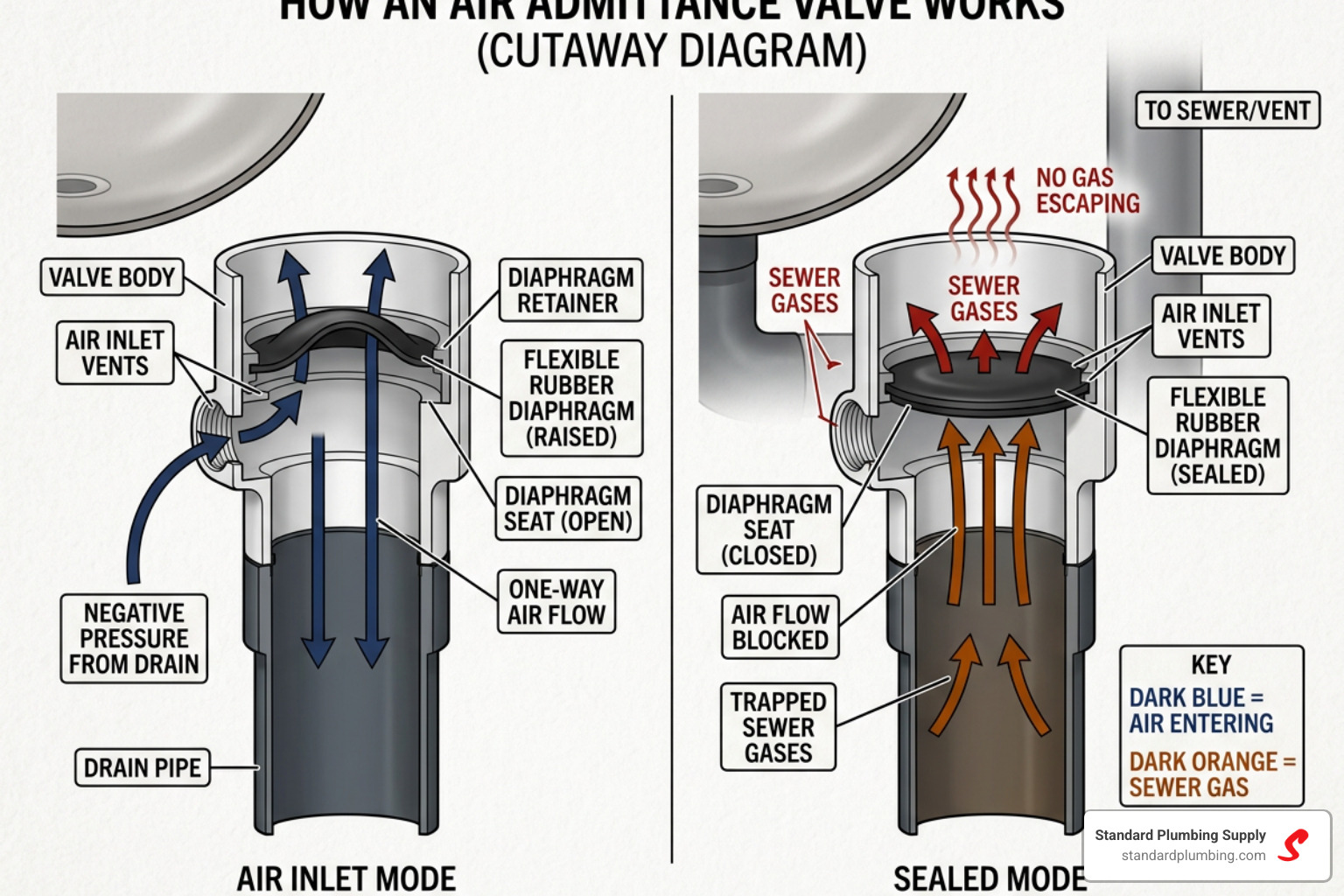
An AAV is a high-tech solution to this age-old physics problem. Internally, it features a sensitive diaphragm or “Sweet Spot™” technology that reacts to pressure changes. When you flush a toilet or drain a sink, the falling water creates a vacuum (negative pressure). This vacuum lifts the valve’s internal seal, allowing atmospheric air to rush into the pipe and equalize the pressure.
As soon as the water stops moving and the pressure equalizes, gravity pulls the seal back down. This creates a gastight closure that prevents foul odors from escaping. It is a one-way street: air comes in, but nothing goes out.
Benefits of Mechanical Venting
Why would a professional choose an aav plumbing vent over a standard pipe through the roof? For us at Standard Plumbing Supply, the answer usually comes down to three things: cost, convenience, and structural integrity.
- Massive Cost Savings: Traditional venting requires running long lengths of pipe through walls, floors, and eventually the roof. This involves significant labor and material costs. An AAV can be installed right under the sink, cutting out hours of work.
- Fewer Roof Penetrations: Every time you poke a hole in a roof, you create a potential leak point. By using AAVs for branch vents, you reduce the number of flashing boots that can fail over time.
- Architectural Flexibility: Have you ever tried to vent a kitchen island sink in a room with a vaulted ceiling? It’s a nightmare. AAVs allow for “island venting” without the complex “loop vent” geometry.
- Aesthetic Appeal: For modern homes with clean rooflines, fewer PVC pipes sticking out of the shingles is a major win for curb appeal.
If you are looking for high-quality venting solutions, our Plumbing Venting – Air Autovents catalog offers a variety of options for your next project.
AAV vs. Traditional Roof Vents
While AAVs are incredible tools, they aren’t magic. There are distinct differences between mechanical valves and the passive pipes we’ve used for a century.
| Feature | Air Admittance Valve (AAV) | Traditional Roof Vent |
|---|---|---|
| Operation | Mechanical (Moving Parts) | Passive (Open Pipe) |
| Air Flow | Intake Only | Intake and Exhaust |
| Failure Risk | Seal can stick or wear out | Virtually zero (unless blocked by debris) |
| Installation | Local (Under sink/in wall) | Through the entire structure to the roof |
| Maintenance | Needs to remain accessible | Maintenance-free |
The biggest trade-off is reliability versus labor. A traditional roof vent has no moving parts; it will work for 100 years. An AAV is a mechanical device. While they are tested for millions of cycles, they can eventually fail. This is why building codes require them to remain accessible for replacement.
When to Use an AAV Plumbing Vent in Your Home
We often get asked by DIYers and pros alike: “Can I use an aav plumbing vent everywhere?” The short answer is no, but they are perfect for specific, challenging scenarios.
Ideal Scenarios for an AAV Plumbing Vent
- Kitchen Island Sinks: This is the “killer app” for AAVs. Since there is no wall behind an island sink to hide a vertical vent pipe, an AAV installed inside the cabinet is often the only practical solution.
- Home Remodels: If you’re adding a bathroom in a basement or a remote corner of the house, tying back into the existing vent stack can be destructive and expensive. An AAV saves you from tearing out drywall across three rooms.
- Slab-on-Grade Construction: In homes built on concrete slabs, re-routing plumbing is incredibly difficult. AAVs provide a local venting option that doesn’t require trenching.
- Mobile and Manufactured Homes: These structures often have limited space for traditional venting, making AAVs a standard industry choice.
- Gurgling Sinks: If your sink “glugs” when it drains, it’s gasping for air. Installing an AAV can often solve this annoying noise instantly.
To make these connections easier, we recommend using Plumbing Venting – Universal Vent Adapters to ensure a perfect fit with your existing PVC or ABS pipes.
Building Code and Limitations
Before you grab a 2-pack of valves, you need to check your local rules. While AAVs are widely accepted, they are governed by specific sections of the International Plumbing Code (IPC Section 918) and the International Residential Code (IRC P3114).
The Golden Rule: An AAV cannot replace your home’s primary vent stack. Every building must have at least one open-pipe vent that terminates outdoors. This is because AAVs only handle negative pressure. If your septic system or the city sewer experiences positive pressure (pushing air into your house), an AAV will stay shut. You need that one roof vent to act as a “pressure relief valve” for the whole system.
Additionally, AAVs are generally limited to venting fixtures on the same floor. You can’t usually use one AAV to vent a whole bathroom group on the first floor and another on the second floor using the same branch. For a deep dive into why these aren’t a total replacement, check out this discussion on why AAVs are not a total replacement for through-roof pipes.
Installation Requirements and Sizing
Proper installation is the difference between a silent, high-performing drain and a smelly mess. AAVs aren’t “set it and forget it” if they aren’t put in the right spot.
Sizing Your AAV Plumbing Vent by DFU
In the plumbing world, we don’t just count sinks; we count Drainage Fixture Units (DFUs). A DFU is a measure of how much water a fixture discharges. For example, a standard private bathroom sink is usually 1 DFU, while a shower is 2, and a toilet can be 3 or 4.
Selecting the right aav plumbing vent depends on the total DFU load:
- Individual/Branch Vents (20 DFU): Most residential sinks and small bathroom groups use a standard 1.5″ or 2″ AAV rated for 20 DFUs.
- Stack Vents (160 DFU): Larger units are available for venting entire branches or stacks in multi-story residential buildings.
- Industrial Models (500 DFU): These are heavy-duty valves used in commercial applications.
Step-by-Step Installation Steps
- Plan the Height: This is the most common mistake. The AAV must be installed at least 4 inches above the horizontal branch drain. Ideally, you want it as high as possible under the sink, but it must be at least 4 inches above the top of the P-trap to prevent waste from backing up into the valve during a clog.
- Orientation Matters: The valve must be installed within 15 degrees of vertical. If it tilts too far, gravity won’t be able to seat the seal correctly, and sewer gas will leak out.
- Dry Fit First: Before applying glue, dry-fit your sanitary tee and the vertical extension pipe. Mark the alignment with a pencil.
- Solvent Welding: Use PVC primer and solvent glue to secure the sanitary tee into the drain line. Attach a vertical “riser” pipe to the top of the tee.
- Thread the Valve: Most AAVs have threaded bases. Apply Plumbing Venting – Draft Hood Connectors or standard thread seal tape to the male threads and screw the valve onto the adapter. Hand-tighten only!
- Accessibility: If you are installing the valve inside a wall, you must use a recessed wall box with a louvered cover. The valve needs a constant supply of fresh air to function, and you need to be able to reach it if it ever fails.
Maintenance and Troubleshooting Common Issues
Even though millions of AAVs have been installed since they were introduced to the US around 1986, they are mechanical devices. Like any machine, they can eventually run into trouble.
Identifying and Fixing Sewer Odors
If you start smelling “rotten eggs” under your sink, the aav plumbing vent is the first suspect.
- Seal Failure: Over time, the silicone or rubber seal inside the valve can dry out or become coated in debris. If the seal doesn’t close completely, sewer gas escapes.
- Test for Failure: You can often test the valve by wrapping it in a plastic bag secured with a rubber band. If the smell disappears, the valve is leaking and needs to be replaced.
- Debris: Sometimes, dust or construction debris gets into the air inlets. Most high-quality valves, like those from Oatey or Studor, have screenings to prevent this, but it’s worth checking.
Preventing Drainage Problems
It is important to note that an aav plumbing vent rarely causes a slow drain. If your sink is draining slowly, you likely have a physical blockage in the pipe. The AAV’s job is to let air in, not to push water down.
However, temperature can play a role. Most AAVs are rated to operate between -40°F and 150°F. In extreme attic temperatures, the internal membrane can become less flexible. If you are installing in an attic, ensure the valve is at least 6 inches above any insulation to prevent clogging and allow for proper air circulation.
Frequently Asked Questions about AAVs
Can an AAV replace my main vent stack?
No. This is a common misconception. Every plumbing system needs at least one primary vent stack that goes all the way through the roof to the open air. This provides a path for positive pressure to escape. If you replaced every vent with an AAV, pressure spikes in the sewer system could blow out your P-traps or prevent the AAVs from opening at all.
Are air admittance valves allowed in my state?
Standard Plumbing Supply serves customers across Arizona, California, Colorado, Idaho, Nebraska, Nevada, Oregon, Utah, and Wyoming. In most of these Western states, AAVs are permitted under the IPC or IRC. However, some local municipalities have specific “local amendments” that might limit how many you can use per house. Always check with your local building inspector before starting a major project.
Where should an AAV be located for best performance?
The “sweet spot” is as high as possible within the cabinet or wall cavity. It must be accessible—never bury an AAV behind finished drywall without an access panel. If you’re installing in an attic, it should be at least 6 inches above the insulation.
Conclusion
The aav plumbing vent is one of the most useful innovations in modern plumbing. It saves labor, protects the integrity of your roof, and solves the “impossible” venting problems found in kitchen islands and basement remodels.
At Standard Plumbing Supply, we pride ourselves on carrying the professional-grade components you need to get the job done right the first time. Whether you’re a homeowner tackling a gurgling sink or a contractor plumbing a high-end custom home, we have the inventory and expertise to help.
Ready to start your project? Use our store locator to find a location near you in Utah, Idaho, California, or any of our other service areas. For more technical details on the valves we carry, check out our More info about plumbing valves section.
Don’t let your plumbing leave you in a glugging, smelly mess. Grab an AAV, keep your roof intact, and let your pipes breathe easy.
