
Why Your Shower Needs a Waterproof Foundation
Shower pan liners are flexible waterproof membranes installed beneath the tile or mortar bed in a shower to prevent water from seeping through to the subfloor and surrounding walls. They act as the critical waterproofing barrier that protects your home from costly water damage and mold growth.
Quick Answer: What is a Shower Pan Liner?
- Primary Function: Creates a waterproof seal beneath shower tiles to prevent leaks
- Common Materials: PVC (40 mil) or CPE (30-40 mil thickness)
- Standard Sizes: Typically 5’x6′ to 6’x100′ rolls
- Key Certifications: ASTM D4551, IAPMO listed
- Cost Range: $25-$370 depending on size
- Installation Location: Between the pre-slope mortar bed and final mortar bed (layer 3 of 5 total layers)
As the research reveals, there are actually five layers to a properly constructed shower floor, and the shower pan liner sits right in the middle as “the most important aspect for waterproofing.” Without it, water permeates through the porous shower wall framing, leading to rot, structural damage, and moldy outbreaks in areas you can’t even see until the problem becomes severe.
Whether you’re tackling a bathroom renovation or building new construction, understanding shower pan liners is essential for long-term success. The liner is marked in 6-inch increments for easy measuring and trimming, and installation requires careful attention to corners, curbs, and drain integration to create a truly watertight seal.
I’m Jacob Reese, Vice President of Standard Plumbing Supply, where I’ve worked since I was eight years old learning every aspect of the plumbing trade. Over my career helping contractors across the Western United States, I’ve seen how proper shower pan liner installation prevents callbacks and ensures customer satisfaction for years to come.
Understanding the Fundamentals of Shower Pan Liners
Let’s dive deeper into what makes a shower pan liner such an indispensable component of any watertight shower. Picture this: your beautiful new tiled shower, sparkling clean, ready for use. But beneath those neat tiles lies a complex system designed to manage water, and the shower pan liner is the unsung hero, the ultimate defender against leaks.
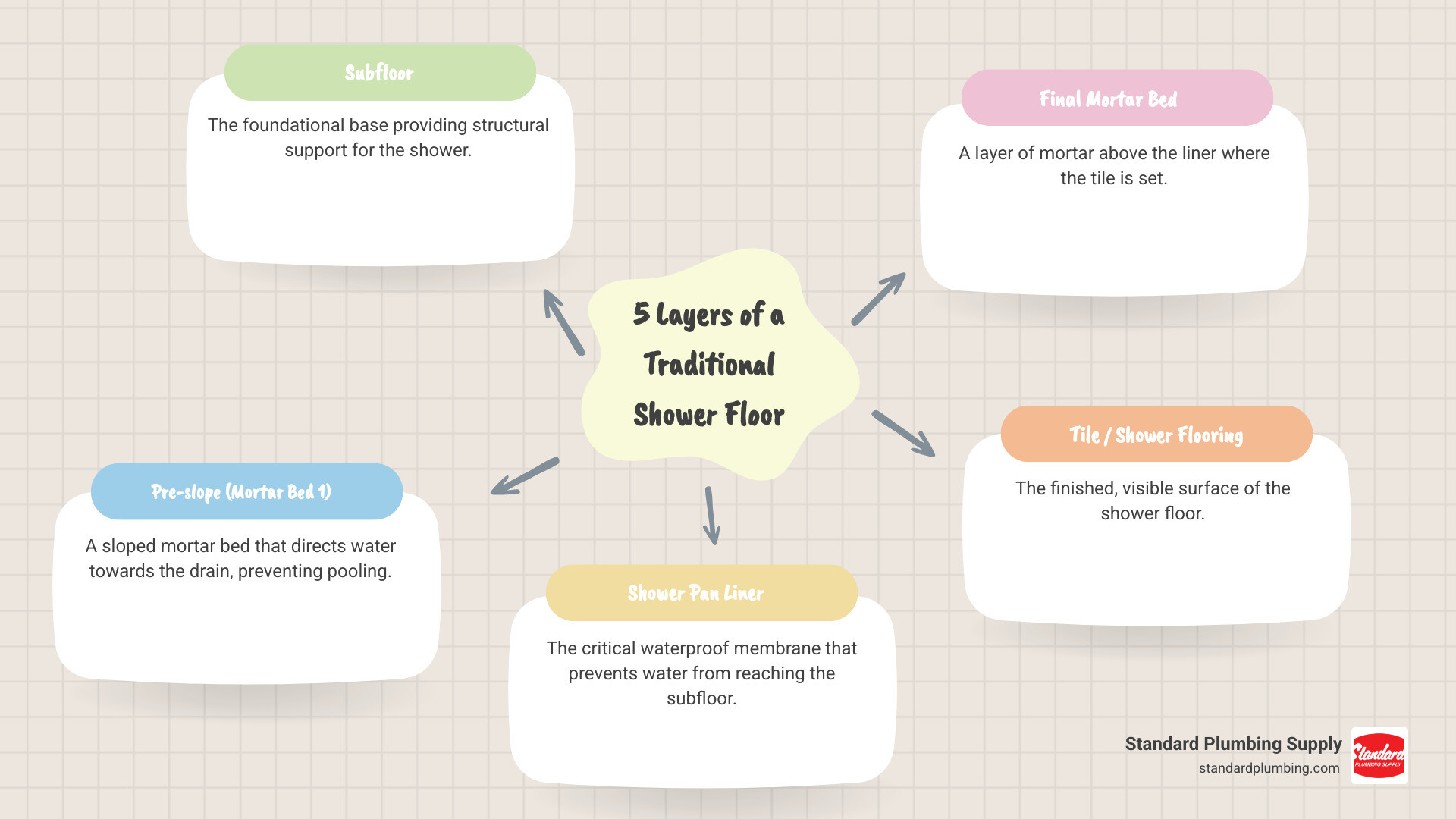
In any shower construction, whether it’s a brand-new build or a renovation in one of our many service areas like Las Vegas, Salt Lake, or Mesa, we’re essentially building a waterproof box. As the infographic above illustrates, a typical shower floor has five distinct layers. It starts with the subfloor (Layer 1), followed by a sloped base or first mortar bed (Layer 2). This pre-slope is crucial because it directs any water that might get past the tile and top mortar bed towards the drain, preventing it from pooling on the liner. Then comes the star of our show, the shower pan liner (Layer 3), a continuous, impermeable membrane. On top of that, we have the final mortar bed (Layer 4) where the tile is set, and finally, the tiling or shower flooring itself (Layer 5).
The shower pan liner is a concealed waterproofing membrane. Its primary function is to catch any moisture that penetrates the grout or tile and funnel it directly into the shower drain, ensuring not a single drop escapes into your home’s structure. This prevents costly water damage, protects your subfloor, and, perhaps most importantly, stops mold and mildew from taking root in hidden, inaccessible areas.
Now, you might wonder, “What’s the difference between a shower pan liner and a pre-fabricated shower pan?” It’s a great question! A shower pan liner is a flexible sheet material that’s custom-formed on-site to fit the specific dimensions and contours of your shower base. It’s then covered by a mortar bed and tile. This approach offers immense flexibility for custom-sized or oddly shaped showers, allowing for unique designs and slopes.
A pre-fabricated shower pan, on the other hand, is a rigid, pre-formed unit, often made of acrylic, fiberglass, or composite materials. These pans come with an integrated slope and drain opening, ready for direct tile installation or as a finished surface themselves. While they can simplify installation, they offer less design flexibility and are limited to standard sizes. For custom tile showers, especially those we see in high-end remodels in areas like Park City or Rancho Cordova, the shower pan liner is the preferred choice for its adaptability and robust waterproofing capabilities when properly installed.
When selecting a shower pan liner, look for specific certifications. We always recommend products that are IAPMO listed and meet ASTM Spec D4551. IAPMO (International Association of Plumbing and Mechanical Officials) listing signifies that the product complies with stringent plumbing standards, ensuring quality and safety. ASTM Spec D4551 refers to the standard specification for PVC plastic flexible sheets for waterproofing, which guarantees the material’s performance and durability. These certifications give us peace of mind that we’re using reliable, industry-approved materials.
Regarding cost, shower pan liners are an economical yet highly effective waterproofing solution. Based on our research, the typical cost range for shower pan liners can vary from approximately $7.98 per linear foot for smaller sections to $369 for larger rolls, depending on the material, thickness, and size. For example, a 5 ft. x 6 ft. PVC shower pan liner kit might be around $96.60, while a larger 6 ft. x 100 ft. roll could be significantly more. This makes them an accessible option for homeowners and contractors alike across our service regions, from Boise to San Diego.
Choosing the Right Shower Pan Liner Material
When it comes to shower pan liners, material choice is key. The two most common types you’ll encounter are PVC (Polyvinyl Chloride) and CPE (Chlorinated Polyethylene). Each has its own set of characteristics that make it suitable for different applications.
| Feature | PVC (Polyvinyl Chloride) Shower Pan Liner | CPE (Chlorinated Polyethylene) Shower Pan Liner |
|---|---|---|
| Flexibility | Good, easy to work with | Excellent, very pliable |
| Durability | Abrasion-resistant, long-lasting | Highly durable, resistant to chemicals |
| Cost | Generally more economical | Slightly higher cost |
| Adhesive | Oatey X-15 Bonding Adhesive | Oatey Weld (or similar solvent cement) |
| Radiant Heat | Not typically recommended | Recommended for radiant heat systems |
| Common Thickness | 40 mil | 30 mil or 40 mil |
| Chemical Resistance | Good | Excellent |
| Ease of Seaming | Easily solvent-welded | Easily solvent-welded |
PVC liner pros & cons: PVC (Polyvinyl Chloride) shower pan liners are widely popular due to their economical nature and proven track record. They are flexible, making them relatively easy to maneuver during installation, and they offer good abrasion resistance for long-lasting use. Oatey’s PVC liners, for instance, have been trusted by plumbing professionals for over 100 years, a testament to their reliability. The main “con” for PVC is that it’s generally not recommended for use with radiant heat systems, as prolonged exposure to high temperatures can affect its integrity.
CPE liner pros & cons: CPE (Chlorinated Polyethylene) shower pan liners are known for their superior flexibility and chemical resistance. This makes them an excellent choice if you anticipate harsh cleaning agents or if you’re installing a radiant heat system in your shower floor. Our research indicates that CPE pan liners are specifically recommended if the floor has a radiant heat system, offering better performance under those conditions. While CPE might come at a slightly higher cost than PVC, its improved properties can be a worthwhile investment for specific projects.
Another critical factor is liner thickness. You’ll commonly find shower pan liners in 30 mil or 40 mil thicknesses. The “mil” refers to one-thousandth of an inch, so 40 mil is thicker and generally more robust than 30 mil. While 30 mil can be adequate for some applications, we often recommend 40 mil PVC for its increased durability and resistance to punctures, especially in areas with heavy foot traffic or where extra protection is desired. Many building codes in our service areas, from California to Wyoming, also specify a minimum of 40 mil for shower pan liners, so always check local regulations.
As for standard sizes and dimensions, shower pan liners are typically sold in rolls or pre-cut sheets. Common widths include 4, 5, or 6 feet, and lengths can range from 6 feet for small projects up to 100 feet or more for larger commercial applications. For instance, you might find a 5 ft. x 40 ft. roll or a 6 ft. x 100 ft. roll. Many suppliers, including us, offer the liner cut to length, allowing you to purchase just what you need for your specific shower dimensions. This flexibility helps minimize waste and ensures you have enough material to extend the liner up the walls by at least 3 inches above the finished curb height, as required for proper waterproofing.
How to Install a Shower Pan Liner: A Step-by-Step Guide
Installing a shower pan liner might seem daunting, but with careful preparation and attention to detail, it’s a manageable task for any dedicated DIYer or professional. This is the most critical waterproofing layer, so no shortcuts! We’re here to walk you through it.
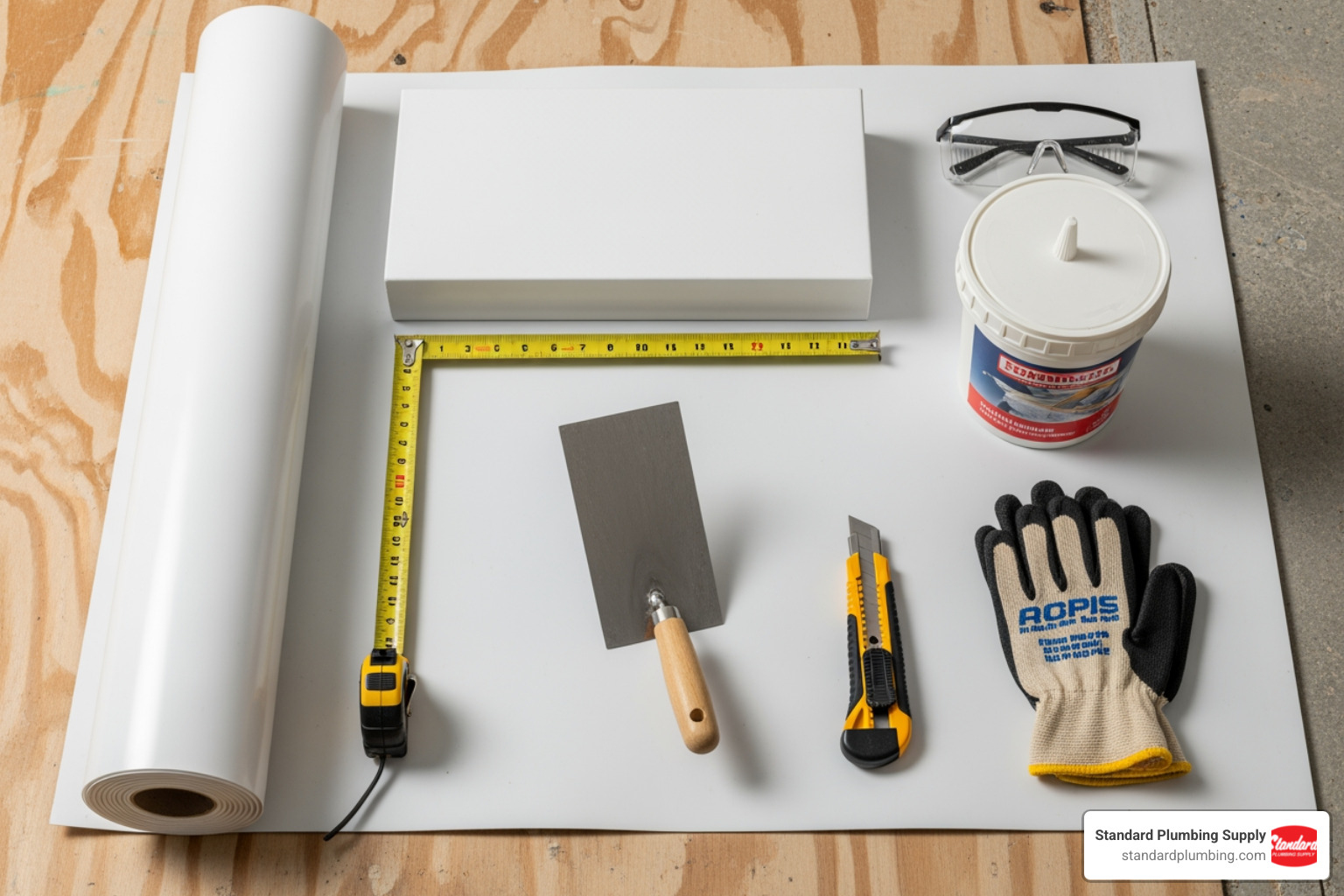
Before we begin, understand the components involved. You’ll have your subfloor, followed by a sloped mortar bed (often called the “pre-slope”) which directs water towards the drain. The shower pan liner then sits on this pre-slope. A clamping ring drain is a special two-part drain designed to sandwich the liner, creating a watertight seal at the drain opening. For detailed instructions, you can always refer to comprehensive guides like the Oatey Product Instructions.
Step 1: Preparation and Gathering Supplies
Preparation is half the battle won! Ensure your subfloor is solid and clean. You’ll need the following tools and materials:
- Shower pan liner (PVC or CPE, 40 mil recommended)
- Oatey Tile Shower Drain (clamping ring type)
- Mortar mix (bagged Portland Sand mix or cement mix for the pre-slope and final bed)
- Silicone caulk (100% silicone, used under the drain flange)
- Bonding adhesive (Oatey X-15 for PVC, Oatey Weld for CPE)
- Dam corners (pre-formed or custom-made)
- Measuring tape
- Utility knife (with plenty of fresh blades)
- Staple gun (with stainless steel staples)
- Hammer (for securing staples if needed)
- Straight edge or T-square
- Permanent marker
- Scrap wood or a drain plug (for the flood test)
Step 2: The Installation Process
This is where the magic happens! Follow these steps carefully to ensure a watertight seal.
-
Install the Drain Base and Pre-Slope: First, install the lower part of your clamping ring drain base, ensuring it’s flush with the subfloor. Apply a bead of 100% silicone caulk to the underside of the drain flange before screwing it to the subfloor. Next, create your pre-slope using a bagged Portland Sand mix. The mortar should be sloped up and away from the drain at 1/4 inch per foot, starting at 1/4 inch thick at the outside of the flange. This crucial step ensures water drains properly, preventing pooling on the shower pan liner. Let this pre-slope cure completely.
-
Measure and Cut the Liner: Measure the dimensions of your shower base, adding enough material to extend the liner up the walls at least 3 inches above the finished curb height, and over the curb itself. The liner is often marked in 6-inch increments, which makes measuring and trimming easier. Lay the liner flat and cut it carefully with your utility knife. It’s always better to cut too large than too small – you can always trim excess later!
-
Drape and Position the Liner: Carefully drape the cut shower pan liner over the cured pre-slope, ensuring it’s centered and covers all areas, including extending up the walls and over the curb. Smooth out any wrinkles or creases. Our research shows that Oatey liners are often rolled to prevent creases, making this step a bit easier.
-
Drain Hole Cutting and Securing: Locate the drain opening. Make a small “X” cut over the drain, starting from the center and extending just beyond the drain opening. Then, carefully cut out the excess liner to expose the drain’s clamping ring. Apply a bead of 100% silicone caulk around the drain opening on the liner, then place the clamping ring over the drain, sandwiching the liner. Screw the clamping ring down firmly, compressing the liner and silicone for a watertight seal.
-
Folding Corners: This is a critical step for waterproofing. At each inside corner of the shower, you’ll need to carefully fold the liner to create a watertight seal.
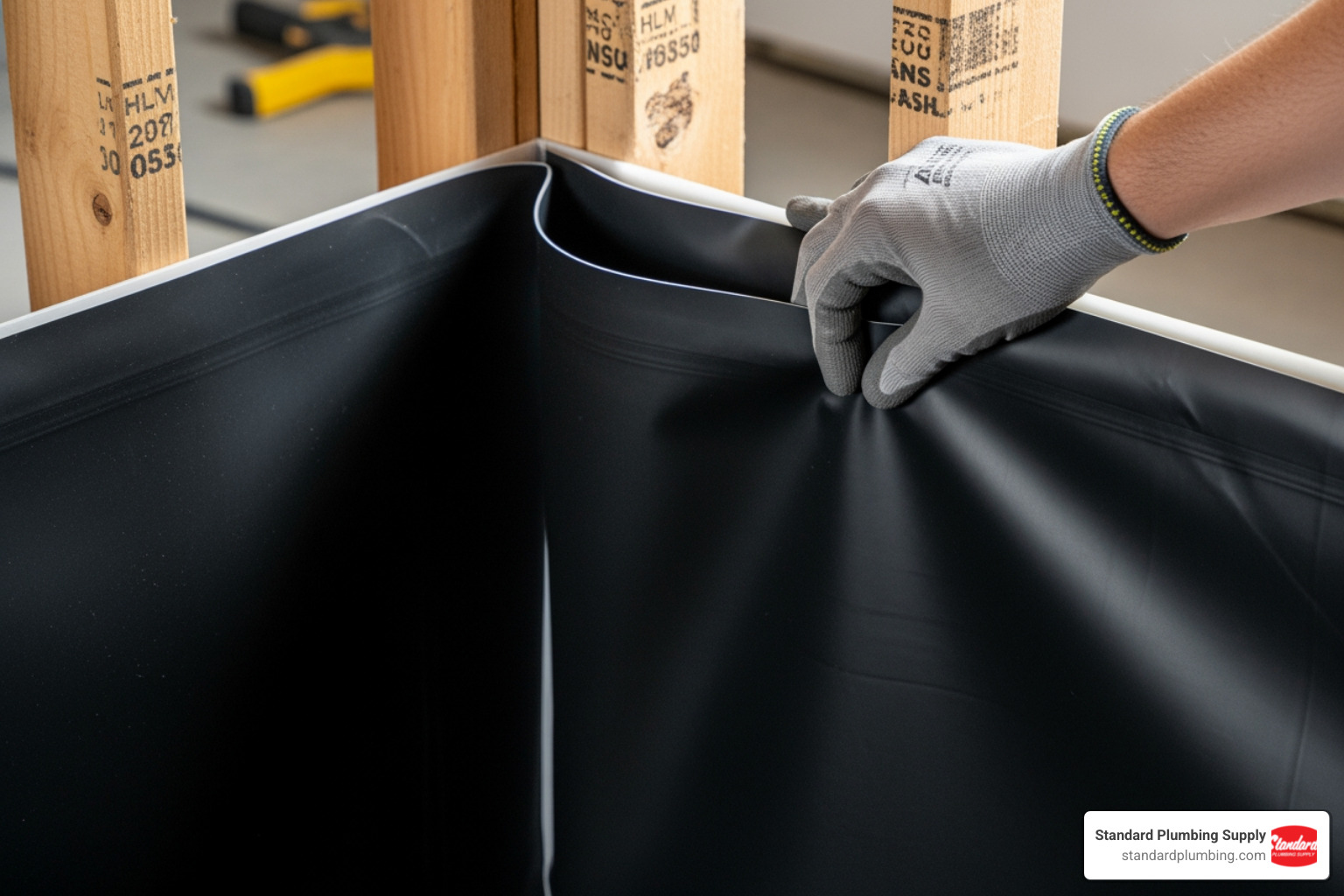
Avoid cutting the liner at the corners if possible, as this creates potential leak points. Instead, create a hospital fold or a similar technique that keeps the liner continuous. Gently press the liner into the corner, creating a flap, then fold it over itself neatly. Secure the top edge of this fold to the wall framing using staples.
-
Securing Liner to Framing: Once the liner is properly positioned and the corners are folded, secure the top edge of the liner to the wall studs using a staple gun. IMPORTANT: Only staple the liner in the top 1/2 inch of the liner, well above the finished curb height. This ensures that no staple punctures are below the potential water level, maintaining the waterproofing integrity.
-
Attaching to the Curb: For the shower curb, you’ll extend the liner over the top and down the outside face. Use your chosen bonding adhesive (Oatey X-15 for PVC, Oatey Weld for CPE) to secure the liner to the curb’s face. If your curb is particularly long or complex, you might need to use additional scrap pieces of liner, adhered with the appropriate bonding agent, to ensure full coverage.
-
Dam Corner Installation: Dam corners are pre-formed or custom-made pieces designed to seal the critical junction where the curb meets the wall framing. These are often included in shower pan liner kits and are essential for preventing leaks at these vulnerable points. Adhere them securely using the recommended bonding adhesive, overlapping them with the main liner and extending them up the wall.
-
Adhesives for PVC vs. CPE: As mentioned earlier, the type of liner dictates the adhesive. For PVC liners, we use a specific bonding adhesive like Oatey X-15, which creates a strong, flexible bond. For CPE liners, a solvent cement like Oatey Weld is typically used, creating a chemical bond that essentially “welds” the pieces together. Always use the manufacturer-recommended adhesive for your specific liner material to ensure proper adhesion and waterproofing.
Step 3: The Crucial Flood Test
You’ve put in all that hard work, and now it’s time for the ultimate test: the flood test. This step is absolutely crucial and should never be skipped. It’s your final confirmation that your shower pan liner installation is watertight.
The flood test serves one primary purpose: to verify the watertight integrity of your newly installed shower pan liner and all its seams and connections. It simulates a worst-case scenario, ensuring that even if water penetrates the tile and mortar, your liner will perform its job perfectly, preventing any leaks into your subfloor or the room below. Skipping this step is like building a boat without checking if it floats – a recipe for disaster!
How to perform a flood test:
- Plug the Drain: After all adhesives have fully cured (allow at least 24 hours, or as recommended by the adhesive manufacturer), insert a mechanical test plug into the shower drain. You can use a temporary plug or even duct tape if a proper test plug isn’t immediately available, but a dedicated test plug is best for a reliable seal.
- Fill with Water: Slowly fill the shower bed with water. The water level should reach a height equal to the top of your shower curb, or at least 2 inches deep. This ensures all potential leak points, especially around the curb and lower wall sections, are submerged.
- Wait and Observe: Let the water sit for a minimum of two hours. Many professionals, including us, prefer to leave it for 24 hours to be absolutely certain. During this time, regularly check for any signs of leakage.
- Checking for Leaks: Look for damp spots on the subfloor below the shower, wetness on adjacent walls, or any dripping from the ceiling of the room below. If you see any signs of a leak, you’ll need to drain the water, locate the source of the leak, repair it, and then repeat the flood test. Only when the flood test passes can you proceed with the final mortar bed and tiling.
Always remember to check your local building code requirements for specific flood test durations or procedures in your area, whether you’re in Colorado, Utah, or any of our service locations. These regulations are designed to protect your home and ensure long-term structural integrity.
Pro Tips and Common Pitfalls
We’ve covered the basics, but let’s talk about some insider tips and crucial warnings to make your shower pan liner installation a success.
One decision you’ll face is whether to opt for pre-formed liner kits vs. separate components. Pre-formed kits, like the Oatey® PVC Shower Pan Liner Kit, often include the liner, pre-formed dam corners, and sometimes even a drain. The benefits of using a kit are convenience and assurance that components are compatible. The pre-formed dam corners, for instance, simplify sealing the curb and wall junctions, which can be tricky with bulk liner material. For many DIYers or even experienced pros working on standard-sized showers, these kits can be a real time-saver and provide peace of mind. Buying liner and accessories separately offers more flexibility for custom sizes or if you have specific brand preferences for each component.
Regarding long-term maintenance requirements, the beauty of a properly installed shower pan liner is that it requires virtually no maintenance once it’s in place and covered. Its job is to sit there, silently doing its duty. The key is protecting it during construction. Once the liner is installed and has passed the flood test, be extremely careful not to puncture it with tools, dropped materials, or even sharp edges from the subsequent mortar bed or tile installation. Any breach can compromise its waterproofing capabilities, leading to future headaches.
Common Mistakes to Avoid During Shower Pan Liner Installation
Even experienced pros can make mistakes, but we can learn from them! Here are some common pitfalls to steer clear of:
- Improper Slope: This is a big one! If your pre-slope isn’t pitched correctly (1/4 inch per foot towards the drain), water can pool on the shower pan liner instead of draining away. This standing water can lead to unpleasant odors and potential issues down the line. If you’re not confident in creating a perfect mortar slope, consider using a pre-sloped base product like Oatey’s Perfect Slope.
- Puncturing the Liner: A single puncture, no matter how small, can compromise the entire waterproofing system. Be incredibly careful with tools, screws, and staples. When securing the liner to the wall studs, only staple in the top 1/2 inch, well above the finished curb height, to prevent water from reaching the staples.
- Incorrect Corner Folding: Cutting the liner at the inside corners instead of folding it creates a seam that is a prime candidate for leaks. Always strive for continuous, watertight folds at corners.
- Not Performing a Flood Test: As we emphasized, skipping the flood test is like playing Russian roulette with your bathroom. It’s the only way to confirm your hard work has paid off.
- Using the Wrong Adhesive: PVC and CPE liners require specific bonding agents. Using the wrong adhesive can result in weak seams that fail over time. Always match the adhesive to your liner material.
- Stapling Too Low on the Wall: Any staples below the finished curb height or potential water line are direct entry points for water into your wall structure. Keep staples high and proud!
- Not Protecting the Liner: Once the liner is installed, protect it from damage until the final mortar bed and tile are in place. A piece of cardboard or plywood can go a long way in preventing accidental punctures.
Frequently Asked Questions about Shower Pan Liners
We get a lot of questions about shower pan liners, and we’re happy to clear up any confusion!
What type of mortar should I use with a shower pan liner?
For both the pre-slope (the base beneath the liner) and the final mortar bed (on top of the liner, under the tile), we recommend using a bagged Portland Sand mix or a general cement mix. If you’re mixing products, it’s crucial to use Portland sand mix under the liner. This type of mortar provides a solid, durable base that can withstand moisture and support the weight of the tiles. Always follow the manufacturer’s instructions for mixing and curing.
How thick should the pre-slope mortar bed be?
The pre-slope mortar bed is critical for proper drainage. The general rule is that the concrete should be 1/4 inch thick at the outside of the drain flange, and then it should slope up and away from the drain at 1/4 inch per foot. This ensures that water naturally flows towards the drain, preventing pooling on the shower pan liner. Always check the specific recommendations of your drain and liner manufacturer, as well as local building codes, for any variations or minimum thickness requirements.
Can a shower pan liner be used for applications other than tile showers?
Absolutely! While shower pan liners are most commonly associated with tile showers, their function as a concealed waterproofing membrane makes them suitable for a variety of other applications. They can be used for concealed waterproofing in other wet areas where a flexible, impermeable barrier is needed. Think of custom applications like dog wash stations, laundry room floors, or even planter boxes where you want to prevent water egress. As long as the area requires a waterproof membrane beneath a finished surface, a shower pan liner can be a versatile and effective solution.
Conclusion
We hope this deep dive into shower pan liners has demystified this crucial plumbing component for you. From understanding its primary function as the ultimate waterproof guardian to navigating the installation process and avoiding common mistakes, you’re now equipped with the knowledge to ensure your shower stands the test of time.
A properly installed shower pan liner is the secret to preventing costly water damage and unsightly mold, giving you peace of mind for years to come. Whether you’re undertaking a new construction project or a much-needed renovation in Arizona, California, or any of our locations, we believe you can approach this task with confidence.
At Standard Plumbing Supply, we’re proud to offer a wide range of high-quality shower pan liners and all the necessary accessories to help you achieve a perfectly waterproof shower. Our team is always ready to assist you in finding the right materials and answering any questions you may have.
Explore our full range of PVC plumbing fittings and other plumbing essentials today!
